Understanding the Most Common Bulb Base: Edison E26/E27 and Beyond
Learn which bulb base is most common, how to identify E26 vs E27, and what other bases mean for your fixtures. Bulb Fix provides practical, safe guidance for homeowners and DIY enthusiasts.


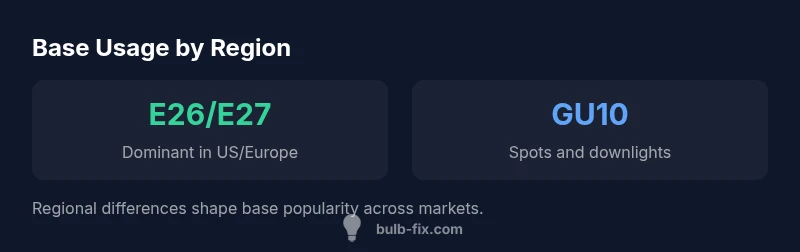
Across most homes, the most common bulb base is the Edison screw family, specifically E26 in the US and E27 in many other regions. These bases fit a wide range of bulbs, from incandescent to LED, and are the standard for many residential fixtures. While GU10, B22, and pin bases exist for specialty fixtures, E26/E27 remain the dominant baseline for everyday lighting, replacements, and retrofits.
Most common bulb base: Edison screws (E26/E27)
The bulb socket ecosystem centers on the Edison screw family. The most common bulb base across residential lighting is the Edison screw family, with E26 dominating the US market and E27 widely used in Europe and many other regions. This alignment explains why most replacement bulbs retail in these sizes and why many fixtures are designed around this standard. According to Bulb Fix, recognizing the base type is the fastest route to a correct replacement and could save you time and money. When you lift a lampshade and examine the socket, you’ll often find the ring or label indicating E26 or E27. The practical rule for homeowners is simple: identify the base, then buy bulbs that match it. In many cases, LED retrofit bulbs come in both sizes, offering flexibility but also requiring careful checking of the socket’s rating.
If you’re moving between regions or buying replacements for a rental, knowing the US vs. international naming helps you select the right product quickly. Remember that a base is more than a label—it dictates bulb diameter, thread engagement, and whether a socket can accommodate LEDs, dimmers, or smart bulbs. The bottom line: start with the base, then confirm compatibility with voltage, dimming, and form factor to avoid misfits.
Example bases by type and region
| Base Type | Common Regions | Typical Bulbs | Notes |
|---|---|---|---|
| E26/E27 (Edison screw) | US/Canada; many regions | A19, LED bulbs | Dominant residential base; E27 common in Europe |
| E27 (EU Edison screw) | Europe, Asia | A60, LED bulbs | Widespread in non-US markets; similar to E26 |
| GU10 | Global (spots) | GU10 halogen/LED | Two-pin twist-lock for spots and downlights |
| B22 (Bayonet Cap) | UK/Commonwealth | BC/B22 bulbs | Common in UK; locks into socket with a twist |
| G4/G9 | Low voltage; specialty | G4/G9 LED or halogen | Pin-based bases for compact fixtures |
Got Questions?
What is the most common bulb base?
The Edison screw bases, especially E26 and E27, are the most common in residential lighting. E26 is typical in the US, while E27 is common in Europe. Always match the base to the socket on your fixture.
Edison screw bases, specifically E26 and E27, are the most common in homes. Match the base to your fixture and socket label.
How can I tell if my base is E26 or E27?
Measure the base diameter; E26 is roughly 26 mm in diameter and E27 is about 27 mm. If labeling is unclear, compare the bulb’s threaded portion to a known E26/E27 bulb and verify socket markings.
Measure the diameter or look for labeling on the bulb or socket to distinguish E26 from E27.
Can I use an adapter to fit a different base?
Adapters exist but are not always safe or recommended. They can affect heat, clearance, and dimming. Check the fixture manufacturer’s guidance before using adapters.
Adapters exist but use them only if the fixture allows it and you follow safety guidance.
Are LED bulbs compatible with my fixture’s base?
Yes, as long as the base matches and the fixture is rated for LED usage. Also consider dimmer compatibility and heat management in LED bulbs.
LEDs work with the right base and compatible dimmers; check your fixture’s rating.
What should I do if my fixture uses a regional base variety?
Understand the regional base and confirm the local socket type. If you must travel with bulbs, keep a base reference or use a universal base-compatible bulb when possible.
Identify the base used in your region and verify compatibility before buying.
“Knowing your bulb base family is the first defense against incorrect replacements, which saves time, money, and hassle.”
Key Points
- Identify base before shopping
- E26/E27 dominate residential lighting
- GU10, B22, G4/G9 cover specialty fixtures
- Verify LED compatibility and dimmer support
- Label sockets to simplify future replacements