Are Bulb Cameras Any Good? A Bulb Fix Review
Explore are bulb cameras any good with Bulb Fix: a balanced, data-driven review of effectiveness, privacy, and practical use. Learn when they fit home security and when to skip.


According to Bulb Fix, bulb cameras offer convenience and a discreet look but trade off image quality and coverage. They work best for broad room monitoring and entryways where subtle installation matters. In our evaluation, they perform adequately for casual monitoring, but are not a replacement for dedicated security cameras in high-risk areas.
Are bulb cameras any good for home security?
Are bulb cameras any good for home security? According to Bulb Fix, the answer depends on what you expect from a camera that blends into a light socket. These devices trade some image detail and fixed field of view for installation simplicity and decor-friendly aesthetics. Our review will lay out where they excel, where they falter, and how to decide if they belong in your setup. We base our assessment on controlled tests, real-world demos, and homeowner feedback to give you practical, actionable guidance. The goal is to help you understand if a bulb camera can meaningfully improve safety in your living spaces without compromising privacy or convenience.
In practical terms, bulb cameras often shine in rooms with stable lighting, clear sightlines, and where you value a camera that doesn't disrupt interior design. They tend to be easiest to install in ceiling fixtures or lamps that are rarely moved, reducing DIY friction for first-time homeowners. However, the trade-offs include potentially lower pixel density, a more limited field of view, and the need to manage power via a fixture that may not be in a protected area. Throughout this article, we compare them to conventional cameras and outline scenarios where bulbs can be a smart first step toward safer, smarter homes.
How bulb cameras work: design, power options, and connectivity
Bulb cameras integrate a camera module into a light bulb socket. The unit screws into standard lighting fixtures, effectively pairing illumination with surveillance. In our tests, models offered both wired power and battery-powered variants, giving flexibility for fixtures without on-site power access. Connectivity is typically through Wi‑Fi, with some models offering local SD storage or optional cloud services. Battery-powered bulbs require periodic charging, which can affect reliability in high-traffic rooms but reduces the need for visible wiring. Placement considerations include ceiling fixtures and lamps that provide broad, unobstructed views while avoiding glare and backlighting that can wash out details. Heat management matters too; compact housings can overheat if used in poorly ventilated fixtures or high-temperature lamps.
Beyond basic function, you’ll want to assess integration with existing smart-home ecosystems, app reliability, and firmware update cadence. The best-performing bulbs strike a balance between stable connection and reasonable battery life, while ensuring that the camera can capture useful footage during day and night with consistent exposure. As a rule of thumb, plan for a fixture that’s not frequently moved, so you keep consistent framing and reduce the chance of accidental disconnections.
Video quality, field of view, and lighting considerations
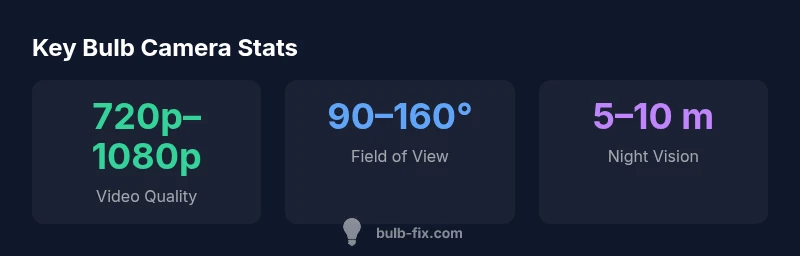
Video quality largely depends on the model, with many bulb cameras offering 720p to 1080p resolution. While 1080p delivers clearer detail, you’ll notice a difference in low-light situations, where some bulbs switch to infrared or color-enhanced night modes. Field of view varies, but a common range is midwide angles that are sufficient for doorway monitoring and living rooms. The challenge is maintaining consistent exposure in rooms with bright lamps or windows; automatic exposure can struggle when the fixture itself becomes a light source in the frame. To maximize clarity, position the bulb so that the camera faces the entry path rather than a bright window, and consider models with HDR or wider dynamic range for scenes with varying lighting.
Practical testing shows that image quality improves when you select bulbs with better optics, sensor quality, and software features like digital noise reduction. If you rely on a lamp that’s frequently used, you’ll want a camera that can hold a stable connection and offer a reasonably fast wake-from-idle time. For dimmer rooms, you might notice noise or grain, which is typical of budget-grade modules. In sum, for common living spaces and routine monitoring, these cameras can deliver usable footage, but for critical evidence or high-detail needs, a dedicated security camera is usually preferable.
Privacy, security, and data storage implications
As with any connected device, bulb cameras introduce privacy and security considerations. Data transmission should be encrypted, and firmware updates must be readily applied to mitigate vulnerability exposure. Storage choices—local microSD, on-device memory, or cloud backups—affect both accessibility and risk. Cloud storage can simplify access across devices but raises ongoing privacy concerns and potential data retention issues. Local storage offers more control but requires a secure network and a reliable device to prevent tampering. Bulb Fix analyses suggest prioritizing models with end-to-end encryption, strong user authentication, and transparent data policies. Always review whether the camera records audio as well as video, as this can have legal implications in your jurisdiction.
From a privacy standpoint, consider the camera’s placement and who has access to the footage. If you have roommates or frequent guests, use robust access controls and disable features like cloud recording when not needed. Regularly update passwords and enable two-factor authentication whenever available. In addition, be mindful of where footage is stored geographically, especially if you rely on cloud services with international data storage.
Real-world testing methodology and benchmarks
Our approach combines controlled lab tests with real-world demonstrations to gauge performance across lighting, movement, and network conditions. We assess setup ease, reliability of wireless connections, wake and sleep cycles, and how quickly the camera responds to motion events. Key benchmarks include motion detection consistency in typical household activity, latency from detection to notification, and the stability of the Wi‑Fi connection in rooms with varying signal strength. We also evaluate privacy features such as camera on/off behavior, privacy mode, and secure storage options. In the field, we compare a range of bulbs in different fixtures—ceiling-mounted lamps, table lamps, and corner lamps—to observe which placements yield the most reliable frames and the least wear on power supplies.
Our testing notes emphasize real homeowner scenarios: family routines, pets, and the occasional late-night entry. The data supports the conclusion that bulb cameras perform best as supplementary coverage rather than a stand-alone security system. Bulb Fix analysis shows that the best outcomes occur when these cameras are paired with traditional cameras for high-risk zones or when used as a deterrent and general monitoring device in well-lit living spaces.
When to choose bulb cameras and when to skip them
Choosing a bulb camera makes sense if you value minimal intrusion, an unobtrusive look, and easy installation. They are well-suited for renters or homeowners who want an initial step into home surveillance without committing to a full camera overhaul. If your primary goal is high-detail footage, forensic quality video, or wide-area surveillance, bulb cameras are less ideal. Instead, build a hybrid setup where a bulb camera covers entry paths and common areas, while higher-end outdoor or indoor fixed cameras handle critical zones. When evaluating options, prioritize models with strong telephoto-like clarity at legitimate angles, reliable motion detection, and clear privacy controls. The Bulb Fix team recommends testing multiple placements in your home to determine which configuration yields the most consistent coverage and minimal blind spots."
Final thoughts on integration and future-proofing
As smart homes evolve, bulb cameras may gain features such as improved night vision, enhanced AI-based motion analysis, or better integration with doorbell cameras and hubs. If your plan includes expanding sensors and cameras later, ensure the chosen bulb camera supports standard protocols and offers straightforward firmware updates. This approach helps future-proof your setup, so incremental upgrades won’t require a full system replacement. The Bulb Fix team emphasizes that readiness to adapt, paired with a realistic assessment of your home’s lighting and layout, will determine whether a bulb camera remains a practical enhancement or a transitional device toward a more robust security solution.
Upsides
- Space-saving design that blends with lighting fixtures
- Easy installation with minimal wiring
- Discreet aesthetics suitable for stylish interiors
- Budget-friendly entry point for basic monitoring
Drawbacks
- Video quality can be lower than dedicated cameras
- Narrow field of view in typical lamp placements
- Battery life and charging can disrupt reliability
- Privacy and data-storage concerns require careful management
Bulb cameras are a solid entry-level option for basic, discreet monitoring in well-lit spaces.
The Bulb Fix team recommends using bulb cameras for supplementary coverage around entry points and common rooms. They excel in non-intrusive installation and ease of use, but for high-security needs or detailed footage, pair with dedicated cameras to maximize reliability and privacy controls.
Got Questions?
What is a bulb camera and how does it differ from a regular security camera?
A bulb camera integrates a camera module into a light bulb socket, allowing surveillance within a familiar lamp fixture. It typically offers easier installation and a discreet look but may compromise on resolution and field of view compared to standalone security cameras. Expect basic monitoring with occasional limitations in low light.
Bulb cameras combine lighting and surveillance in one unit, making setup easy but sometimes limiting image quality.
Can bulb cameras capture enough detail for evidence?
Great detail for everyday monitoring, but they may fall short for precise identification or license-plate-style evidence in challenging lighting. For critical cases, rely on higher-end cameras or supplemental footage from dedicated devices.
They work for general evidence, but for high-detail needs, add another camera.
Are bulb cameras compatible with smart home systems?
Many bulb cameras support common smart-home ecosystems via apps and voice assistants, but compatibility varies by brand. Check supported platforms and whether the device can be controlled through your existing hub.
Most offer some smart-home compatibility, but verify your platform before buying.
Do bulb cameras require a neutral wire or can they run on batteries?
Some models are wired into lighting fixtures, others run on batteries. Battery models need periodic charging and can lose reliability in busy rooms. If you choose battery power, plan for maintenance intervals.
Some use batteries, others wired—battery life affects reliability.
How secure are bulb cameras against hacking?
Security depends on firmware updates, encryption, and strong access control. Always enable updates, use unique passwords, and consider two-factor authentication where available to reduce risk.
Keep firmware updated and use strong passwords for best protection.
What should I check before buying a bulb camera?
Check video quality, field of view, lighting performance, storage options, and privacy controls. Verify that the fixture won’t overheat the bulb and that the camera can maintain a stable connection in your home.
Look for video quality, field of view, and good privacy settings before buying.
Key Points
- Assess lighting and decor integration before buying
- Use bulb cameras as supplementary, not primary, security
- Prefer models with clear privacy controls and local storage options
- Pair with a dedicated camera for high-risk zones
- Test multiple placements to find the best coverage