BR30 Bulb vs BR40: A Practical Comparison for Recessed Lighting
Comprehensive comparison of BR30 vs BR40 bulbs for recessed lighting. Learn beam spread, fit, dimming, efficiency, and real-world scenarios to choose the right bulb with practical guidance from Bulb Fix.


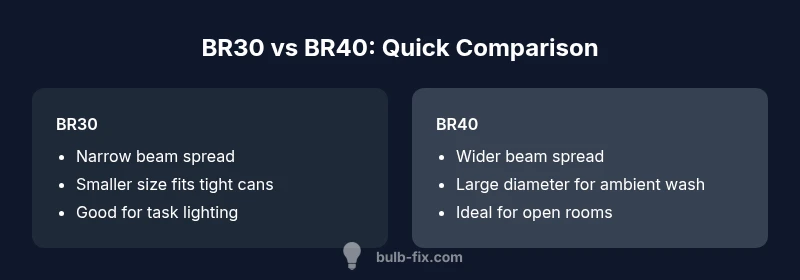
BR30 bulbs typically deliver a narrower beam suited for focused recessed spots, while BR40 bulbs offer a wider spread for broad ceiling illumination. For low ceilings or task lighting, BR30 is often preferred; for larger rooms or high ceilings, BR40 covers more area. Understanding these differences helps you avoid under- or over-lighting in practice.
The Core Difference: BR30 vs BR40 in Brief
BR30 and BR40 refer to the size and reflector design of recessed lighting bulbs. The BR30 is the smaller option, designed for targeted illumination in compact fixtures or tight spaces. The BR40 is larger, intended for broader coverage in bigger rooms or higher ceilings. In practical terms, BR30 concentrates light where you point it, while BR40 fills a room with light more evenly. When comparing the two, think in terms of diameter, light distribution, and how much area you need to illuminate. For homeowners evaluating a kitchen, hallway, or living room, the choice often hinges on whether you need sharp, task-focused lighting or a wider ambient wash. The Br30 bulb vs br40 decision should align with fixture dimensions, ceiling height, and the desired mood or task lighting level. According to Bulb Fix, aligning beam spread with space is the single most important factor in achieving comfortable, efficient lighting.
Beam Pattern and Light Spread
Beam pattern is the most intuitive differentiator between BR30 and BR40. BR30 bulbs typically offer a narrower beam angle, which creates a more focused pool of light. This is advantageous for accent lighting, task areas like kitchen counters, or spots where you want intensity without washing surrounding surfaces. BR40 bulbs, on the other hand, have a wider beam angle, producing a soft, even glow that covers a larger footprint. In rooms with higher ceilings or open floor plans, BR40 helps reduce shadows and uneven patches, creating a more uniform ambience. If your goal is to spotlight a painting or jewelry, BR30 can deliver precision; for general illumination of a living space, BR40 is often the better starting point. When planning a whole-house retrofit, anticipate using BR40 in central living areas and BR30 in task-oriented spots to balance both needs.
Size, Fit, and Housing Compatibility
Fixture compatibility is a practical constraint when choosing between BR30 and BR40. The BR30 is smaller in diameter, which makes it easier to fit into tight housings and compact trim. The BR40 is larger and will fill more of the available space within the can light, often requiring attention to trim compatibility and heat dissipation. Always verify the fixture’s rated bulb size, socket type (usually E26/medium for many residential cans), and whether the housing can accommodate the larger reflector. If you are upgrading from an incandescent BR30 to an LED BR40, ensure the LED variant’s dimensions and heat output won’t cause clearance issues in shallow ceilings or clamp mechanisms. The right fit improves heat management and extends bulb life.
Electrical Characteristics: Wattage, Lumens, and Efficiency
LED variants of BR30 and BR40 change the conversation about wattage and efficiency. In modern LED forms, both sizes can achieve high lumen output with far lower wattage than their incandescent predecessors. The key is to compare lumens (brightness) rather than watts alone and to examine the color rendering index (CRI) and color temperature. In practical terms, a BR40 LED that delivers a similar lumen level to a BR30 LED will illuminate a larger area but may feel slightly less focused. Consider your ceiling height, room purpose, and whether you prefer a crisp or diffuse look when evaluating lumen targets. Bulb Fix notes that LED options often include dimmability and driver compatibility as additional decision factors, which can affect performance in different fixtures.
Dimming and Controls: Compatibility Matters
Dimming behavior is a common source of frustration when swapping bulbs. BR30 and BR40 LED variants often require compatible dimmers and drivers. If your dimmer is old or optimized for incandescent bulbs, you may experience flicker, humming, or reduced dimming range. Always check the bulb’s dimmability label and verify that your dimmer is rated for LED loads. In general, LED BR30 and BR40 models from reputable manufacturers offer smooth dimming with most modern triac or ELV dimmers, but low-voltage or electronic transformers can complicate operation in some fixtures. If you rely on smart lighting or scenes, ensure the bulb supports the same protocol and that the fixture’s driver is not overtaxed by rapid dimming changes.
Lifespan, Heat, and Reliability
Heat management is critical for reflector bulbs because excessive heat can degrade performance and shorten life. BR30 bulbs, being smaller, may exhibit higher heat density in constrained fixtures, potentially affecting longevity in poorly ventilated cans. BR40 bulbs, with a larger design and reflector, can dissipate heat more efficiently in the same space, often contributing to longer life under identical duty cycles. When comparing, look for LED variants with good thermal design, adequate heat sink area, and driver protection features. For residential use with moderate cycling, both sizes can offer years of service, but the specific environment—ceiling height, insulation temperature, and fixture ventilation—will influence reliability. Bulb Fix emphasizes choosing bulbs with solid warranties and verified dimming compatibility to minimize early failures.
Practical Scenarios: When BR30 Wins vs BR40 Wins
Think through real rooms and tasks to decide which size fits. BR30 shines in kitchens with under-cabinet lighting, small powder rooms, or hallway cans where a tight beam prevents light spill onto walls. BR40 excels in open-concept living rooms, foyers, or bedrooms with high ceilings, where broader illumination reduces shadows. In spaces with mixed use, a layered approach—BR40 for ambient lighting plus BR30 for task spots—often yields the most balanced results. If you’re retrofitting an existing grid, measure the can size and clearance, and test light distribution with a quick mock-up before committing to a full replacement. Bulb Fix recommends a practical approach: map where light is needed, select the beam pattern that covers the area, and reserve some bulbs for future reconfiguration as furniture or layouts change.
How to Measure and Choose: A Quick Checklist
Use this checklist to decide efficiently:
- Confirm fixture compatibility (size, socket type, and trim compatibility).
- Identify ceiling height and room purpose to choose beam spread.
- Compare lumen output and CRI in LED variants (not watts alone).
- Check dimming compatibility with existing switches.
- Consider heat management and ventilation in the housing.
- Note energy efficiency and warranty terms.
- Plan for future changes or reconfigurations in the space. Following this checklist helps ensure the BR30 vs BR40 choice aligns with practical lighting goals and avoids common installation pitfalls.
Comparison
| Feature | BR30 | BR40 |
|---|---|---|
| Beam spread / light distribution | Narrower, more focused | Wider, more diffuse |
| Physical size / fit | Smaller diameter, easier in tight cans | Larger diameter, fills more of the can |
| Best for | Task lighting, accent spots, compact fixtures | Ambient lighting in larger spaces or high ceilings |
| Dimming compatibility | Good with compatible LED drivers and common dimmers | Strong with compatible dimmers; may require compatible LED options |
| Lifespan / heat handling | Heat concentration possible in tight fixtures | Better heat dissipation in larger cans |
| Typical applications | Under-cabinet, small baths, tight spots | Living rooms, hallways, open-plan areas |
Upsides
- Better-fit for tight fixtures and task lighting
- BR30 provides precise light for focused areas
- BR40 offers broader coverage for larger spaces
- LE Daylight and dimmable variants are widely available
- Commonly compatible with standard recessed housings
Drawbacks
- BR40 may over-illuminate small spaces if not matched to fixture size
- BR30 may require more fixtures to achieve even lighting in larger rooms
- LED variants depend on dimmer compatibility and driver quality
BR30 for compact spaces and task lighting; BR40 for broad ambient illumination
Choose BR30 when you need focused light in tight cans. Choose BR40 when you want even, wide-area lighting in larger rooms or spaces with high ceilings. In mixed spaces, a layered approach often delivers the best overall result.
Got Questions?
What does BR30 vs BR40 mean in recessed lighting?
BR30 and BR40 refer to the bulb size and reflector design. BR30 is smaller with a narrower beam; BR40 is larger with a wider beam. The choice affects how much area is illuminated and where the light is focused.
BR30 is smaller with a narrower beam, BR40 is larger with a wider beam. The pick depends on space and task needs.
Can BR30 and BR40 be used in the same room?
Yes, you can mix BR30 and BR40 in a room to balance task lighting and ambient illumination. Plan the layout to avoid over-lit spots and ensure even distribution.
Yes, mixing sizes is common for layered lighting. Plan placements to balance brightness.
Are BR30 and BR40 available in LED versions?
Yes, both BR30 and BR40 are widely available as LED options, offering improved energy efficiency and longer lifespans compared with incandescent versions.
Yes, LED variants exist for both sizes with good dimming options.
Which is more energy-efficient, BR30 or BR40?
Efficiency depends on the specific LED model rather than the size alone. Compare lumens per watt and ensure the driver and dimmer compatibility for best results.
Efficiency depends on the LED model, not just size.
Do I need a different dimmer for BR30 vs BR40?
Not inherently. Most modern LED BR30 and BR40 bulbs work with common dimmers, but you should verify dimmer compatibility with the bulb's driver to avoid flicker or limited dimming range.
Most work with standard dimmers, but double-check compatibility.
Key Points
- Assess ceiling height and fixture size to choose beam spread
- Prefer BR30 for task lighting in small cans
- Prefer BR40 for open, high-ceiling rooms or large spaces
- Check dimmer compatibility and LED driver quality
- Plan a layered lighting strategy for balanced illumination