Bulb Daylight vs Soft White: A Practical Comparison
Explore daylight vs soft white bulb differences in color temperature, mood, and energy use. Bulb Fix guides homeowners to choose the right bulb for each room and task with clear, evidence-based guidance.


For most homes evaluating lighting, bulb daylight vs soft white boils down to color temperature, lumens, and use case. Daylight bulbs (roughly 5000-6500K) deliver cooler, crisper light ideal for tasks and color accuracy, while soft white (2700-3000K) offers warmer ambience. This guide compares them across rooms, tasks, and energy use to help you choose.
What daylight vs soft white really means for color temperature and perception
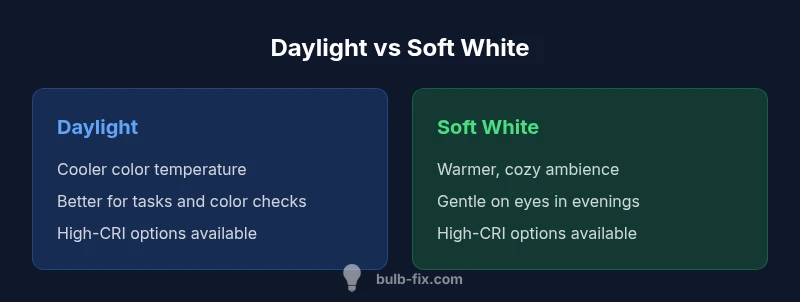
Color temperature and light quality set the tone for any room. Daylight bulbs emit a cooler, bluish light typically described as bright and energizing, while soft white bulbs emit a warmer, yellowish light that many people associate with relaxation. In practical terms, daylight is generally labeled as around 5000–6500K and soft white around 2700–3000K. Beyond temperature, color rendering (CRI) matters: high-CRI bulbs reproduce colors more faithfully in both daylight and warmer whites, which matters in kitchens, bathrooms, and spaces where you judge color accuracy. According to Bulb Fix, the choice of color temperature can dramatically affect perceived brightness and task performance; the wrong temperature can make rooms feel sterile or overly cozy. For most home settings, the trick is to balance mood with function, selecting a temperature that supports the room’s primary use while preserving comfort in the evening.
In this guide, we’ll dissect how daylight vs soft white changes the feel of each space and the practical implications for energy use, dimming, and mixing temperatures across a typical home.
Room-by-room guidance: kitchens, bathrooms, living spaces, and home offices
Choosing daylight vs soft white is not a one-size-fits-all decision. In kitchens, daylight can help you see true colors when chopping herbs, inspecting produce, and reading labels during food prep. For bathrooms, daylight on vanity fixtures can provide crisp visibility for grooming tasks like shaving or applying makeup, but a softer white in the rest of the bathroom can reduce glare. Living rooms and bedrooms benefit from softer white for a welcoming, relaxing feel, especially in evening hours. Home offices and study nooks often gain from daylight or a bright neutral white to support focus and reduce eye strain. The key is layering light: use daylight where you need focus and color clarity, and softer whites to create a warm, relaxing transition as the day ends. Remember that wall color, natural light, and furniture tones influence how daylight or soft white reads in a given space. Bulb Fix emphasizes testing combinations in your actual rooms to verify mood and task performance before committing to a bulk swap.
Task-focused scenarios: reading, cooking, crafts, and screen work
Reading and detailed crafts benefit from daylight or bright neutral white because these temperatures enhance contrast and reduce eye fatigue. When cooking, daylight’s color accuracy helps you judge doneness more reliably, especially with meat, produce, and sauces where color cues matter. For color-critical tasks like sewing, painting, or color matching, select high-CRI daylight bulbs to ensure true color reproduction. If your work involves screens, a cooler, daylight hue helps with readability during daytime, but you may prefer a warmer tone in the evening to minimize blue light exposure. In practice, you can create a dedicated high-clarity task lamp with daylight tones and keep room lighting slightly warmer as a general ambience. Bulb Fix notes that personal comfort should guide long-term choices; if a daylight task setup feels harsh after an hour, temper it with a softer white option nearby.
Energy use, lumens, and bulb types: LED, CFL, and incandescent blends
Energy efficiency has evolved with LEDs offering substantial energy savings across both daylight and soft white variants. Daylight LED bulbs deliver high brightness with good color rendering while staying energy-efficient. Soft white LEDs can provide similar efficiency with a warmer tone that many people prefer for living spaces. Incandescent bulbs, while providing warm white light, are far less energy-efficient and have shorter lifespans, making them rarer in modern homes. CFLs sit in between on efficiency and color rendering, but many homeowners now favor LED due to longevity and instant-on performance. When selecting, compare lumen output and CRI rather than relying solely on watts. The goal is to achieve adequate brightness for the task without creating glare or fatigue. Bulb Fix’s analysis shows that people often overvalue brightness alone; color temperature, but more importantly, color accuracy and contrast, shape the perceived quality of light in real rooms.
To optimize energy use while achieving the desired mood, pair daylight or soft white choices with dimmers or smart controls that align with the time of day and activity.
Color rendering and perceptual effects under daylight vs soft white
Color rendering index (CRI) measures how accurately a light source reveals colors compared with natural light. For most home tasks, aim for CRI values of 80 or higher, especially in kitchens, bathrooms, and rooms used for sewing, painting, or makeup. Daylight bulbs can dramatically improve the visibility of subtle color differences under shadows and glare, which is useful for food presentation or selecting fabrics. Soft white bulbs, while warmer, can still offer good CRI if chosen from reputable brands. The difference is not only in the color temperature but also in the spectral content; some daylight LEDs emphasize blues and greens, which affects perception in rooms with cool walls or stainless-steel surfaces. Bulb Fix guidance suggests choosing high-CRI daylight or high-CRI soft white options based on the room’s primary use and the natural light available during the day. If color-critical work is ongoing, test bulbs side-by-side to compare skin tones, fabrics, and paint swatches.
Dimming, compatibility, and smart lighting considerations
Dimming behavior varies by bulb type. Traditional incandescent bulbs dim smoothly, while many LEDs require compatible dimmers to avoid flicker or color shifts. Daylight LEDs and soft white LEDs with dimming capabilities can both support smart home ecosystems, but you’ll want to verify compatibility with your preferred dimmer switch or smart hub. If you plan to use scenes or routines, consider bulbs labeled as “dimmable” and with a stable color temperature at lower brightness levels. Some bulbs drift toward a warmer tone when dimmed, which can defeat the intended color effect. For multi-room setups, maintain a consistent color temperature within zones to prevent jarring transitions when moving from one space to another. Bulb Fix recommends testing dimming performance in your actual fixtures to ensure smooth operation.
Layered lighting: creating balance with daylight and soft white
A practical approach is to layer lighting with a daylight task layer and a soft white ambient layer. Use daylight fixtures in task zones like kitchen counters, home offices, and craft tables, while soft white fixtures provide warmth in seating areas, bedrooms, and hallways. In rooms with large windows, daylight can complement natural daylight during daytime hours, while soft white keeps spaces from feeling clinical after sunset. Balancing temperatures across a room reduces eye strain and creates a more inviting atmosphere. Remember, the goal is not to pick one temperature for all spaces but to tailor lighting to the activity, time of day, and desired mood. The Bulb Fix team frequently practices this layering approach in real homes to demonstrate practical results.
Longevity, replacement costs, and total ownership considerations
Lifespan and replacement costs vary by bulb type. LEDs typically outlast incandescent bulbs by a wide margin, delivering long-term savings even if upfront costs are higher. When comparing daylight versus soft white LEDs, consider not just price but the total ownership cost, including energy use and frequency of replacement. A higher upfront cost can be offset by longer life, lower energy use, and better color rendering in the long run. Bulb Fix notes that real-world ownership costs depend on fixture type, usage patterns, and ambient conditions (e.g., heat exposure). If a room is used frequently for color-critical tasks, investing in high-CRI daylight bulbs with longer lifespans may offer the best value over time.
Practical purchase checklist for homeowners and DIY enthusiasts
- Define the primary use for each room: task-focused or ambience-driven.
- Choose a target color temperature: daylight for tasks, soft white for relaxing zones.
- Prioritize high-CRI LEDs for color accuracy.
- Check dimmer compatibility and smart-home integration.
- Favor bulbs with a long rated life and energy efficiency rating.
- Test lighting in your space before committing to a full swap.
- Consider layering: daylight task lighting plus soft white ambient lighting.
A well-planned lighting plan prevents regrets later and makes rooms feel more comfortable and functional. Bulb Fix emphasizes testing in your actual spaces to confirm mood, color accuracy, and usability.
How to plan a practical daylight vs soft white lighting strategy for a typical home
A thoughtful strategy begins with a simple floorplan and a room-by-room assessment. Start by listing activities in each room: cooking and prep in the kitchen, grooming in the bathroom, reading in the living room, and focused work in a home office. Assign daylight bulbs to high-precision tasks and color-critical areas, and soft white where comfort and unwinding matter. Use layered lighting: ceiling ambient light softened by task lamps or under-cabinet lighting to fill shadows. Avoid abrupt color shifts between zones by selecting consistent temperature families (either daylight or soft white, or a careful mix with the same CRI and wattage class). Over time, you’ll refine your choices by observing how daylight changes with the seasons and how your evening routines feel with different temperatures. Bulb Fix’s framework helps homeowners iterate toward a balanced lighting plan.
Final considerations for homeowners and DIY enthusiasts
Lighting impacts mood, performance, and energy use. When choosing between daylight vs soft white, consider not only the room’s function but also the time of day you use it most. Daylight can maximize focus and color discrimination during daylight hours, while soft white supports relaxing evenings and cohesive ambiance. The best approach is to run a small experiment: swap bulbs in one room first, observe the effect across a week, and adjust as needed. For many households, a mixed approach that leverages daylight for task areas and soft white for living and sleeping areas provides the most practical balance. In all cases, choosing high-quality, high-CRI bulbs from reputable brands helps ensure consistent performance and long-term satisfaction. The Bulb Fix team recommends a measured, room-by-room approach rather than a blanket switch across the entire home.
Comparison
| Feature | Daylight bulbs | Soft white bulbs |
|---|---|---|
| Color temperature | Cooler, bluish hues (roughly 5000–6500K) | Warmer, yellowish hues (roughly 2700–3000K) |
| Best for | Task-focused rooms and color-critical work | Relaxed spaces and ambient mood |
| Color rendering (CRI) | High CRI achievable with high-CRI daylight LEDs | High CRI achievable with high-CRI soft white LEDs |
| Energy efficiency | Excellent with LED daylight options | Excellent with LED soft white options |
| Best for photos/video | Often preferred for color accuracy in visuals | Usually less harsh for general living spaces |
| Dimming behavior | Depends on bulb and dimmer compatibility; ensure LED-dimmable | Depends on bulb and dimmer compatibility; ensure LED-dimmable |
Upsides
- Clear differentiation between task-focused daylight and ambience-focused soft white
- Helps design layered, flexible lighting schemas
- Common bulb types are widely available and energy-efficient (LEDs)
Drawbacks
- Can be confusing for first-time buyers without a plan
- Mixing temperatures in a single room may feel jarring if not planned
- Dimming performance can vary by bulb and dimmer compatibility
Daylight for tasks and soft white for ambience, with layered lighting for best balance
Choose daylight where precision matters (kitchen prep, drafting, sewing) and soft white where warmth is preferred (living rooms, bedrooms). For most homes, a mixed approach with proper dimming and high-CRI LEDs yields the best overall experience.
Got Questions?
What is the essential difference between daylight and soft white bulbs?
Daylight bulbs emit a cooler, bluish light suited for tasks and color accuracy, while soft white bulbs emit a warmer, yellowish light that creates a cozy atmosphere. Both can offer high color rendering if chosen with care. The best choice depends on room use and personal preference.
Daylight is cooler and better for tasks; soft white is warmer and better for relaxing spaces. Both can render colors well if you pick high-CRI options.
Which bulb is better for reading and work?
For reading and detailed work, daylight or daylight-equivalent LEDs are usually preferred because they improve contrast and reduce eye strain. Use a dedicated task light with a higher color temperature and CRI to complement ambient lighting.
For reading, choose daylight LEDs with high CRI and place a task light to reduce eye strain.
Can I mix daylight and soft white in the same room?
Mixing is common, but plan carefully to avoid abrupt color shifts. Use daylight for task zones and soft white for ambient areas, and keep consistent brightness levels to prevent glare or mismatched tones.
Yes, but keep zones distinct and brightness balanced to avoid jarring color shifts.
Are daylight bulbs energy-efficient?
Yes, modern daylight bulbs are often highly energy-efficient when using LEDs. They provide strong task lighting with lower energy use compared to traditional incandescents, but always check lumens per watt and CRI.
Daylight LEDs are energy-efficient and great for tasks; look for high CRI too.
How do I choose between daylight and soft white for a home office?
For a home office, daylight or a bright neutral white is typically preferred to maximize focus and reduce eye strain. Pair it with a warmer ambient light in nearby seating areas to create a balanced environment.
Choose daylight for the desk area and balance with softer lighting nearby.
What should I consider for color accuracy in rooms with artwork or fabrics?
Prioritize high-CRI daylight bulbs for spaces with artwork or fabrics to ensure accurate color perception. If you prefer warmth, ensure the soft white option you choose also has high CRI.
Use high-CRI daylight bulbs in art-rich or fabric-focused rooms.
Key Points
- Define room function before choosing color temperature
- Layer daylight and soft white to balance mood and clarity
- Prioritize high-CRI LEDs for color accuracy
- Test in real rooms to confirm comfort and usability
- Consider dimming and smart controls for flexibility