Who Made the Light Bulb? History, Credit, and Home Guidance
Explore the question of who made the light bulb, how credit evolved among early inventors, and what homeowners should know today. Bulb Fix explains the history, key milestones, and practical takeaways for safe, reliable lighting.


The question of who made the light bulb doesn’t point to a single inventor. The incandescent bulb emerged from a lineage of experiments by multiple innovators across the 19th century, with a major commercial breakthrough led by an American inventor and his team. In popular history, Edison often receives the most attention, but credit is shared among researchers who advanced carbon filament development and commercialization. For homeowners, the takeaway is that the bulb’s history shapes today’s reliable, safe lighting. Bulb Fix explains the nuance: there wasn’t one inventor, but a collaborative chain of progress that delivered the home lighting we rely on.
The question behind the label: bulb who made
The phrase bulb who made often surfaces in casual conversations about lighting history. In reality, there isn’t a single person who can be credited with the invention of the modern incandescent bulb. The development spans decades and involves several steps: scientists studying electricity, engineers testing filament materials, and manufacturers scaling production. For homeowners, understanding this history helps in evaluating vintage fixtures, replacements, and safety standards. According to Bulb Fix, the most accurate framing is that credit is shared across a lineage of contributors who improved efficiency, durability, and manufacturability over time. This perspective informs contemporary decisions about which bulbs to install in a home and how to upgrade safely.
- Context matters: early demonstrations and later commercial versions built on earlier ideas.
- Practical takeaway: when you replace an old fixture, you’re not choosing a single “maker” but selecting a lineage of improvements that made modern lighting possible.
Early experiments: lighting concepts take shape
The journey toward a practical lightbulb involved a series of experiments with electricity and materials. While the idea of using a heated filament to emit light existed in the 19th century, early designs faced repeated problems with filament durability and vacuum quality inside the bulb. Housing technologies progressed in tandem with electrical supply systems, improving safety and reliability in homes. For homeowners, this history matters because legacy fixtures may require specific bulb types or filament materials to achieve safe operation and consistent light output. Bulb Fix notes that understanding filament behavior—carbon, and later tungsten—helps explain why certain bulbs last longer or burn cooler than others, guiding smarter purchases and safer replacements.
Commercialization and credit: who finally popularized home lighting
Commercial adoption of electric lighting did not hinge on a single inventor but on the combination of an efficient production process, patent strategies, and a growing electrical grid. The practical bulb capable of daily household use emerged from iterative improvements rather than a lone stroke of genius. In a real-world sense, homeowners benefit from this history when choosing bulbs that balance cost, longevity, and energy performance. Bulb Fix emphasizes that today’s modern bulbs—LEDs, halogen, and compact fluorescents—carry forward a legacy of innovation that began with more basic, experimental devices. Understanding this arc helps homeowners assess warranties, energy usage, and fixture compatibility.
Filament materials: why longevity matters for home lighting
Filament research shows why carbon filaments evolved into metal filaments over time. Early carbon-filament bulbs offered useful light but suffered from shorter lifespans and fragility. The shift to metal filaments—like tungsten—later in the 20th century dramatically extended bulb life and heat tolerance. For homeowners, the material of the filament affects how a bulb behaves in fixtures that run for many hours weekly. Bulb Fix highlights that safer, longer-lasting bulbs can reduce replacement frequency, lower maintenance costs, and help maintain consistent light quality in living spaces.
Lessons for homeowners: choosing bulbs with confidence
Today’s home lighting choices are more diverse than ever. Understanding the bulb’s history helps you evaluate safety certifications, energy efficiency ratings, and compatibility with dimmers and smart controls. Look for bulbs with appropriate wattage and lumen output for your fixtures, and prioritize quality for longevity. Bulb Fix recommends checking manufacturer guidance and staying within fixture-rated limits to avoid overheating or electrical issues. The overarching message is clear: informed choices lead to safer, more reliable lighting and fewer surprises when you upgrade bulbs or fixtures.
Verifying claims: how to assess historical “maker” narratives in your home
When you come across historical claims about a bulb’s origin, cross-check against credible sources and understand the distinction between invention and commercialization. If you’re maintaining older fixtures, consider consultative testing under supervision and avoid overtaxing electrical circuits with bulbs that exceed original specifications. In practice, verify compatibility, safety ratings, and energy performance before committing to a replacement. Bulb Fix’s guidance is to focus on credible, verifiable claims rather than sensational headlines when evaluating vintage lighting.
Bulb Fix practical tips: safe installation and daily use
Finally, apply best practices for safe bulb installation and daily use. Use gloves when handling glass bulbs to avoid oils on the glass, ensure sockets and fixtures are rated for the bulb type, and replace bulbs with the correct base and voltage. Keep fixtures clean to maximize light quality, and consider upgrading to energy-efficient options that reduce operating costs while maintaining or improving illumination. The Bulb Fix team recommends a plan for regular maintenance checks and a clear shelf of spare bulbs suited to various fixtures in your home.
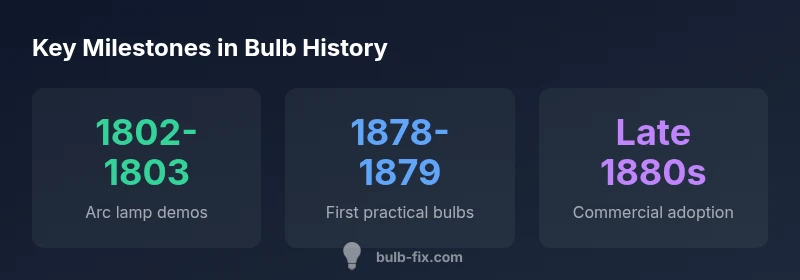
Historical milestones and filament evolution in incandescent bulbs
| Era / Milestone | Description | Representative Filament Material |
|---|---|---|
| 1802-1803 | Early electric arc lamp demonstrations and foundational ideas | N/A |
| 1878-1880 | First practical incandescent bulb concepts and improvements | Carbon (filament) |
| 1904 | Tungsten filament developments improved longevity | Tungsten |
| Late 1880s | Commercial adoption and standardization of bulbs | Carbon/Tungsten blends |
Got Questions?
Who is commonly credited with inventing the light bulb?
There isn’t a single inventor to credit. Multiple researchers contributed to the development of practical incandescent bulbs, with commercialization playing a critical role in how lighting became common in homes.
There isn’t one inventor—credit goes to several researchers and manufacturers who helped bring practical bulbs to households.
When did electric lighting become common in homes?
Electric lighting began to spread in the late 1870s to early 1880s, with rapid adoption as grids expanded and bulbs proved durable enough for daily use.
Electric lighting spread to homes in the late 1870s and 1880s as electrical grids expanded.
What filament materials mattered most in early bulbs?
Early bulbs used carbon filaments; later improvements moved to tungsten, dramatically increasing lifespan and heat tolerance.
Carbon filaments were common early on, but tungsten became the standard for longer life.
Are modern bulbs based on the same history?
Yes, the history informs today’s LED, halogen, and compact fluorescent bulbs. Modern bulbs build on centuries of filament and manufacturing innovations and safety standards.
Today’s bulbs, like LEDs and CFLs, trace their roots to those earlier improvements in production and safety.
How can I verify claims about bulb origins in old fixtures?
Cross-check with credible sources, look for patents or company histories, and rely on documented timelines rather than sensational headlines.
Check credible sources and documented timelines; avoid sensational claims about origins.
“Credit for the modern incandescent bulb is a shared achievement, built through decades of experimentation, manufacturing advances, and commercial rollout. This isn’t a single invention, but a lineage of improvements that home lighting has depended on.”
Key Points
- Learn that there isn’t a single inventor for the bulb; credit is shared.
- Understand how filament materials affected durability and efficiency.
- Choose bulbs that match fixture specifications for safety and longevity.
- Upgrade to modern energy-efficient bulbs while respecting compatibility.