How big is a G25 light bulb? A Practical Size Guide
Discover the exact dimensions of a G25 globe bulb, including diameter, length, bases, and tips for choosing the right bulb for your fixtures.


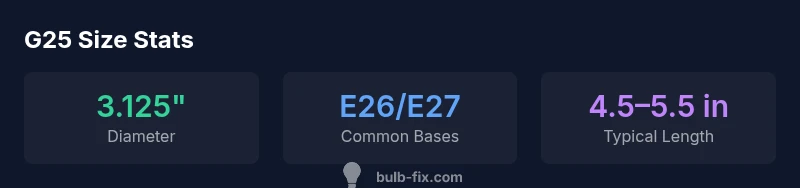
The G25 globe bulb is defined by its diameter—about 3.125 inches, or roughly 79 millimeters. That size, paired with standard bases like E26/E27, makes it a popular choice for decorative fixtures, vanity lighting, and pendants. While the G25's shape is the key feature, actual length varies by filament design and base, so measure your fixture before buying.
How to read bulb size abbreviations
When you start shopping for bulbs, a jumble of letters and numbers can be confusing. For many homeowners, the question how big is a g25 light bulb comes up early in the process. In plain terms, G25 denotes a globe-shaped bulb with about 3.125 inches of diameter. The “G” indicates globe, while the number references the diameter in eighths of an inch; a G25 is roughly 3.125 inches across. This size is common in decorative fixtures, vanity lighting, and pendants. Different manufacturers may vary slightly in length, but the diameter is the primary identifier that affects fit inside shades and fixtures.
Understanding this sizing helps you avoid buying a bulb that looks oversized in a fixture or too small to diffuse light properly.
Diameter and overall shape explained
The G25 size is defined by diameter rather than length. A typical G25 globe is about 3.125 inches (79 mm) across at its widest point. The bulb's body is spherical, with variations in glass thickness and filament design that can affect the overall length. Expect total length to run roughly between 4.5 and 5.5 inches (115 to 140 mm), depending on whether the bulb has a compact filament or a taller form. The shape influences how light spreads; the optics through a globe often provide softer, more diffuse illumination, which is why G25 bulbs are popular in bathrooms, dressing areas, and decorative fixtures where glare must be minimized.
Measuring at home: practical steps
To confirm fit before you buy, measure the fixture opening and the shade clearance. Tools: a ruler or tape measure, and a caliper if you have one. Step 1: measure the widest point of the bulb's globe (diameter). Step 2: estimate the bulb length from base to tip. Step 3: check the socket base—most G25 bulbs use E26 or E27 bases in many regions. Step 4: compare with your fixture's shade inner diameter and heat clearance. Keep in mind that LED G25s may be shorter or longer than incandescent equivalents due to internal LED module design.
A quick at-a-glance rule: if the globe diameter is close to 3.125 inches and the shade is generously sized, you’re likely in good shape.
Bases and fixture compatibility
Common bases for G25 bulbs are E26 and E27, though some markets use other bases. The base must match the socket; otherwise the bulb will not seat correctly or may cause poor contact. In addition to base, confirm maximum wattage and dimmer compatibility if your fixture uses a dimmer switch. Shade and fixture openings also vary; a bulb that fits the socket technically may touch the shade or housing if the shade opening is small. In those cases, consider a G25 with a shorter overall length or a smaller globe.
LED vs incandescent G25: performance and compatibility
LED G25 bulbs bring energy efficiency and cooler operation, typically consuming far less power than incandescent equivalents while delivering comparable brightness. A LED G25 bulb often uses 4–11 watts and can provide 300–900 lumens depending on the model. Incandescent G25 bulbs typically fall around 40–60 watts when used as equivalents. Color temperatures range from warm white (2700–3000K) to cool white (4000K). When replacing, consider dimmer compatibility, heat output, and the fixture's UV exposure to plastics.
Choosing the right G25 for your fixture
Start with the fixture opening: measure the widest point of the glass globe and the shade's interior diameter. For pendants or vanity fixtures, aim for a globe that allows at least 0.5 inches of clearance on all sides. Consider the lamp's brightness: LED versions give you more efficient light and longer life, but you may prefer the warmth of an incandescent look. Lastly, double-check the socket: E26/E27 are the most common, but regional variations exist. If you’re unsure, bring a sample bulb to the store or request a size chart from the manufacturer.
Safety and handling tips for bulb replacement
Always power off the fixture and allow bulbs to cool before handling. Wear gloves or use a cloth to grip the bulb to avoid oil on the glass. G25 bulbs are fragile; ensure the glass globe is not cracked or etched during removal. When installing, align the base with the socket, and gently rotate clockwise until snug—do not over-tighten. Never force a bulb into a socket of a different base type; use the proper adapter if available. Finally, dispose of broken glass safely and keep a spare G25 on hand.
Cleaning and disposal: extending bulb life
Keep fixtures clean and dust-free to maintain light output. Use a soft cloth to wipe the globe, never use water on hot bulbs. When it's time to replace, recycle or dispose according to local guidelines. Many regions accept spent bulbs at recycling centers; LED versions should be treated as electronics. Check local waste management guidelines to ensure safe disposal.
Quick sizing checklist for homeowners
Before buying, answer these: Is the globe diameter about 3.125 inches? Does the fixture use E26 or E27 bases? Will shade clearance allow full globe, not touch the shade? Is LED a good option for energy savings? Do I have the correct dimmer compatibility? If you confirm these points, you’ll minimize return trips and fit issues.
Comparison of G25 vs G30 globe bulb sizes
| Bulb Size | Diameter (in) | Diameter (mm) | Common Bases | Notes |
|---|---|---|---|---|
| G25 Globe | 3.125 | 79.4 | E26/E27 | Popular for decorative fixtures and vanity lighting |
| G30 Globe | 3.75 | 95.0 | E26/E27 | Larger globe for statement lighting |
Got Questions?
What does G25 mean in bulb sizing?
G indicates globe shape, and 25 refers to the diameter in eighths of an inch. Practically, a G25 globe is about 3.125 inches across. This size is common for decorative fixtures.
G25 means the bulb is globe-shaped and about three and a quarter inches wide, which is a common size for decorative lighting.
Can I use a G30 in place of a G25?
No. G30 is larger (about 3.75 inches in diameter) and may not fit shade openings or fixtures designed for G25.
A G30 is larger and might not fit in fixtures designed for G25 globes.
Are LED G25 bulbs available?
Yes. LED G25 bulbs exist and offer lower power use with a range of brightness levels. Always check lumen output and color temperature to match your needs.
Yes, you can find LED G25 bulbs that save energy and come in different brightness levels.
What bases are common on G25 bulbs?
The most common bases are E26 and E27, depending on regional standards. Verify the socket type before purchasing.
Most G25 bulbs use E26 or E27 bases; confirm your socket type first.
How do I measure bulb diameter at home?
Use a ruler or caliper to measure the bulb's widest point. Compare that with your shade and fixture opening to ensure a proper fit.
Measure the bulb's widest point with a ruler to compare with your fixture.
What safety steps are needed when replacing bulbs?
Power off the fixture, let the bulb cool, wear protective gloves, and avoid touching the glass with bare fingers. Ensure the bulb is the correct base before twisting in.
Turn off power, wait for cooling, and handle with care when replacing bulbs.
“Accurate sizing matters for decorative fixtures, where a mismatch can affect shade fit and light diffusion. The Bulb Fix Team recommends always measuring the fixture opening and cross-checking with the bulb's diameter before purchase.”
Key Points
- Know the diameter: G25 is about 3.125 inches.
- Match the base: common options are E26 and E27.
- Length varies by model; verify shade clearance.
- LED equivalents save energy but check dimmer compatibility.
- Measure fixture opening before buying to avoid fit issues.