R30 Bulb vs BR30: Which Recessed Lighting Bulb Fits Your Fixture?
A thorough, practical comparison of R30 and BR30 bulbs, covering beam patterns, efficiency, compatibility, and best-use scenarios to help homeowners pick the right recessed-light bulb.


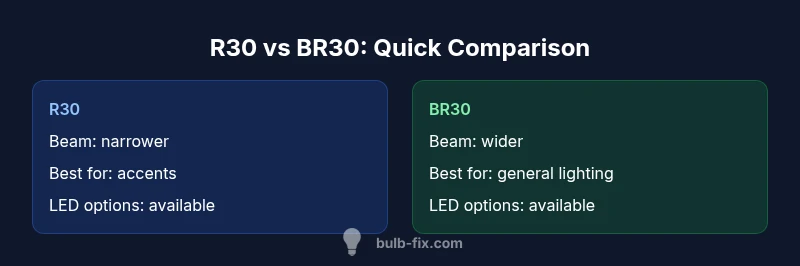
This quick comparison shows that the r30 bulb vs br30 choice hinges on beam spread, fixture size, and energy goals. BR30 generally provides broader, more even coverage suitable for general lighting in kitchens and living spaces, while the R30 often delivers a more focused beam for accent lighting or task areas. For most modern homes, LED BR30 options offer energy efficiency with good color quality, but R30 LED options are strong when you need targeted illumination in smaller fixtures.
r30 bulb vs br30: What they are and how they differ
When shopping for recessed lighting, the terms r30 bulb vs br30 come up often. This guide explains what each bulb is, their common base types, and why the choice matters for beam control and space feel. According to Bulb Fix, the decision between an R30 and a BR30 should start with fixture compatibility, ceiling height, and the intended room use. The Bulb Fix team found that most homeowners underestimate how much beam shape changes perceived brightness and room atmosphere, especially in kitchens and bathrooms. In short, your fixture size, trim style, and desired ambiance will drive whether an r30 bulb vs br30 is the better pick.
What to know at a glance: both bulbs share size compatibility with many recessed fixtures and typically use standard bases, but BR30 options are more common for wide-field illumination, while R30 tends toward tighter, directional lighting. The choice also depends on whether you prioritize energy efficiency (LED variants) or traditional light output (incandescent/halogen).
Beam spread and light distribution: r30 bulb vs br30
Beam spread is the defining difference in the r30 bulb vs br30 debate. R30 bulbs generally produce a narrower, more focused beam, which can create dramatic highlights on artwork or architectural features and reduce glare in tight ceiling zones. BR30 bulbs, by contrast, incorporate a built-in reflector that widens the beam and softens shadows, making them a natural fit for general ambient lighting. In environments with high ceilings or open floor plans, BR30 often yield more uniform brightness across a room, while R30 may require more strategic placement to avoid dark corners. When choosing, measure your fixture’s opening and consider how the beam will interact with adjacent walls and furniture. If your ceiling height is tall or the space is hard to reach with direct light, BR30’s broader spread can help keep walls and surfaces evenly lit. Strategic placement matters for both types, but BR30 typically offers more forgiving coverage.
Energy efficiency and LED options
Energy efficiency is a critical factor when deciding between r30 bulb vs br30, especially as LED technology becomes the default for many homes. LED BR30 bulbs usually deliver better overall efficiency and longer life than incandescent BR30s, translating into lower operating costs over time. LED R30 options are equally capable but may emphasize beam control and color rendering differently, depending on the model. If you’re replacing old incandescent or halogen bulbs, LED versions of either form will cut energy use and reduce heat load in recessed fixtures. Be mindful of the LED driver or ballast compatibility, as some dimmers require compatible drivers to avoid flicker or color-shift. For most homeowners, LED BR30 provides a balance of efficiency, coverage, and ease of installation; LED R30 can be a better fit where spotlighting or narrow beams are desired.
Color temperature and light quality
Color temperature and color rendering influence how r30 bulb vs br30 perform in daily use. Both bulb styles come in a spectrum from warm to cool tones; the exact options depend on whether you choose incandescent/halogen or LED variants. For kitchens and living areas where you want a natural, inviting look, warmer temperatures around 2700–3000K are common, while workspaces or task lighting may benefit from cooler tones in the 3500–4000K range. BR30 LED options often maintain consistent color temperature across the beam, helping ensure uniform appearance. In contrast, some R30 LEDs may exhibit slight tint variation if the fixture position or dimmer interaction affects color perception. Test samples in your actual room to confirm the aesthetic before committing.
Dimmability and compatibility with dimmers
Dimmability is a key factor in the r30 bulb vs br30 decision, especially for living rooms, bedrooms, and kitchens where controlling brightness adds comfort. Many BR30 and R30 bulbs are available in dimmable LED formats, but compatibility varies by brand and dimmer type. If you have an older dimmer, confirm whether it is compatible with LED drivers to avoid humming, flicker, or limited dimming range. Some LED BR30/R30 bulbs include features like smooth dimming curves and memory settings, which can improve the user experience. Always check the ballast or driver requirements and verify fixture compatibility before purchasing.
Fixture compatibility and installation tips
Fixture compatibility is often overlooked but critical in r30 bulb vs br30 decisions. Most recessed fixtures designed for R30 or BR30 lamps share a similar base (often E26/medium), but trim size and housing depth can vary. Before buying, measure the can trim diameter, housing clearance, and the distance to any heat-sensitive components. In some cases, BR30 with a wider reflector may require a deeper can or a specific trim kit to prevent overheating or interference with the inner baffle. If you’re unsure, consult the fixture manufacturer’s guidance or have a lighting professional verify fit and heat handling. When replacing, handle bulbs with care to avoid fingerprint oils, which can affect performance over time.
Use-case scenarios: kitchens, bathrooms, living rooms vs r30 bulb vs br30
Selecting between r30 bulb vs br30 often boils down to the room’s purpose. In kitchens and open-plan spaces, BR30’s broader spread helps illuminate countertops and seating areas evenly, reducing the need for multiple fixtures. Bathrooms benefit from BR30’s wide, even glow around mirrors and vanities, while R30 can be ideal for accent lighting over artworks or architectural features where a more focused beam is desired. In living rooms with high ceilings or stairwells, BR30 can eliminate dark pockets, while R30 is a better choice for highlighting textures or sculptural elements. Remember that the beam shape, color temperature, and dimmability all influence perceived brightness and atmosphere.
Longevity, maintenance, and waste considerations
Longevity and maintenance are practical concerns when comparing r30 bulb vs br30, particularly in rooms with hard-to-reach fixtures. LED variants typically last longer than incandescent or halogen options, reducing maintenance frequency and replacement costs. When LEDs reach end-of-life, they gradually lose brightness or efficiency, and you should replace them with equivalent or better LED lamps to maintain lighting quality. Disposal considerations depend on the bulb type; LEDs don’t contain hazardous materials like older fluorescent lamps, but they still should be recycled properly where possible. Always follow local guidelines for bulb disposal and consider a recycling program for energy-efficient LEDs to minimize environmental impact.
Replacement costs and value considerations
Replacement costs for r30 bulb vs br30 depend heavily on the bulb technology (LED, incandescent, halogen) and whether you opt for dimmable or smart features. In general, LED options carry a higher upfront price but bring energy savings and longer lifespans that offset initial costs over time. If your fixtures see frequent use or are in hard-to-access areas, LED BR30s can offer better value by maximizing brightness consistency and reducing replacements. For homeowners on a tighter budget, incandescent or halogen R30 bulbs provide a lower upfront cost, but energy usage and heat output may increase running costs. Always balance up-front price with energy savings, fixture compatibility, and lighting goals when evaluating r30 bulb vs br30 investments.
LED vs incandescent vs CFL: performance notes for r30 bulb vs br30
The modern market leans toward LED for both r30 and br30 forms, thanks to efficiency, longer life, and color stability. Incandescent and halogen variants remain available for consumers who want immediate, familiar brightness and lower upfront costs, though they consume more energy and generate more heat. CFL options exist in some older installations, but their footprint, warm-up time, and color consistency may not compare favorably with LED options. When choosing between LED R30 and LED BR30, prioritize lumens-per-watt, driver compatibility, and heat management. For most homes, LED BR30 offers a practical blend of efficiency and broad coverage, whereas LED R30 excels when you need a more targeted beam to accent specific features.
Practical buying tips for r30 bulb vs br30
When buying, create a short checklist: fixture compatibility (base type and trim size), desired beam spread, color temperature, dimmability, and whether LED is preferred for efficiency. Compare LED BR30 and LED R30 models for brightness consistency across the beam and ensure your dimmer is compatible with the LED driver. Inspect the warranty, ensure heat ratings match the fixture, and consider the room’s ceiling height and wall surfaces. If possible, test two options in the same space to observe beam behavior, color, and dimming range before making a final decision. For many homeowners, starting with LED BR30 yields the most forgiving balance of coverage and efficiency, while LED R30 remains a strong choice for accent lighting.
Common pitfalls when choosing r30 bulb vs br30
Common mistakes include overlooking fixture depth, misjudging beam spread, and ignoring dimmer compatibility. Some homeowners buy BR30s for small cans or R30s for fixtures that require broader coverage, leading to suboptimal lighting or heat buildup. Others underestimate the impact of color temperature on room mood, resulting in an atmosphere that feels too cold or too warm for the space. Always confirm base type, trim compatibility, and dimmer compatibility before purchasing, and avoid mixing bulb types in the same circuit unless the fixture design explicitly supports it. Finally, don’t skip energy-efficiency considerations; LED variants generally offer long-term savings and reduced heat output.
Authoritative sources and further reading
- Energy.gov: LED Lighting Facts and residential lighting guidance
- energystar.gov: Solid guidance on LED replacements and bulb performance
- Lighting Research Center (lrc.rpi.edu): In-depth lighting quality and beam characteristics
For homeowners seeking more depth, these sources provide standards, performance benchmarks, and practical advice for selecting r30 bulb vs br30 in various fixtures and room contexts.
Comparison
| Feature | R30 bulb | BR30 bulb |
|---|---|---|
| Beam spread / light distribution | Narrower, more directional beam | Wider, more diffuse flood coverage |
| Base type | E26/medium common base | E26/medium common base |
| Energy efficiency (LED vs incandescent) | Typically less efficient in incandescent versions; LED options exist | Typically more energy-efficient when LED; better overall efficiency in practice |
| Dimmability & compatibility | Often compatible with standard dimmers; check bulb type | Usually compatible with dimmers with LED drivers; verify dimmer compatibility |
| Best for | Accent lighting, task-focused spots | General ambient lighting and broader room illumination |
| Typical lifespan (LED vs traditional) | Shorter if incandescent/halogen; longer with LED | Longer, especially with LED variants |
| Color temperature options | Warm to cool; varies by technology | Warm to cool; LED options common |
| Price/value context | Lower upfront options exist (incandescent variants) | Higher upfront with LEDs but lower operating costs |
Upsides
- BR30 often provides broad, even illumination ideal for general room lighting
- R30 can offer focused, controllable accents and better hotspot control
- LED variants for both types improve energy efficiency and longevity
- Standard bases simplify compatibility in many recessed fixtures
- LED BR30 combinations typically deliver better overall light quality in open spaces
Drawbacks
- Incandescent/halogen variants in both types consume more energy and emit more heat
- LED drivers can complicate dimmer compatibility in some installations
- BR30’s broader beam may wash out detail in small, focal areas
- R30’s narrow beam requires careful fixture placement to avoid dark spots
Choose BR30 for broad, even coverage and energy efficiency; opt for R30 when you need focused lighting and accent detailing.
BR30 is generally the better all-around choice for most recessed applications due to wider beam and LED efficiency. Choose R30 if your design relies on targeted highlights or narrow beams. Always verify fixture compatibility and dimmer support before buying.
Got Questions?
What is the primary difference between R30 and BR30 bulbs?
The main difference is beam spread: R30 is typically more focused while BR30 has a built-in reflector that broadens the beam. Both share similar base types, but the choice affects how light fills a room and highlights surfaces.
R30 focuses light; BR30 spreads light more widely. Check your fixture and intended lighting goal to choose the right one.
Are BR30 bulbs more energy-efficient than R30 bulbs?
LED versions of both BR30 and R30 are energy-efficient options, but BR30 LED variants often deliver broader illumination with good efficiency. Incandescent/halogen versions are less efficient and produce more heat.
LED BR30s tend to be efficient and provide broad lighting; LED R30s are efficient too but focus depends on the application.
Can I mix BR30 and R30 in the same room?
Yes, you can mix BR30 and R30 in a room if the fixtures and circuits support it, but you should plan layout to avoid uneven lighting or hotspots. Consistency in color temperature helps maintain a cohesive look.
You can mix them, just keep an eye on balance and color temperature.
Which bulb is better for kitchens and bathrooms?
BR30 generally provides broader illumination suitable for kitchens and bathrooms, reducing shadows around work areas. R30 may be preferred for targeted lighting over sinks or accent features where focused light is beneficial.
BR30 for wide lighting; use R30 when you want a focused beam over a specific spot.
Are LED R30 and BR30 available in dimmable options?
Yes, both R30 and BR30 LEDs are available in dimmable forms, but dimmer compatibility varies by model. If you have an older dimmer, confirm compatibility to avoid flicker or limited dimming range.
Yes, look for dimmable LED versions and check your dimmer compatibility.
How do I know which base size my fixture uses?
Most recessed fixtures use a standard E26/medium base in North America, but some older fixtures or international installations may vary. Measure the base and verify the fixture’s requirements before purchasing.
Check the base type and fixture requirements before buying the bulb.
Key Points
- Choose BR30 for broad coverage in kitchens and living spaces
- Opt for R30 when you need focused lighting and accents
- Prefer LED variants in either form for energy savings
- Always check fixture compatibility and dimming with LEDs
- Consider color temperature to match room mood