Why Are Compact Fluorescent Bulbs Better? A Practical CFL Comparison
Learn why are compact fluorescent bulbs better in certain setups, compare CFLs with LEDs and incandescent options, and get practical guidance from Bulb Fix for homeowners and DIYs.


This quick answer explains why are compact fluorescent bulbs better in some homes: CFLs use less energy than incandescent bulbs and emit less heat, while remaining affordable compared with many LEDs. They are a solid mid-range option when budgets and retrofits matter. Understanding these tradeoffs helps you pick the right bulb for kitchens, living rooms, and outdoor fixtures.
Why CFLs Still Matter in Modern Homes
According to Bulb Fix, CFLs remain a viable option in older homes or fixtures where retrofitting to LEDs isn't practical. The central question many homeowners ask is why are compact fluorescent bulbs better in certain contexts, and the answer depends on fixture type, usage patterns, and budget. CFLs offer a solid energy advantage over incandescent bulbs while avoiding some of the high upfront cost associated with LEDs. They also perform well in areas where lights are used for several hours per day but not at full brightness. For kitchens, basements, and outdoor fixtures with standard sockets, CFLs can deliver dependable light with reasonable return on investment. When managed properly, CFLs contribute to a lower household electricity bill without requiring major rewiring or new fixtures. This section will unpack these considerations with practical tips for choosing the right CFL for your space. We will also discuss how to balance energy savings with light quality, warm-up time, and disposal requirements.
From a practical standpoint, homeowners frequently wonder the operational limits of CFLs. They typically work well in rooms where lights stay on for extended periods but can be less ideal for quick on/off usage. Understanding these conditions helps you avoid frustration and maximize efficiency. The Bulb Fix approach is to align bulb choice with actual usage patterns, fixture type, and environmental considerations, creating a balanced lighting plan that respects both cost and comfort.
Key Performance Factors: Energy, Light Quality, and Longevity
The effectiveness of CFLs hinges on three core dimensions: energy consumption per lumen, light quality (color rendering and consistency), and expected lifespan. CFLs generally consume less energy than traditional incandescent bulbs for the same light output, delivering noticeable savings in rooms that are lit for several hours a day. Light quality matters as well; CFLs vary in color temperature and CRI, which affects how natural colors appear in your space. Longevity determines how often you will replace bulbs in high-use areas. In many typical home setups, CFLs offer a durable compromise between up-front cost and long-term efficiency, especially when a full LED retrofit isn’t feasible. As you compare CFLs to LEDs, you’ll see how differences in energy efficiency, startup time, and fixture compatibility shape long-term value.
Energy Efficiency and Operating Costs
When evaluating energy efficiency, CFLs usually outperform incandescent bulbs while not always reaching LED performance. The energy savings per hour add up quickly in living areas, hallways, or outdoor lighting that remains on throughout the evening. From a total-cost perspective, CFLs typically have a lower upfront price than LEDs, and their longer life compared with incandescent bulbs reduces replacement frequency. However, LEDs often win in total cost of ownership over a multi-year span due to higher efficiency and substantially longer lifespans. Practical usage patterns—like how often you switch lights on and off and whether you dim them—will influence the overall savings you experience with CFLs versus LEDs. To maximize value, pair CFLs with fixtures that align with their operating profile and avoid frequent cycling that can shorten life.
Light Quality and Color Rendering
Color rendering quality matters for tasks like cooking, makeup, and art projects. CFLs have historically varied in color accuracy, with some models producing a noticeable greenish tint or uneven color distribution. Advances in CFL technology have narrowed this gap, giving you better color fidelity in many common home settings. The perceived warmth or coolness of light is also a consideration; choose a color temperature that complements the room’s purpose and your décor. If you want a true-to-life color appearance, compare CRI ratings among CFL options and consider blends that approximate daylight at higher color temperatures.
Durability, Warm-up Time, and Dimming
CFLs traditionally require a short warm-up period to reach full brightness, which can be an annoyance in frequently used spaces. In contrast, LEDs provide instant full brightness and generally superior dimming performance. Dimming CFLs is possible with compatible fixtures and ballast, but not all CFLs dim evenly across the range. If you have dimmer switches or need flexible control, LEDs may offer a more reliable, wider dimming range. For spaces where lights are left on for long periods, CFLs offer acceptable performance, while for ambient areas that require quick on-off cycling, LEDs can be the better choice.
Mercury Content, Environmental Considerations, and Recycling
A key environmental factor with CFLs is the presence of a small amount of mercury. This means proper disposal and recycling are important, especially when bulbs break. Most households can recycle CFLs at local hazardous-waste facilities or through municipal programs. The disposal process is a trade-off to consider when comparing CFLs with LEDs, which do not contain mercury. Responsible recycling practices protect air and water quality and help you avoid environmental penalties. If you live in an area with robust recycling options, CFLs can be used responsibly within a well-managed lighting strategy.
Real-World Scenarios: When CFLs Are the Better Fit
Certain home scenarios still favor CFLs: rooms with steady, long-term lighting and limited budget for a full LED upgrade; spaces with standard screw bases and fixtures that may not be energy-optimized; historical homes where wiring limits upgrades; and areas where warm, soft light is preferred and dimming requirements are modest. For these situations, CFLs offer meaningful energy savings without the higher upfront cost associated with LEDs. If you expect to replace fixtures soon or prioritize ultra-long life and instant-on brightness, LEDs may be a better long-term value. The choice should be guided by your usage patterns, fixture compatibility, and willingness to engage in recycling practices for spent bulbs.
CFLs vs LEDs: A Structured Comparison
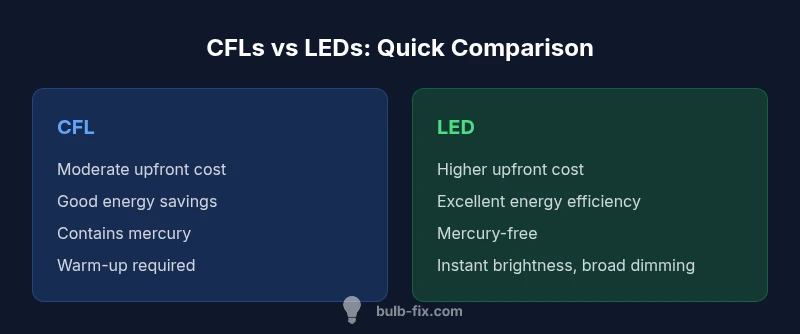
This section introduces a side-by-side analysis to help you weigh CFLs against LEDs. CFLs typically deliver solid energy savings with lower upfront costs but may lag behind LEDs in efficiency, lifespan, and instant brightness. LEDs, meanwhile, offer higher energy efficiency, longer life, and more reliable dimming capabilities, often at a higher upfront price. The comparison considers energy use, cost of ownership, light quality, dimming compatibility, and environmental considerations. By focusing on your room-by-room needs, you can identify where CFLs are the better fit and where LEDs provide a stronger long-term return on investment.
Safe Use and Disposal Best Practices
Adopt safe handling practices for CFL use, especially in households with children or pets. Keep bulbs away from moisture and avoid overtightening to prevent breakage. When a CFL reaches the end of life or breaks, follow local disposal guidelines and recycle through approved programs. Maintaining a simple inventory of where CFLs are used helps you track replacement cycles and ensures that you rotate bulbs to optimize lifespan. For households with experiences of frequent on/off cycling, consider LEDs for improved durability and immediate brightness. Following these practices enables you to realize CFLs’ benefits while minimizing environmental impact.
Comparison
| Feature | CFL (Compact Fluorescent Lamp) | LED (Light Emitting Diode) |
|---|---|---|
| Energy efficiency | Good | Excellent |
| Upfront cost | Lower | Higher |
| Lifespan | Moderate | Long |
| Color rendering (CRI) | Good | Excellent |
| Warm-up time | Requires warm-up | Instant/near-instant |
| Mercury content | Contains mercury (recyclable) | Mercury-free |
| Dimming compatibility | Limited/ballast-dependent | Broad and reliable |
| Disposal | Recycling required for mercury | Easier disposal; no mercury |
Upsides
- Lower upfront cost than LEDs, making CFLs approachable for budget-conscious projects
- Decent energy savings over incandescent options in steady-use rooms
- Good compatibility with most standard fixtures and sockets
- Solid mid-range option when full LED upgrades aren’t feasible
Drawbacks
- Contains mercury, requiring careful disposal and recycling
- Longer warm-up times and less instant brightness than LEDs
- Dimming and color-temperature consistency can be variable across models
- Lifespan is shorter than LEDs, leading to more frequent replacements in high-use spaces
CFLs are a solid mid-range option; LEDs generally win on long-term efficiency and lifetime
Choose CFLs when upfront cost matters and you don’t need the utmost longevity. For long-term savings and broader dimming options, LEDs are typically the stronger choice.
Got Questions?
Are CFLs more energy-efficient than incandescent bulbs?
Yes. CFLs use significantly less energy to produce the same amount of light as incandescent bulbs, translating to lower electricity bills over time. They also generate less heat, which can improve comfort in warm rooms.
CFLs use less energy and give off less heat than incandescent bulbs, which saves energy over time.
Do CFLs contain mercury?
Yes, CFLs contain a small amount of mercury. This is why recycling and proper disposal are important to minimize environmental impact.
CFLs contain a small amount of mercury, so recycle them properly when they reach the end of life.
Can CFLs be used with dimmer switches?
Some CFLs are available in dimmable versions, but compatibility depends on the ballast and dimmer type. Check packaging and use fixtures labeled for CFL dimming.
Some CFLs dim, but check that both the bulb and dimmer are compatible.
Are CFLs compatible with most fixtures and sockets?
In most cases, CFLs use standard screw bases (E26/E27) and fit common fixtures. Some older fixtures with electronic ballasts may require special CFLs.
Most fixtures take CFLs, but verify ballast compatibility if you have older equipment.
What should I know about long-term cost with CFLs vs LEDs?
LEDs typically offer higher energy efficiency and much longer lifespans, which often yields lower total cost of ownership despite higher upfront prices. CFLs can be cheaper upfront but require more frequent replacements.
LEDs usually save more energy and last longer, reducing total cost over time.
Key Points
- Assess room usage before choosing CFLs vs LEDs
- Factor in fixture compatibility and warm-up expectations
- Plan for proper CFL recycling due to mercury content
- LEDs often offer longer lifespan and energy efficiency
- Maintain a balanced lighting plan to optimize energy savings