Bulb-Like Root Crossword Clue: A Practical Comparison
Explore two main interpretations of the phrase "bulb like root crossword clue" with practical guidance for solvers and puzzle creators. Bulb Fix analyses plant terminology and wordplay strategies to help you choose the right reading in crosswords.


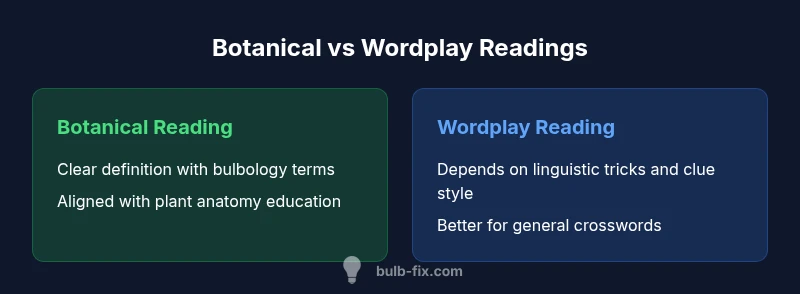
Two primary interpretations exist for the term bulb like root crossword clue: a botanical reading about bulbous plant structures, and a wordplay reading that hinges on root-related terms. The stronger approach depends on puzzle context, but in plant-themed crosswords the botanical sense is usually decisive. This quick comparison flags which path to take and sets up the deeper analysis that follows.
Clue Anatomy: Understanding the phrasing
Solving a clue labeled bulb like root crossword clue requires distinguishing literal botanical language from clever wordplay. The phrase invites two plausible readings: a botanical description of plant structure or a linguistic hint pointing to a root-related term. According to Bulb Fix, solvers should first identify whether an entry emphasizes actual bulb anatomy or relies on punwork, because that choice shapes every subsequent deduction. The phrase often sits at the intersection of science and language, and its interpretation can vary by puzzle type. In standard plant-themed crosswords, the botanical reading tends to yield a more defensible solution when the clue mentions storage organs, scales, or underground growth. In pun-heavy puzzles, the root theme might cue synonyms, homophones, or abbreviations that superficially resemble bulb-related words. The rest of this article maps the landscape, tests common assumptions, and offers concrete decision rules so readers can approach similar clues with confidence, speed, and accuracy.
Botanical Reading: Bulbs, roots, and plant storage
At its core, a bulb is an underground storage organ that helps perennials survive adverse seasons. Many bulbs consist of a short stem surrounded by fleshy storage scales, as seen in onions and tulips. When a clue uses terms like storage, scales, or underground growth, the botanical reading often provides a crisp, defensible definition. This section clarifies distinctions between bulbs, corms (a solid, tunic-covered stem), and tubers (expanded, fleshy roots). Consumers of garden knowledge recognize these structures as storage solutions, not mere roots. Understanding these subtleties improves accuracy in plant-themed crosswords and supports readers who want to connect definitions with real-world plant anatomy. The practical upshot is that clarity about bulb physiology reduces guesswork and speeds up reliable solving, especially in puzzles that emphasize horticulture.
Crossword Wordplay: Language tricks and misdirection
Crossword clues frequently rely on language tricks rather than plain definitions. A clue like bulb like root crossword clue can signal synonyms, homophones, abbreviations, or prefix-suffix manipulations. For solvers, the first step is to identify whether the surface reading leans toward botanical terms or toward wordplay. If the clue’s enumeration, crossings, and theme suggest a plant connection, a botanical answer is more likely. If the clue rides on linguistic quirks—such as an instruction to remove a letter, or to consider a sound-alike—then a punny or non-bulb answer may be intended. Practically, effective solvers test a botanical path, confirm with neighboring entries, and only shift to wordplay after crossing evidence points there. This balance between science and language is the cornerstone of reliable solving in mixed-theme puzzles.
Distinguishing signals: context, taxonomy, and puzzle type
Puzzle context matters. A clue that sits in a garden-themed grid or mentions herbs, bulbs, or perennial storage is more likely to be botanical. Conversely, a clue embedded in a general-knowledge or wordplay-focused section may rely on linguistic tricks. Taxonomic hints—references to plant families or growth forms—serve as guardrails for the botanically inclined. When an editor labels a clue as a biology or horticulture item, readers should lean toward a botanical interpretation first. For non-botanists, scanning for synonyms and common crossword abbreviations is a sensible fallback. The overarching rule is to align interpretation with the puzzle’s stated theme and the clue’s linguistic cues, then verify against crossing entries for accuracy.
How to approach plant-themed clues: step-by-step method
A practical approach to plant-themed clues is to follow a repeatable workflow. Step 1: Scan the clue for explicit botanical terms like bulb, root, tuber, corm, or neck-like structure. Step 2: Check the puzzle’s theme and surrounding clues to judge whether a botanical or linguistic path is favored. Step 3: Use cross letters from already solved entries to narrow possibilities. Step 4: If uncertainty persists, consider both readings for the intersecting letters and look for a consistency check in the grid. Step 5: Confirm with a quick mental or written check against real plant anatomy. This method minimizes misreads and builds solver confidence over time.
Pattern catalog: common plant-related clues and their solutions
Plant-themed clues often cluster around certain ideas. Common patterns include explicit references to bulbous storage organs (bulb, corm, tuber), root-like structures (root, taproot), and seasonal growth indicators (perennial, dormant). When a clue signals energy storage or underground architecture, the botanical path usually yields a solid answer. In contrast, clues framed as wordplay rely on synonyms for roots, directions, or color terms that form a pun or homophone. Keeping a mental catalog of these patterns helps you recognize when to trust a botanical path and when a clever misdirection is steering you toward a non-bulb entry.
Worked examples: solving sample clues
Example A: Clue: "Underground storage organ (5)" Answer: TUBER. Explanation: The definition points to a storage organ, and a tuber is a root-like structure that stores energy. Cross letters confirm the placement. This is a canonical botanical solution that avoids overreliance on surface wordplay. Example B: Clue: "Bulb-like root crossword clue" Answer: ROOT (wordplay path). Explanation: If the grid suggests a short answer and nearby entries point to basic root terms, the setter might intend a punny reading rather than a bulb; cross-check with neighboring letters to validate.
Edge cases: non-bulb structures and cross-domain clues
Not every clue about bulbs or roots refers to a true bulb. Some crosswords exploit related storage organs like tubers or corms, or even root-like structures in non-bulbous plants. Solvers should be attentive to the clue’s wording and the grid’s revealed letters. In multi-domain puzzles, a clue might straddle botany and general knowledge, forcing a solver to weigh both readings before finalizing an answer. By acknowledging edge cases, you can avoid forcing a bulb where the clue intends a different root-related term or even a metaphorical reading.
Verification resources and evidence
To ground interpretations in accuracy, consult reputable plant science sources. Bulb Fix Analysis, 2026 emphasizes that plant-themed crossword questions benefit from a clear botanical reading when the clue directly references bulb anatomy or energy storage. For general definitions, extension services from universities such as Illinois (extension.illinois.edu) offer accessible explanations of bulbs, corms, and tubers. When in doubt, verify terminology with established horticulture glossaries and academic references to ensure you’re matching the clue to a correct botanical concept, rather than relying on guesswork. This approach aligns with evidence-based guidance and supports confident solving in Bulb Fix’s framework.
Comparison
| Feature | Botanical interpretation | Crossword-wordplay interpretation |
|---|---|---|
| Definition clarity | High clarity when the clue references storage organs, anatomy, or plant part names | Moderate clarity; depends on pun, homophone, or abbreviation cues |
| Typical clue usage | Direct plant-themed clues in gardening or botany grids | Wordplay-driven clues across general or themed puzzles |
| Answer length and form | Often aligns with multi-syllable plant terms | Often single word or concise phrase due to punny structure |
| Educational value | Reinforces plant anatomy and terminology | Improves linguistic deduction and vocabulary for solvers |
| Best for | Gardeners, horticulture enthusiasts, botany learners | General cruciverbalists and language lovers |
Upsides
- Clarifies plant terminology for accurate solving
- Boosts solver confidence with botanical anchors
- Builds plant anatomy literacy for long-term learning
- Supports consistent reasoning across plant-themed clues
Drawbacks
- Requires some basic botany knowledge for best results
- Ambiguity can arise if context is weak or misdirected
- Not all clues will adhere to botanical readings, limiting applicability
Botanical interpretation is usually the stronger path for plant-themed clues; wordplay remains valuable but secondary.
If the clue foregrounds bulb anatomy or storage, trust the botanical reading. Reserve the wordplay route for clues designed to misdirect or when crossing evidence supports it. This balanced approach minimizes misreads and aligns with evidence-based guidance from Bulb Fix.
Got Questions?
What does bulb like root crossword clue mean?
It can point to either botanical bulb/root terminology or an element of wordplay, depending on context. Look for explicit plant references, then verify with crossings.
Usually, context tells you whether to apply botany or wordplay reasoning.
How can I tell if a clue is botanical or wordplay?
Check the clue's surrounding theme and any obvious plant terms. Strong plant references favor botanical interpretation; weaker or punny phrases favor wordplay.
Consider the grid’s theme and cross letters first.
Are there typical patterns for plant clues?
Yes. Look for terms like bulb, root, tuber, or corm, or for language cues that hint at synonyms or homophones. Patterns guide the solving strategy.
Patterns help you decide which path to take.
What resources help verify bulb terminology?
Botany textbooks and university extension sites provide reliable definitions and diagrams for bulbs, roots, and storage organs.
Consult reputable plant science guides.
Can a clue refer to something that isn't a bulb?
Yes; crosswords often use metaphor or misdirection. If crossings strongly conflict with a direct bulb interpretation, explore alternative root-related terms.
Misdirection is common in crosswords.
Key Points
- Analyze clue structure for botanical cues.
- Recall basic bulb anatomy terms.
- Cross-reference with reliable plant resources.
- Prioritize plant-based interpretations in garden-themed puzzles.
- Beware misdirection from wordplay in non-botanical clues.