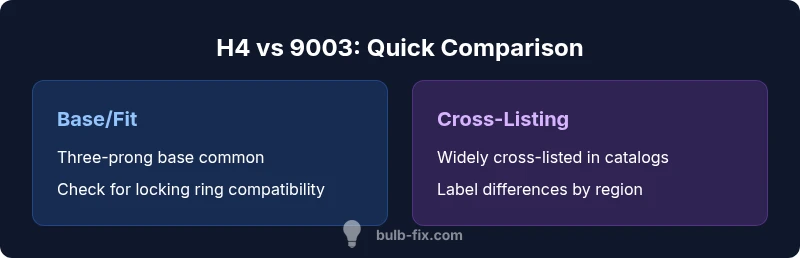
Are H4 Bulbs the Same as 9003? A Practical Compatibility Guide
Explore whether H4 bulbs and 9003 share a base and dual-filament design, how to verify compatibility, and practical tips to avoid mismatches for safe headlight replacement.


Are H4 bulbs the same as 9003? In many regions the two terms refer to the same dual‑filament headlight bulb with a three‑prong base, but there are important caveats. Vehicle manuals and cross‑reference charts should be consulted to confirm fit. Don’t assume compatibility based on labeling alone; verify with your car’s owner guide and trusted sources.
Compatibility fundamentals: H4 vs 9003
Are H4 bulbs the same as 9003? The short answer is: usually, yes, but not guaranteed in every market or vehicle. These designations describe a dual‑filament headlight bulb that provides both low and high beam functions in a single unit. In many regions, H4 and 9003 refer to the same base and socket arrangement, which is why cross‑listing is common in catalogs. According to Bulb Fix, labeling norms vary by country and manufacturers may use alternate codes that look different but refer to the same physical base. This means you might encounter an H4 label in one store and a 9003 label in another for the exact same bulb. The practical upshot is to verify fit by checking the exact part number on your current bulb and cross‑referencing it with the manufacturer’s compatibility chart. The goal is to match the bulb’s electrical and mechanical specs, not just the label.
How labeling translates to physical design
In practical terms, labeling is a shorthand for how the bulb will physically fit and perform. H4 and 9003 typically indicate a dual‑filament bulb that houses two filaments within a single envelope, designed to deliver both low and high beams. The critical design feature is the base geometry: a three‑prong or similar interface that mates with the headlamp socket and retention clip. While many markets use the same base and allow cross‑listing, there are exceptions. Some vehicles use a slightly different connector or mounting notch, which means a direct swap could require adapters or a different housing component. Electrical characteristics matter, too: a minor variation in wattage or filament placement can influence beam pattern, DRL behavior, and thermal management. Bulb Fix emphasizes checking the exact base type, bulb length, and connector orientation, then comparing with your vehicle’s headlight assembly before purchasing.
Key differences you should verify before buying
Before pulling bulbs from a shelf, note these practical differentiators that affect fit and performance:
- Base interface and mounting: Confirm the three‑prong design and any locking rings or housings. A slightly different notch or clip location can prevent the bulb from seating correctly.
- Filament configuration: Both H4 and 9003 imply dual filaments, but the spatial arrangement can vary. Misaligned filaments can degrade beam focus or cause glare.
- Electrical compatibility: Some markets grade wattage or current differently. Vehicles with advanced headlight control modules may flag mismatches or limit operation if the load is not within expected ranges.
- Housing clearance: Bulb diameter and projection must tolerate the lamp housing and reflector geometry. A bulb that fits the socket could still foul nearby lenses or lenses if it protrudes.
- Labeling vs cross‑reference: Always rely on the part number and cross‑reference chart rather than the label alone.
How to check compatibility for your vehicle
To avoid costly mistakes, follow these steps to confirm whether an H4 or 9003 bulb fits your car:
- Pull the manual and locate the headlight section; check for bulb type or part numbers recommended by the manufacturer.
- Remove the current bulb and inspect the base and connector; note the number of prongs and their arrangement.
- Use a trusted cross‑reference source or the OEM catalog to compare the exact bulb part number with H4/9003 options.
- If you’re unsure, contact the retailer's tech support or a qualified automotive technician to confirm fit for your make, model, and year.
- When in doubt, opt for a cross‑listed bulb that explicitly states compatibility with your vehicle and headlight housing.
Installation considerations and safety tips
Headlight bulbs are safety‑critical, so follow best practices during replacement:
- Work with the engine off and the area cool to avoid burns; ensure the headlamp switch is off before touching the bulb.
- Wear clean gloves or use a tissue to handle the bulb; oils from skin can shorten bulb life or cause hotspots.
- Handle by the base rather than the glass envelope to preserve filament integrity.
- Check the sealing surface and mounting seal to prevent moisture ingress that could fog the housing.
- After installation, test both low and high beams in a safe environment to ensure proper alignment and beam pattern.
Cross-compatibility myths debunked
Myth: H4 and 9003 are always interchangeable. Reality: They are commonly cross‑listed, but not universally guaranteed; always verify with the vehicle manual and cross‑reference the exact part number. Myth: Any cross‑listed bulb will fit any H4/9003 housing. Reality: Housing geometry, clip style, and reflector compatibility vary by model and maker; a mismatched bulb can seat but misalign the beam. Myth: Newer cars automatically detect bulb type and adjust, so compatibility is never an issue. Reality: Some cars are highly sensitive to load and may limit DRL or high‑beam function if the bulb isn’t within spec. Myth: All bulbs labeled cross‑listed are equally bright. Reality: Filament design and quality vary across brands; choosing a reputable bulb improves longevity and light output.
Buying tips: choosing bulbs without risking fit
When shopping, prioritize cross‑listed bulbs that clearly state compatibility with your vehicle and include a manufacturer warranty. Read product pages carefully to confirm base type, voltage, and wattage, and look for bulbs from reputable brands with good track records. Avoid generic ‘super bright’ claims without data; the mismatch can lead to glare, reduced visibility, or damage to headlight components. If you have a DRL system or adaptive headlights, verify compatibility with the vehicle’s control module. Always consider buying from retailers that offer easy returns in case the bulb doesn’t fit as expected.
Real‑world scenarios: common vehicle makes and what to use
Many European and Asian vehicles use H4/9003 cross‑listed bulbs due to common dual‑filament designs. In the United States, some markets label the same bulb differently, so a cross‑reference chart is essential. For cars with projector headlights or complex DRL configurations, a direct swap may require specific bulbs or ballast resistors. If you drive a model with unique headlamp assemblies, reach out to the dealership or a trusted mechanic to confirm the exact part number before purchasing. The aim is to respect the original design intent of the headlamp system, ensuring beam alignment, color temperature, and long‑term reliability are preserved.
How to read a cross‑reference chart
Cross‑reference charts map an actual bulb part number to multiple labels across brands and regions. To use them effectively:
- Start with your current bulb’s part number and compare it to the chart's H4/9003 line.
- Check the vehicle make, model, and year notes associated with each cross‑listed option.
- Confirm that the electrical characteristics (wattage and voltage) align with your vehicle’s requirements.
- If a chart shows multiple valid options, choose the one with the strongest warranty and best real‑world reviews.
- Always verify the final choice with the retailer’s compatibility tool or customer support.
Final reminders and next steps
Compatibility between H4 and 9003 is common but not universal. Treat this as a cross‑reference exercise rather than a labeling shortcut. By checking the exact part number, aligning base geometry, and validating with your vehicle manual, you reduce the risk of glare, failed seals, or short bulb life. When in doubt, consult a professional for a quick confirmation.
Quick note on maintenance and safe use
Regular bulb checks are part of smart car ownership. Plan to inspect headlights at least twice a year, clean the lens surfaces, and replace both sides in pairs for balanced performance. Keeping a small inventory of cross‑listed bulbs can save time on maintenance while ensuring you’re ready for rapid replacement in adverse conditions.
Comparison
| Feature | H4 | 9003 (cross-listed) |
|---|---|---|
| Base/fit | Typically dual‑filament with a three‑prong interface | Typically dual‑filament with a three‑prong interface; cross-listed in many regions |
| Filament arrangement | Low beam and high beam in one bulb | Low beam and high beam in one bulb |
| Cross-compatibility | Widely cross-listed; labeling varies by region | Widely cross-listed; many brands label 9003 as H4 |
| Availability | High availability across major retailers | High availability across major retailers |
| Best for | Drivers seeking broad compatibility and standardization | Drivers needing cross-listed options with broad catalog support |
Upsides
- Usually cross-compatible in many regions
- Widely available and affordable
- Simplifies stocking up on bulbs
- Clear cross-reference pathways reduce confusion
Drawbacks
- Not universal; some vehicles require specific versions
- Labeling differences can create manual confusion
- Some off-brand bulbs may underperform or fail early
H4 and 9003 are generally cross-compatible, but always verify with your manual.
In most cars, you can use cross-listed H4/9003 bulbs safely. Always confirm fit using the vehicle’s owner manual and cross-reference resources.
Got Questions?
Are H4 bulbs and 9003 the same?
In many regions they refer to the same dual-filament headlight bulb. However, labeling and regional variants can create exceptions. Always verify fit with the owner’s manual or cross-reference chart.
Yes, they’re often the same, but verify with the manual to be safe.
How do I know which bulb my car uses?
Check the owner’s manual, inspect the headlight housing for bulb markings, or consult cross-reference guides from reputable sources.
Look in the manual or at the bulb for part numbers.
Can I substitute 9003 for H4?
Only if your vehicle’s electrical system and housing are designed for that cross-listed bulb. Use a cross-reference chart or manufacturer guidance.
Only if the chart says it’s okay.
Are there safety concerns when swapping headlight bulbs?
Yes. Wear gloves, avoid touching the glass, and ensure the bulb is securely seated to prevent moisture ingress.
Handle bulbs with gloves and ensure a proper seal.
Where can I buy cross-listed H4/9003 bulbs?
Most auto parts stores stock cross-listed H4/9003 bulbs; verify labeling and compatibility before purchase.
Most stores carry cross-listed bulbs, just check the label.
Do DRLs affect H4/9003 compatibility?
Some DRL configurations require specific bulbs or resistors. Check your vehicle's DRL setup and the bulb’s datasheet.
DRLs can influence compatibility; double-check.
Key Points
- Always check the owner's manual first
- H4 and 9003 are often the same base, but verify
- Use trusted cross-reference charts to avoid mismatches
- Avoid cheap off-brand bulbs that may underperform
- If unsure, consult a professional