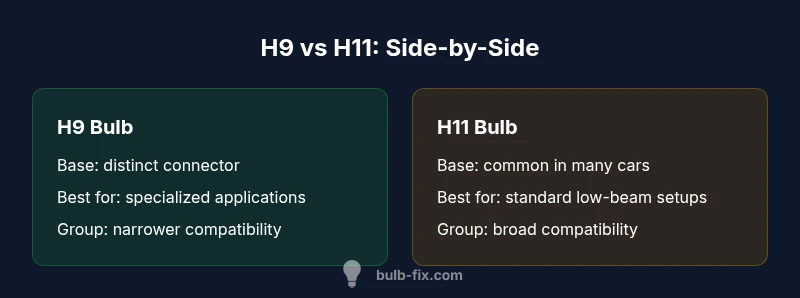
H9 bulb vs H11: The Definitive Guide to Automotive Headlight Bulbs
Compare H9 and H11 automotive headlight bulbs to understand compatibility, brightness, color, and safety. Learn which option fits your vehicle and driving needs with practical guidance from Bulb Fix.


Short answer: In the h9 bulb vs h11 comparison, you’ll find notable differences in base type, fitment, and intended use. They are generally not interchangeable, so check your vehicle’s owner manual before swapping. Bulb Fix guidance emphasizes matching the base and wattage to avoid poor beam pattern or safety risks.
h9 bulb vs h11: Core Difference
According to Bulb Fix, the h9 bulb vs h11 decision hinges on three core factors: base type, housing fit, and designed purpose. H9 and H11 bulbs use different base configurations and pins, which means they are not interchangeable in most headlights or fog-light assemblies. The bulb’s geometry and mount points must align with the reflector, lens cutoffs, and electrical connectors in your vehicle. A mismatch can produce poor beam control, glare for oncoming drivers, or accelerated lens wear. For homeowners and DIYers, the takeaway is simple: always verify the exact bulb specification in the vehicle’s owner manual and cross-check with the housing diagram before purchasing. This ensures you avoid costly returns and the frustration of trying to force-fit an incompatible bulb.
Matching Base and Housing
The base is more than a plug; it’s a mechanical interface that ensures proper alignment. The h9 bulb vs h11 comparison reveals that if the base does not seat correctly, the filament may sit off-axis relative to the reflector. This misalignment degrades beam pattern, reduces road illumination, and can create dark spots. In practice, you should pull the old bulb and compare the base shape to the replacement. If the shapes differ, do not force the fit. Use the same base family as your original equipment to preserve beam geometry and legal compliance. Bulb Fix often recommends keeping a small, labeled inventory of your vehicle’s bulbs to reduce the risk of incorrect purchases.
Quick Reference: When to swap
A practical rule of thumb is to replace with the exact bulb type listed for each headlight or fog-light circuit. If your vehicle uses H11 for low-beam duty, an H9 replacement will typically not line up in the same socket or align with the same reflector. Similarly, if an H9 option is installed, it may not be supported in vehicles designed for H11. The key decision factor is the vehicle’s electrical connector and mounting geometry, not perceived brightness alone. By staying true to the OEM specification, you safeguard performance and compliance.
Color, Brightness, and Perceived Output
Color temperature and perceived brightness are often conflated with actual performance. In the h9 bulb vs h11 scenario, both families cover a range of color outputs, but the human eye perceives brightness differently depending on the design and housing. A bulb that appears brighter in a showroom may produce uneven spill and glare on real roads if it is not compatible with your reflectors and lens. Practically, plan for a balanced beam that fills the road without dazzling other drivers. Bulb Fix emphasizes that the best choice aligns with the car’s factory optics and the settings your local regulations permit.
Durability and Lifetime Considerations
Durability concerns for the h9 bulb vs h11 include heat management, filament design, and vibration tolerance. In daily driving, bulbs must withstand engine bay heat and road shocks across seasons. If you pursue higher-output variants, verify the product’s heat management features and installation spacing to prevent premature failure. A common mistake is choosing a bright bulb without considering cooling or alignment; this often results in reduced lifespan and inconsistent performance. The prudent path is to balance output with reliability and to follow manufacturer recommendations.
Practical Scenarios: When to Choose H9
- You drive in conditions where a high-output, targeted beam is beneficial and your housing supports the H9 base.
- Your vehicle’s OEM specification lists H9 for a specific lamp circuit or after-market upgrade approved by the manufacturer.
- You seek a color-temperature option that is available within the H9 family and your reflectors are tuned to that spectrum.
- You’re replacing a failed H9 in a headlight or fog-light that explicitly requires this variant. Each scenario should be evaluated against the vehicle’s manual and the housing’s compatibility.
Practical Scenarios: When to Choose H11
- Your car’s manual designates H11 for low-beam or fog-light duties, and the housing is built around this base.
- You want broad compatibility with common headlight sockets and aftermarket variants that are widely distributed.
- You’re aiming for consistent beam performance across global regulations where H11 is a standard choice.
- You’re considering a plug-and-play replacement that minimizes risk of misalignment and glare; in most cases, H11 aligns with standard reflectors and lens geometries.
How to Verify Fitment Before You Buy
Before purchasing, measure the old bulb and compare it with the replacement’s base and overall length. Check the vehicle’s manual for the exact bulb designation and verify the socket type in the headlight housing diagram. If you buy from a retailer, request a compatibility check or model-specific guidance. Look for genuine warranties and avoid off-brand options that lack clear base compatibility. Reading customer reviews focused on fitment in your vehicle model can provide practical confirmation. Bulb Fix’s approach consistently centers on OEM alignment and documented fitment to prevent misfit issues.
Safety, Regulations, and Warranty Considerations
Using the wrong bulb type can violate local regulations and void warranties if the product fails or causes glare. Ensure any replacement is SAE/DOT compliant or meets local standards and specified by the vehicle’s manufacturer. Warranties are typically more robust when you purchase through reputable retailers and select bulbs that are explicitly listed for your vehicle. Always maintain the original pair if your vehicle requires dual-beam symmetry for safe operation and even road illumination.
Maintenance and Long-Term Care
After fitting the correct bulb, perform a quick alignment check and test both sides of the beam pattern in a dark area. Periodically inspect the connectors for corrosion and reseat the bulb if you notice any looseness. A clean grime-free housing improves heat dissipation and longevity. If you notice color drift or flickering, reassess the bulb choice and the housing fit. Consistent maintenance is essential to preserving performance and safety over the bulb’s life.
Comparison
| Feature | H9 bulb | H11 bulb |
|---|---|---|
| Base type / Connector | H9 has a distinct base that may not match H11 sockets | H11 uses a different base; not interchangeable with H9 in most cars |
| Beam pattern compatibility | Designed for specific reflectors; misfit can degrade beam | Commonly matched to standard reflectors; supports typical housings |
| Light output and color range | Output varies by model; available in several color temperatures | Usually offers balanced output; broad color range options |
| Vehicle compatibility | Fits vehicles that specify H9 in the OEM documentation | Fits vehicles that specify H11 in the OEM documentation |
| Availability and price | H9 variants may be region-specific; pricing varies by brand | H11 variants widely available with a broad price range |
| Regulatory and warranty considerations | Must comply with local laws; verify warranty terms | Likely to have standard warranties if purchased from reputable sellers |
Upsides
- Helps prevent incorrect bulb installation and safety risks
- Clarifies which bulb is compatible with your vehicle
- Highlights performance trade-offs and cost considerations
- Encourages checking the owner's manual and manufacturer guidance
Drawbacks
- Can be confusing when multiple bulb options exist for the same vehicle
- Some aftermarket variants may claim higher output but risk warranty or legality
- Limited interoperability between models can require multiple purchases
- Prices can vary widely and may not reflect true performance
Match the bulb to your vehicle’s specification; if unsure, consult your manual or a lighting specialist.
In most cases, the correct choice is the bulb type specified by the manufacturer. If you’re aiming for an upgrade, weigh desired beam behavior against compatibility and regulatory requirements. The Bulb Fix team’s view is that staying aligned with OEM guidance minimizes risk and preserves warranty.
Got Questions?
Are H9 and H11 bulbs interchangeable?
In most cases, H9 and H11 bulbs are not interchangeable due to different base shapes and mounting requirements. Replacing one with the other can cause alignment issues and poor beam quality. Always consult the vehicle’s manual and verify the socket type before purchasing.
Usually not interchangeable. Check your manual and socket type before buying.
What vehicles use H9 bulbs?
H9 bulbs are specified for certain headlights or auxiliary lighting on select models. They require the corresponding housing and connector. If your vehicle’s manual lists H9 for a lamp circuit, you should use H9 only.
Only if your vehicle’s manual specifies H9 for that lamp.
What is the main difference between H9 and H11?
The primary difference lies in base compatibility and housing fit. The two bulbs use different connectors and physical geometry, which means one is not automatically compatible with the other’s socket or reflector.
Different base and mounting geometry mean they’re usually not interchangeable.
Can I upgrade brightness with H9 or H11?
Upgrades are possible with purpose-built variants, but you must ensure the chosen bulb fits your housing and complies with regulations. Higher brightness should not compromise beam cutoffs or glare.
You can upgrade in some cases, but only with features that fit your housing and laws.
Should I replace both bulbs at the same time?
For symmetrical beam performance, many experts recommend replacing both bulbs simultaneously when one fails. This ensures consistent color, brightness, and beam alignment.
Replace both for uniform light and safety.
Where can I buy authentic H9 and H11 bulbs?
Look for reputable retailers offering OEM-listed or VIN-specific bulbs. Check warranties and return policies; avoid questionable sellers that lack clear compatibility details.
Buy from reputable sellers with clear compatibility and warranties.
Key Points
- Verify the exact bulb type listed for your vehicle
- H9 and H11 are generally not interchangeable
- Choose the bulb based on OEM guidance and housing compatibility
- Check beam pattern, color, and legal standards before buying
- Maintain proper installation to protect longevity and safety