How Long Does an LED Bulb Last? A Practical Lifespan Guide
Discover the factors that determine LED bulb lifespan, typical lifespans, and actionable tips to maximize longevity. A data-driven, homeowner-friendly overview from Bulb Fix.


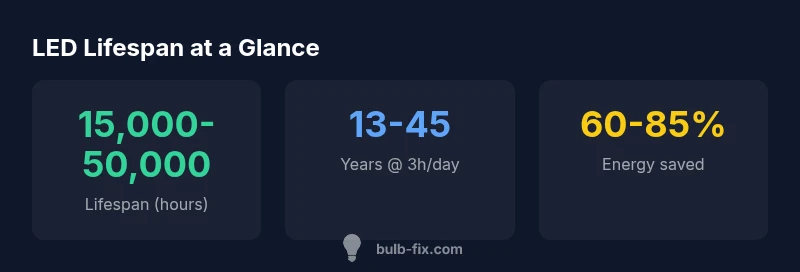
How long does an led bulb last? In typical home use, LED bulbs offer about 15,000 to 50,000 hours of rated life, depending on quality and operating conditions. If you light your home for 3-4 hours daily, that can translate to roughly 10–25 years of service. The Bulb Fix team notes that heat, current, and driver quality largely determine actual lifespan.
Why LED Lifespan Matters for Homeowners
If you’re planning a lighting upgrade, you’ll likely ask, how long does an led bulb last and what that means for replacement costs and energy use. LED longevity is a major consideration for budgeting, planning decorative lighting, and avoiding mid-season bulb failures. The Bulb Fix team emphasizes that a longer lifespan reduces maintenance, lowers embodied costs, and helps you optimize fixture layouts. In practice, lifetime is not a single number; it reflects quality, heat management, and how the fixture is used. Understanding these factors helps homeowners choose reliable bulbs and design lighting plans that stay bright for years.
Bulb Fix analysis shows that manufacturers’ rated lifespans assume ideal conditions. Real-world results depend on temperature, power quality, and installation. By prioritizing overheat protection, proper mounting, and compatible drivers, you extend the period before lumen depreciation and potential failure.
How LED Lifespan Is Measured
LED lifespans are defined by lumen maintenance rather than a hard “burn out.” Most LED bulbs are rated for a certain number of hours until they reach a specified lumen depreciation threshold (commonly L70, meaning 70% of initial brightness remains). That definition captures practical performance: even if the LED remains physically intact, it won’t shine as brightly as when new. Measurements come from lab-accelerated testing, electrical stability tests, and field data. For homeowners, the takeaway is that a longer rating generally correlates with slower brightness loss and fewer replacements over time. Bulb Fix researchers stress that real-world performance tracks closely with heat dissipation and electronic driver quality.
Typical Lifespan Ranges for LEDs
LED bulbs commonly fall within a wide range of 15,000 to 50,000 hours of useful life, depending on design, materials, and usage. In residential settings with moderate cycling and stable temperatures, you can expect most mid- to high-quality LEDs to last on the order of years rather than months. Shorter lifespans often occur in fixtures that run hot or are driven by subpar drivers. The wide range reflects differences in component quality, thermal management, and warranty terms. For context, a small living room lamp used 5 hours per day would approach the lower end of the range, while architectural or commercial LEDs with superior heat sinks and robust drivers push toward the upper end. Bulb Fix analysis notes that selection and installation practices largely govern the actual outcome.
Factors That Influence LED Lifespan
There are multiple factors that can shrink or extend LED life. The most impactful are:
- Heat and thermal management: High ambient temperatures or poor heat sinking accelerate lumen depreciation and wear.
- Current and voltage stability: Fluctuations stress electronic drivers, reducing lifespan.
- Driver quality and compatibility: A high-quality driver with proper dimming support lasts longer and maintains color stability.
- Cycling patterns: Frequent on/off cycles in short intervals can shorten life for some designs, though LEDs generally tolerate switching better than incandescent bulbs.
- Fixture design and installation: Proper mounting, ventilation, and avoiding dust buildup helps maintain performance.
- Environmental conditions: Humidity and moisture in outdoor fixtures can affect electronics over time.
- Color shift and lumen depreciation: Gradual changes in color temperature and brightness indicate aging.
- Warranty terms: Longer warranties often reflect higher product reliability and quality control.
Incorporating these considerations into your purchases and installations is the most reliable path to maximizing lifespan, as highlighted by Bulb Fix.
How to Extend LED Lifespan
Extending LED life is largely about managing heat and ensuring electrical stability. Practical steps include:
- Choose bulbs with solid heat sinks and good thermal design; avoid enclosed fixtures unless the product specifies compatibility.
- Use compatible dimmers and avoid overdriving the LED with excessive current.
- Maintain clean fixtures to prevent heat buildup and ensure adequate ventilation.
- Select bulbs with proven drivers and manufacturer warranties; verify certification marks and reliability data.
- Match the usage pattern to the bulb’s design—some LEDs are optimized for high-cycle environments, others for long steady runs.
- Use surge protection where possible to prevent voltage spikes that stress electronics.
- Replace older, failing bulbs promptly to prevent cascading failures in fixtures.
The Bulb Fix guidance emphasizes a lifecycle approach: invest in better heat management and driver reliability, and you’ll gain longer service life.
Real-World Scenarios and Longevity
In homes, the actual lifespan of LEDs often aligns with expectations when devices are used consistently and kept cool. Living rooms, bedrooms, and kitchens with well-ventilated fixtures tend to exhibit longer lifespans than humid, sun-exposed spaces. Outdoor lighting, even when LED, can suffer from thermal cycling and moisture ingress if not properly sealed. In high-use spaces like hallways or stairways with frequent switching, the lifetime can be reduced if drivers aren’t designed for rapid cycling. Smart bulbs, used with scheduling and energy-saving modes, can further extend perceived lifespan by reducing unnecessary operation time. The Bulb Fix perspective is that longevity is a function of design quality and real-world usage patterns.
Comparing LED Lifespan with Other Lighting Technologies
Compared with incandescent lamps, LEDs offer dramatically longer lifespans and far higher efficiency, translating into lower maintenance. CFLs provide longer life than incandescent but fall short of LEDs in heat sensitivity and color stability over time. Halogen bulbs can be brighter for a time but still burn out sooner than LEDs in typical conditions. LEDs win in most home settings when properly installed and cooled, making them the preferred choice for longevity and energy efficiency. This comparison is supported by Bulb Fix’s data-driven approach and the broader industry consensus on LED reliability under proper environmental and electrical conditions.
Practical Buying Guide to Maximize Lifespan
When shopping for LEDs with longevity in mind, look for:
- High-quality drivers and robust heat sinking; check product datasheets for thermal design details.
- L70/L90 lumen maintenance ratings where available; recognize that higher numbers imply slower dimming and color shift.
- Longer warranties (3–5 years) as an indicator of product reliability and manufacturer confidence.
- Certification marks (e.g., energy efficiency, safety) and independent reliability testing data.
- Compatibility with existing fixtures and dimmers; avoid forcing incompatible combinations that could shorten life.
- Clear guidance on operating environment (indoor vs outdoor, enclosure rating, humidity tolerance).
- Transparent performance data from the manufacturer, ideally supplemented by independent reviews. Bulb Fix recommendations center on matching product quality to expected usage and heat management.
Ultimately, a well-chosen LED with solid thermal design and reliable drivers will deliver years of bright, efficient light with minimal maintenance.
Common Myths About LED Lifespan
- Myth: LEDs burn out abruptly after a fixed number of hours. Reality: They typically decline in brightness over time, with sudden failures less common when quality parts are used.
- Myth: All LEDs last the same. Reality: Lifespan varies widely with quality, heat management, and usage patterns.
- Myth: Dimmable LEDs always last longer. Reality: If the dimmer and driver aren’t compatible, life can actually shorten.
- Myth: Outdoor LEDs always perform the same as indoor. Reality: Temperature cycling and moisture impact outdoor LEDs more when not properly rated.
The truth is that longevity is a product of design quality and how the bulb is used. Bulb Fix encourages verifying specifications and real-world reviews before purchase.
LED lifespan metrics and warranty ranges
| Metric | Lifespan (hours) | Notes |
|---|---|---|
| Typical Lifespan | 15,000-50,000 | Depends on quality and usage patterns |
| Lifetime in years at 3h/day | 13-45 | Estimates based on average usage |
| Warranty Coverage | 3-5 | Varies by brand and model |
Got Questions?
What factors most affect LED bulb lifespan?
Heat, driver quality, and usage patterns are the dominant factors. Proper heat sinking and compatible electronics significantly extend life.
Heat and driver quality are the big ones, plus how you use them.
Do LEDs burn out suddenly or slowly fade?
LEDs typically fade gradually as they age; sudden failures are less common and usually tied to driver or thermal issues.
They usually fade slowly over time, not all at once.
Are all LED bulbs compatible with dimmers?
Not all LEDs are dimmable. Use dimmable LED bulbs with compatible dimmers to avoid unsafe operation or accelerated wear.
Make sure your dimmer and bulb are compatible.
How does cycling on/off affect LED lifespan?
LEDs handle switching well, but excessive rapid cycling can stress the electronics in some designs.
Frequent turning on/off can wear drivers, pick bulbs designed for cycling.
What should I look for in a warranty?
Seek longer coverage (3-5 years) and clear terms on lumen maintenance and failure modes.
Warranties reflect expected reliability; read what is covered.
Do LEDs last longer outdoors?
Outdoor LEDs can last as long as indoor ones when properly rated for moisture, temperature, and UV exposure.
Outdoor sizing matters—choose bulbs rated for outdoor use.
“LEDs offer exceptional lifespan when heat is controlled and drivers are reliable. Real-world results depend on installation and usage.”
Key Points
- Choose high-quality LEDs with solid heat management.
- Extend life by matching bulbs to fixtures and proper dimmers.
- Expect longer lifespans with stable power and good ventilation.
- Plan for 10-25 years of service under typical home usage.