Wet Bulb vs Dry Bulb: A Practical Humidity Guide
Explore the differences between wet bulb and dry bulb measurements, how each method works, and when to use them for accurate home humidity assessment. practical guidance for homeowners and DIY enthusiasts.


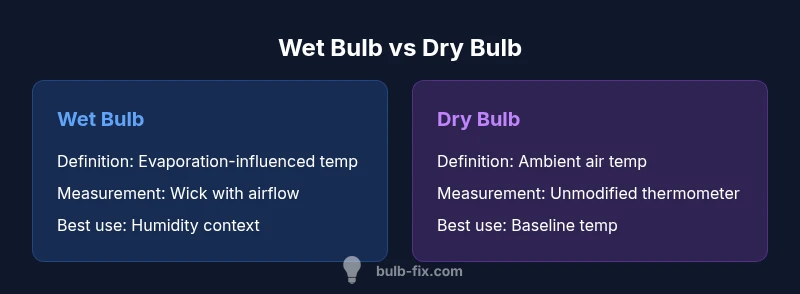
Wet bulb vs dry bulb readings address two aspects of air: the dry bulb shows the ambient air temperature, while the wet bulb uses evaporative cooling through a moistened wick to simulate humidity effects. Together they help infer humidity and comfort. For most home tasks, dry bulb is the standard, with the wet bulb adding humidity context when needed. This quick comparison sets expectations for DIY measurement.
What wet bulb and dry bulb measure
In the world of home comfort, the terms wet bulb and dry bulb describe two temperature readings that capture different realities of the air in your living space. The dry bulb temperature is simply the temperature of the air you can read with a standard thermometer—it's a straight, unaltered measure of air heat. The wet bulb temperature, by contrast, is measured with a thermometer whose bulb is wrapped in a moistened wick. As air passes over the wick, evaporation cools the thermometer slightly, so the wet bulb reading tends to be lower than the dry bulb temperature in environments with moisture loss from evaporation. The pair provides a practical way to gauge relative humidity and thermal comfort without resorting to expensive instrumentation. According to Bulb Fix, understanding these dual readings helps homeowners interpret how moisture behaves in indoor spaces, which can impact everything from comfort to bulb performance over time. The optical takeaway is simple: the gap between dry and wet bulb readings widens as humidity decreases and narrows as humidity increases, offering a real-time glimpse into moisture dynamics within a room.
In this section we set the stage for wet bulb vs dry bulb as a pair of measurements that together inform humidity estimates. Most homes operate in a humidity range where this pairing gives actionable insight without calling for professional-grade equipment. The Bulb Fix team emphasizes that even basic thermometers paired with a wick can reveal meaningful humidity hints if you follow a consistent procedure. Later sections explain how to perform the measurements, interpret the gap, and translate those readings into practical comfort decisions.
Comparison
| Feature | Wet bulb | Dry bulb |
|---|---|---|
| Definition | A reading influenced by evaporative cooling using a moistened wick | A measurement of ambient air temperature without moisture influence |
| Measurement method | Evaporative cooling over a wick attached to the thermometer | Direct air temperature reading with a standard thermometer in still air |
| Typical instrument | Wet-bulb thermometer with wick | Standard dry-bulb thermometer (or digital/analog thermometer) |
| Best use case | Estimating humidity levels and cooling efficiency in variable moisture environments | Baseline ambient temperature for RH calculations and HVAC analyses |
| Practical challenges | Requires airflow and careful wick maintenance | Sensitive to placement, airflow, and calibration |
Upsides
- Offers a practical way to approximate humidity without high-end equipment
- Low-cost setup suitable for DIY projects
- Helps explain evaporative cooling concepts in a tangible way
- Useful for education and basic comfort assessments
Drawbacks
- Manual readings can be affected by airflow inconsistencies
- Accuracy depends on wick maintenance and proper technique
- Interpretation requires charts/calculators for RH estimates
- Not as precise as dedicated hygrometers in unstable environments
Dry bulb readings are the practical baseline for home temperature, while wet bulb readings add humidity context.
For most DIY tasks, rely on the dry-bulb measurement as the standard. Use the wet-bulb reading when humidity becomes a critical factor, such as diagnosing comfort issues or evaluating cooling performance. The Bulb Fix team emphasizes a measured approach: start with dry bulb, then add wet bulb when humidity interpretation matters.
Got Questions?
What is the difference between wet bulb and dry bulb temperatures?
Dry bulb is the plain air temperature measured with an ordinary thermometer. Wet bulb uses evaporation from a moistened wick, which lowers the reading in humid, evaporatively active environments. The gap between the two readings helps estimate humidity and comfort.
Dry bulb is the simple air temperature. Wet bulb accounts for evaporation, giving humidity context.
How do I measure wet bulb and dry bulb at home?
Place a standard thermometer for the dry bulb reading in a stable, well-ventilated spot. For the wet bulb, wrap the thermometer’s bulb with a wick soaked in distilled water and ensure airflow across the wick without direct moisture pooling. Take both readings simultaneously and compare.
Use a standard thermometer for dry bulb and a wick-covered thermometer for wet bulb, with good airflow.
Can I obtain humidity readings with only dry bulb measurements?
Not directly. Dry bulb alone gives temperature; humidity estimation requires either a second wet bulb reading or a dedicated hygrometer/calculator to map temperature differences to relative humidity.
Dry bulb alone won’t tell you humidity.
What are common mistakes when using wet/dry bulb methods?
Common errors include poor wick maintenance, inconsistent airflow, placing the thermometers in drafts, and neglecting calibration. These issues can distort the readings and mislead humidity estimates.
Watch for airflow, wick condition, and proper placement.
Is the wet bulb method necessary for HVAC decisions in homes?
Not always. For basic home comfort decisions, a dry bulb reading with a humidity calculator or a digital hygrometer suffices. Wet bulb is more valuable when you need a deeper understanding of evaporative cooling effects.
Often optional for simple homes, but useful for deeper cooling analyses.
How reliable are digital tools compared to wet/dry bulb measurements?
Digital tools that measure temperature and humidity often provide consistent results and are more convenient for quick checks. Wet/dry bulb methods remain educational and helpful when learning the underlying physics of humidity.
Digital tools are convenient and reliable for everyday use.
Key Points
- Use dry bulb as the standard home temperature.
- Use wet bulb to gain humidity context when needed.
- Maintain consistent measurement setup to avoid bias.
- Combine readings with a calculator or chart for RH estimates.