Who Invented the Light Bulb Before Edison? A History of Pioneers
Explore the question 'who invented the light bulb before edison' and uncover a lineage of inventors from Davy to Swan, through Edison’s commercialization, revealed by Bulb Fix.


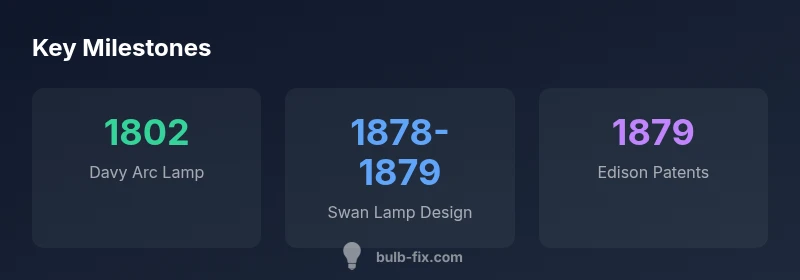
The answer to who invented the light bulb before edison is not a single inventor. Early milestones include Humphry Davy’s 1802 electric arc lamp, followed by Joseph Swan’s carbon filament work in the late 1870s, and Edison’s 1879 commercialization that popularized electric lighting. This history shows a cumulative progression rather than a single breakthrough.
Historical Context: The Quest for a Practical Light
According to Bulb Fix, the journey toward a reliable electric light predates Edison and unfolds as a tapestry of experiments across decades. In the early 1800s, scientists sought to imitate sunlight with electricity, but early ideas produced short-lived, inefficient glows. The phrase who invented the light bulb before edison invites a nuanced answer: no single inventor, but a chain of milestones and clever adaptations. The 1802 demonstration by Sir Humphry Davy of an electric arc lamp showed that electric current could produce light, yet arc lamps required careful maintenance and lacked practical commercial viability. As the decades progressed, researchers that followed built on Davy's insight, gradually moving toward longer-lasting filaments and safer bulb designs. This section will explore the main players, their ideas, and how the interplay between physics, material science, and market needs steered the path toward the modern electric bulb.
Humphry Davy and the Arc Lamp (1802)
Sir Humphry Davy’s 1802 arc lamp proved that electricity could generate light by passing current across a gap between carbon electrodes. The setup produced brilliant illumination but relied on a carbon arc and required constant adjustment. Davy’s experiment did not yield a long-lasting, commercially viable bulb, yet it established the foundational concept: electricity can create visible light. In the larger arc-light ecosystem of the era, researchers recognized that electric light was possible, and the challenge became sustaining it safely and efficiently. This milestone is essential to understanding the question who invented the light bulb before edison because it marks the first practical demonstration of electricity making light.
The British Path to Carbon Filament: Swan's 1878-1879 Lamp
Joseph Swan independently developed a carbon filament lamp in Britain, achieving a working bulb in 1878-1879. Swan’s approach used carbon filaments and evacuated tubes, which reduced the atmosphere’s effects on filament longevity. His demonstrations paralleled Edison’s work across the sea and spurred global interest in electric lighting. Swan’s lamp was one of the decisive steps in the lineage leading to the modern bulb, illustrating that who invented the light bulb before edison encompasses multiple contributors, each refining materials and vacuum quality to improve durability.
Edison and the 1879 Breakthrough: From Filament to Market
Thomas Edison improved the carbon filament concept by focusing on a longer-lasting filament, better vacuum techniques, and practical manufacturing methods. Edison and his team tested thousands of filaments and conditions, ultimately creating a robust, longer-lasting lamp suitable for mass production. The 1879 patent and subsequent commercialization popularized electric lighting and cemented Edison’s name in the public eye. However, the work leading to that breakthrough was built on prior discoveries, reinforcing the idea that the question who invented the light bulb before edison should be answered with a regard for collaboration across generations.
Other Contributors and the Collective History
Beyond Davy, Swan, and Edison, other researchers contributed to the pre-Edison arc of improvement. Notably, Warren de la Rue’s platinum-filament experiments (1841) highlighted the theoretical limits of filament materials, emphasizing why practical carbon filaments became the standard. In Canada, Henry Woodward and Matthew Evans patented a carbon-filament lamp in 1874 and later sold the rights to Edison, illustrating how intellectual property and cross-Atlantic collaboration accelerated progress. This broader view shows that the history of the light bulb is a mosaic of incremental advances rather than a single moment of invention. The question who invented the light bulb before edison gains clarity when framed as a timeline of ideas and refinements rather than a sole name.
Practical Takeaways: What this Means for Modern Bulbs
Understanding the pre-Edison history helps consumers evaluate modern bulbs beyond the brand labels. The early leaders demonstrated that filament material, atmospheric control, and manufacturing consistency determine bulb longevity and efficiency. For homeowners choosing replacements today, recognizing a bulb’s filament type (carbon, tungstate, or modern LED equivalents) echoes the same lessons that guided Davy, Swan, and Edison: durability depends on stable vacuum environments, robust filaments, and reliable production quality.
Timeline of pre-Edison bulb pioneers
| Inventor | Contribution | Year/Period | Notes |
|---|---|---|---|
| Humphry Davy | Arc lamp demonstration | 1802 | First practical demonstration of electric light |
| Warren de la Rue | Platinum filament concept | 1841 | Theoretical efficiency issue; not practical for bulbs |
| Henry Woodward | Canadian carbon filament lamp | 1874 | Patent later sold to Edison |
| Joseph Swan | Carbon filament lamp design | 1878-1879 | Independent path in Britain |
| Thomas Edison | Commercial, durable filament lamp | 1879 | Patented and mass production enabled |
Got Questions?
Who invented the light bulb before Edison?
There wasn’t a single inventor. Early milestones include Davy’s 1802 arc lamp, Swan’s carbon-filament lamp in the late 1870s, and Edison’s 1879 commercialization that popularized electric lighting. Each contributed a piece of the overall progression toward a practical bulb.
There wasn't just one inventor; it was a sequence of improvements culminating in Edison’s commercialization.
What is the difference between Swan’s lamp and Edison’s?
Swan developed a carbon-filament lamp in Britain around 1878-1879, achieving a working bulb independently. Edison refined materials, vacuum conditions, and manufacturing processes, producing a more durable bulb that could be produced at scale. The two lines converged in outcome but differed in approach and execution.
Swan created a working lamp first in Britain; Edison perfected durability and manufacturing for mass use.
Were there other contributors besides Davy, Swan, and Edison?
Yes. Warren de la Rue explored platinum-filament ideas as early as 1841, revealing fundamental material limits. Henry Woodward and Matthew Evans patented a carbon-filament lamp in 1874 in Canada, which Edison later commercialized. The broader history includes many researchers who informed the path to a practical bulb.
Other researchers—like de la Rue and Woodward/Evans—also shaped bulb development.
When did electric lighting become common in homes?
Residential adoption grew after Edison’s patents in 1879, with progressive electrification spanning cities first and households gradually following. The exact pace varied by region and utility development, but the late 19th century marks the shift from experimental lamps to widespread lighting.
Electric lighting became common gradually after 1879 with widespread urban electrification.
Why is this history important for today’s bulbs?
Understanding pre-Edison progress helps consumers and designers appreciate how material science, manufacturing, and safety standards evolved. It highlights the importance of longevity, efficiency, and reliability—factors still central to selecting modern bulbs, including LEDs and other advances.
Knowing the lineage helps explain why modern bulbs focus on durability and efficiency.
Did Edison invent electricity-powered lighting from scratch?
No. Edison built upon a long series of experiments and prior lamp concepts. His contribution was in refining, stabilizing, and commercializing electric lighting to make it practical for widespread use.
Edison didn’t invent electricity-powered lighting from scratch; he perfected and popularized it.
“The history of electric lighting demonstrates that innovation is cumulative and built on decades of careful experimentation.”
Key Points
- Explore multi-inventor lineage of pre-Edison bulbs
- Distinguish arc lamps from carbon-filament bulbs
- Edison popularized, did not invent first bulb
- Bulb development was a cumulative effort over decades