Bulb Not Working? How to Say It and Troubleshoot Quickly
Learn how to clearly say a bulb not working and follow practical troubleshooting steps to fix common lighting issues. A comprehensive, urgent guide for homeowners in 2026.


Most bulb failures come from loose seating, a dead filament, or a tripped circuit. Start by ensuring the bulb is fully seated in the socket, the fixture is receiving power, and the switch is ON. If the basic checks don’t fix it, swap in a known-good bulb and test the fixture again. For a detailed flow, see our step-by-step guidance.
Clear communication: saying bulb not working clearly
When you’re asking for help about a bulb that won’t light, the more precise you are, the faster you’ll get accurate guidance. A concise description helps technicians or helpers diagnose without unnecessary back-and-forth. For the keyword 'bulb not working how to say', start with the core symptoms and include context such as location, fixture type, and any recent changes.
According to Bulb Fix, framing the issue as a short failure narrative reduces back-and-forth and speeds resolution. The Bulb Fix team found that most homeowners who describe the problem clearly get faster, reliable advice. Use templates like the ones below to communicate quickly:
- The ceiling light in the kitchen won’t light after installing a new bulb; the fixture is a standard medium base, and the switch is ON.
- The lamp in the living room flickers and then goes dark; I tried swapping in a new bulb with no change.
- The exterior porch light does nothing when I flip the wall switch; power to other outlets on the same circuit is fine.
By including location, fixture type, switch status, and what you’ve tried, you set the stage for a precise diagnosis and faster fixes.
Common electrical causes and quick checks
Several common factors can stop a bulb from lighting, and most are simple to verify. First, confirm the bulb is properly seated in the socket and that the fixture is receiving power. A loose connection is a frequent culprit; remove and reinsert the bulb, giving it a gentle twist to ensure full contact. A burned-out bulb is the next possibility; test with a known-good bulb. If the bulb is LED and the fixture uses a dimmer or smart switch, compatibility issues can prevent illumination.
Other causes include a faulty socket with signs of corrosion, a switch that’s not actually turning on due to a faulty return or wiring fault, or a tripped circuit breaker or blown fuse in the panel. If the fixture uses multiple bulbs, a single bad bulb can cause the entire circuit to appear dead. Finally, an incompatible bulb type (e.g., using LED in an old incandescent fixture or using the wrong wattage) can cause dimming or no light.
Safety-first quick checks you can do now
Safety comes first. Before touching any fixture, switch off and, if possible, switch off the corresponding circuit at the breaker. Wait for the fixture to cool if it’s been on. Then perform these simple checks:
- Check seating: remove the bulb and reinsert with a firm, even twist.
- Test power: flip the switch, and if safe, test another device on the same circuit to confirm power.
- Swap in a known-good bulb: use a bulb of the same type and wattage rating.
- Inspect the socket: look for corrosion, pitting, or bent tabs that could prevent contact.
- Try a different fixture: move the bulb to a functioning socket to confirm the bulb isn’t defective.
If these steps don’t restore light, stop and call for professional help. Electrical work can carry risk, and more complex problems may involve wiring or circuit faults that require licensed service.
Diagnostic flow: symptom to solution (quick map)
- Symptom: bulb won’t light; check for simple causes first (power, seating, and switch).
- Possible causes: loose seating (high), dead bulb (high), socket damage (medium), circuit or switch fault (medium).
- Immediate fixes: reseat bulb, replace with a known-good bulb, test the fixture with a different socket or different bulb.
- Next steps: if symptoms persist, inspect the fixture wiring or contact a professional.
This flow helps you stay organized and reduces confusion: you don’t guess—each step verifies a single likely cause before moving to the next.
Step-by-step: fix for the most common cause (loose seating or dead bulb)
- Power off at the breaker and unplug the lamp if portable. 2) Remove the bulb and inspect the socket contacts for cleanliness, corrosion, or damage. Gently bend the contact tabs if needed to ensure a solid grip. 3) Reinstall the original bulb and give it a firm twist to seat fully. 4) If available, insert a known-good bulb of the same type and wattage. 5) Restore power and test. 6) If light still doesn’t work, try a different fixture or socket; if none illuminate, the problem may be wiring or a switch issue. 7) Document symptoms and date the last successful lighting test to help a professional diagnose later.
Tip: When testing, avoid touching glass with bare hands; use a clean cloth to avoid oils that can shorten bulb life. If you feel unsure at any point, pause and seek professional help.
Safety tips, warnings, and prevention
- Always switch off power at the breaker before touching fixtures. Working with live circuits is dangerous and can cause shocks or fire.
- Do not operate damaged sockets or fixtures; replace them instead of attempting temporary fixes.
- Use the correct bulb type and wattage; mismatches cause overheating or failure.
- If you smell burning or see smoke, shut off power immediately and call a professional.
- Regular maintenance: dust fixtures and inspect sockets every 6–12 months to prevent buildup and corrosion.
Tips to prevent future failures: label circuits, keep spare bulbs of the right type, and schedule periodic checks on dimmer compatibility and smart switches.
Quick reference checklist
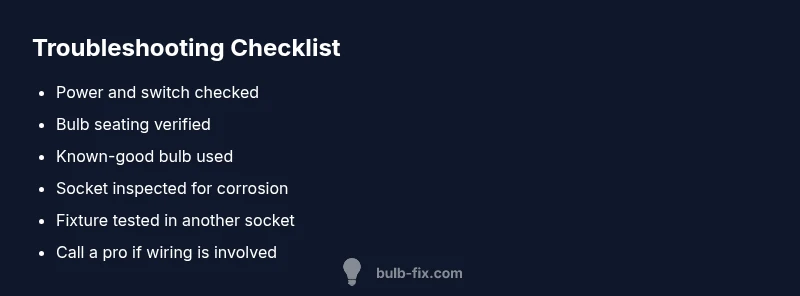
- Confirm switch and power: ensure circuit has power.
- Inspect seating: reinsert bulb with a firm twist.
- Test with known-good bulb: rule out a defective bulb.
- Check socket condition: look for corrosion or bent tabs.
- Test another fixture: isolate the problem to the fixture or wiring.
- Call a pro if wiring or breakers are involved.
This checklist helps you stay calm and methodical during a lighting issue, saving time and frustration.
Steps
Estimated time: 40-60 minutes
- 1
Power down and prepare
Shut off power at the breaker and if portable, unplug the lamp. This ensures your safety before touching any electrical components.
Tip: Safety first: never work on live circuits. - 2
Check bulb seating
Remove the bulb and reinsert with a firm, even twist. Ensure the base is making full contact.
Tip: Avoid over-tightening to prevent damage. - 3
Replace with a known-good bulb
If possible, use a fresh bulb of the same type and rating to rule out a defective unit.
Tip: A failed bulb is a common culprit. - 4
Inspect the socket and contacts
Look for corrosion, pitting, or bent contacts; gently adjust or replace if damaged.
Tip: Dirty contacts can prevent reliable contact. - 5
Test in another fixture
Move the bulb to a different socket to see if it lights there; if yes, the issue is fixture-related.
Tip: This isolates the problem efficiently.
Diagnosis: Bulb won't light in a standard fixture
Possible Causes
- highLoose bulb seating or contact
- highDead or defective bulb
- mediumFaulty socket with corrosion or damage
- mediumSwitch or wiring problem in the fixture or circuit
- lowTripped breaker or blown fuse in the panel
Fixes
- easyReseat bulb and test with a known-good bulb
- easyTry a different socket or fixture to isolate the issue
- easyInspect and clean socket contacts; replace socket if damaged
- easyCheck breaker/fuse and reset as needed
- mediumIf wiring or switch is faulty, contact a licensed professional
Got Questions?
How should I describe a bulb not working to a handyman?
State the location, fixture type, whether the switch is on, and what you’ve tried. Use concise bullet points to summarize symptoms.
Describe the fixture location, switch status, and steps you've already tried.
Why won't a new bulb light up?
Even new bulbs can be defective or not seated properly. Always reseat and test with a known-good bulb before diagnosing further.
A new bulb can be bad or not seated fully; test with another bulb.
Can dimmers affect LED bulbs?
Yes. If the LED isn’t compatible with the dimmer, it may not light or will buzz and flicker. Check compatibility labels.
LEDs need compatible dimmers; otherwise they may fail to light.
If one bulb in a multi-bulb fixture doesn’t light, what should I do?
Move the bulb to another socket to see whether the issue is the bulb or the fixture. If it follows the fixture, inspect wiring.
Switch the bulb to another spot to fault-find.
Is it safe to replace a ceiling fixture bulb myself?
Yes, with power off and a stable ladder. Avoid working near water or while unsure about wiring.
Yes, but turn off power and be careful with ladders.
When should I call an electrician?
If wiring or the breaker shows signs of damage, or you’re unsure how to proceed safely, seek licensed help.
Call a licensed electrician if wiring or circuits seem involved.
Watch Video
Key Points
- Start with power, seating, and switch checks.
- Test with a known-good bulb to rule out a bad bulb.
- Inspect sockets for corrosion or damage.
- If wiring or breakers are involved, call a pro.
- Regular maintenance helps prevent future failures.