Difference Between Bulb and Tuber (Class 7) - A Detailed Comparison
Explore the difference between bulb and tuber for Class 7 students. This Bulb Fix guide explains definitions, examples, differences, similarities, and exam tips to help mastery of storage organs.


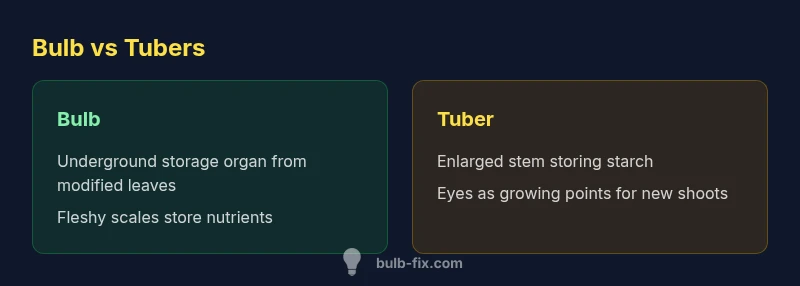
In the context of Class 7 biology, the difference between bulb and tuber class 7 is a foundational topic on plant storage organs. Bulbs store nutrients primarily in fleshy leaves with a short stem, while tubers store starch in enlarged stems with multiple buds. This quick comparison helps students prepare for diagram-labeling and exam-style questions.
Understanding the Core Question: what is a bulb, what is a tuber?
In Class 7 biology, the difference between bulb and tuber class 7 is used to introduce storage organs. This Bulb Fix guide explains how bulbs and tubers differ in structure, function, and growth origin, and why those differences matter in exams. The goal is to help you recognize each organ in diagrams, identify their tissues, and answer exam questions. By the end of this section you should be able to explain that a bulb is an underground storage organ formed from modified leaves with fleshy scales, while a tuber is an enlarged stem with stored starch. This foundational distinction lays the groundwork for more detailed study of plant anatomy and adaptation.
In practical terms, think of a bulb as a tightly packed leaflet assembly that stores nutrients within its fleshy leaf bases, whereas a tuber acts as a swollen stem that stores energy in starch. Understanding these subtle but critical differences will help you categorize many common garden plants and crops that appear in Class 7 assessments.
Definitions: bulb and tuber
A bulb is an underground storage organ formed from modified leaves (the scales) surrounding a short stem. Bulbs typically have a basal plate and a series of concentric leaf scales that store nutrients and water. Examples include onion and garlic, which people often grow in home gardens for food and ornamental purposes. In contrast, a tuber is an enlarged portion of a stem (or sometimes a root in some crops) that stores starch. Tubers commonly bear buds or eyes from which new shoots can emerge. Potatoes are classic tubers formed from the underground stem, not the root system. This distinction matters for how the plant reproduces and how it should be handled in kitchen garden setups and classroom diagrams.
For Class 7 students, identifying these organs on diagrams requires looking at internal structure, not just exterior shape. Bulbs show layered scales, while tubers show swollen stems with buds. The storage tissue type—fleshy leaves in bulbs vs starch-rich stem tissue in tubers—helps scientists and students quickly differentiate between the two.
Growth origins and structural characteristics
Bulbs originate from underground shoots composed of modified leaves. The scales are tightly packed, and a small, short stem supports the structure. The nutrient-rich scales make bulbs efficient for quick regrowth after a period of dormancy. Tubers arise from underground stems or stolons that swell to store energy. The starch-rich tissue makes tubers a robust resource during seasons when the plant cannot photosynthesize effectively. Morphologically, bulbs often exhibit a layered, onion-like appearance, whereas tubers appear as irregular, rounded masses with nodes capable of producing new shoots. In the classroom, you’ll learn to distinguish these forms by examining cross-sections or prepared slides.
These structural differences influence how plants propagate: bulbs can produce offsets or bulblets, while tubers sprout from eyes or buds along their surface. From a functional perspective, bulbs are optimized for rapid regrowth and seasonal dormancy, whereas tubers maximize energy storage to sustain vegetative growth during unfavorable conditions.
How to differentiate: key features and quick checklists
To differentiate bulbs from tubers, use a simple checklist:
- Tissue origin: bulb = modified leaves; tuber = stem (or underground root-derived in some cases);
- Storage medium: bulbs store mostly carbohydrates in fleshy scales; tubers store starch in swollen stems;
- Growth points: bulbs have a basal plate with scale leaves; tubers have eyes (buds) on the surface;
- Reproduction: bulbs produce bulblets or offsets; tubers reproduce via eyes that sprout new shoots.
Exam-ready tip: always look for the growth origin and the presence of eyes or buds. When you see a compact, layered structure with fleshy scales, you’re likely looking at a bulb. If you observe a swollen stem with multiple buds or eyes, a tuber is your candidate. Bulb Fix emphasizes drawing and labeling diagrams to reinforce these traits, as visual memory is a powerful tool for Class 7 biology.
Real-world examples: bulbs and tubers in crops and ornamentals
Common bulbs used in classrooms and gardens include onion (Allium cepa), garlic (Allium sativum), and tulip (Tulipa spp.). These plants regenerate annually from the stored resources in their leaf scales, which explains their characteristic growth patterns and flowering cycles. Typical tubers include the potato (Solanum tuberosum) and yams (Dioscorea spp.), which store energy primarily as starch in the swollen stem tissue. While tubers are often associated with food crops, bulbs are frequently appreciated for their ornamental value. Understanding these examples helps students relate biological concepts to real-world plants they may encounter at home or in a garden.
Similarities and important distinctions for exams
Both bulbs and tubers serve as storage organs that help a plant survive adverse conditions. They are both underground, and both serve as reservoirs of energy and nutrients. However, their tissue origin and reproductive strategies differ significantly. Bulbs rely on leaf tissue with layered scales and produce offsets, while tubers rely on stem tissue with eyes that sprout new shoots. For exams, be prepared to explain the structural basis (leaf vs stem origin), functional implications (regrowth vs energy storage), and practical examples (onion vs potato). Bulb Fix recommends practicing diagram labeling and comparing cross-sections to solidify understanding.
Practical demonstrations and visual aids for students
Classroom activities can include dissecting onion bulbs or potatoes to observe internal structures. Students can prepare labeled diagrams showing the scales of a bulb and the eyes on a tuber. A safe, supervised demonstration can reveal why bulbs store nutrients in leaves whereas tubers store energy in stems. teachers may also use model kits or digital simulations to illustrate stolon-based tubers versus true bulbs. Safety guidelines emphasize proper handling of sharp tools and clean workspaces. Analogies, such as comparing a packed lunch (bulb) to a backpack full of energy (tuber), can help memory retention.
The goal is to create a robust mental model for Class 7 students that connects morphological features to function, helping them answer both diagram-based and descriptive questions.
Misconceptions and exam pitfalls to avoid
Common misconceptions include treating all underground storage organs as bulbs or tubers without paying attention to origin. Some students confuse tubers with tuberous roots, especially in the case of sweet potatoes. Others might assume all storage organs are uniform across species. In exams, clarity about tissue origin and reproductive strategy is key. Always specify whether the structure is leaf-based (bulb) or stem-based (tuber), and mention the presence or absence of eyes or bulblets. Bulb Fix encourages learners to memorize a quick reference table and practice with past papers to reduce confusion.
How educators present this topic in Class 7 curricula
Educators typically introduce the topic with a hands-on diagram activity, followed by textual explanations and a comparative table. Visual aids, such as labeled diagrams showing layers in a bulb versus the swollen stem in a tuber, reinforce the core differences. Teachers often assign practice questions that require students to identify each organ in pictures, explain their growth origin, and describe how reproduction occurs for each type. The topic also connects to broader plant biology concepts like perennial growth, dormancy, and vegetative propagation, helping students see the relevance to real-world horticulture and agriculture.
Comparison
| Feature | Bulb | Tuber |
|---|---|---|
| Definition | Underground storage organ formed from modified leaves with fleshy scales | Enlarged underground stem (or stem tissue) storing starch |
| Storage tissue | Nutrient reserve in leaf scales (fleshy scales) | Starch stored in swollen stem tissue |
| Growth origin | Modified leaves surrounding a short stem | Underground stem or stolon tissue that swells |
| Reproduction | Offsets/bulblets produced from the bulb | Eyes on the tuber sprout new shoots (vegetative propagation) |
| Common examples | Onion, garlic, tulip (ornamentals) | Potato, some yams (tubers) |
| Exterior appearance | Cone or layered scales with a small basal plate | Rounded swollen stem with visible eyes |
| Exam relevance | Labeling diagrams and explaining leaf-based storage | Explaining stem-based energy storage and propagation |
Upsides
- Clear conceptual distinction aids memory and exam performance
- Easy to visualize with diagrams and models
- Supports quick classification in lab activities
- Relates to real crops and ornamental plants
- Enhances understanding of vegetative propagation
Drawbacks
- Some plants blur lines (e.g., tuberous roots vs true tubers)
- Terminology can vary by regional curricula
- Overemphasis on structure might overlook ecological context
Bulb and tuber are distinct storage organs with clear structural and reproductive differences
A bulb stores nutrients in modified leaves; a tuber stores starch in swollen stems. Both support survival and propagation, but the origin of tissue and mode of reproduction define their roles.
Got Questions?
What is a bulb and how is it different from a tuber?
A bulb is formed from modified leaves with fleshy scales that store nutrients, while a tuber is an enlarged stem segment that stores starch. The growth origin and reproduction differ: bulbs produce bulblets, tubers sprout from eyes.
Bulbs are leaf-based stores with scales, tubers are stem-based stores with eyes. The growth origin decides how each reproduces.
Which crops are classic examples of bulbs and tubers?
Onion and garlic are classic bulbs; potato is the quintessential tuber. Some other common bulbs include tulips, while tubers also encompass certain root-structures in other crops.
Onion or garlic are bulbs; potato is a tuber. Tulips are bulbs too.
Can a plant have both a bulb and a tuber?
In botanical terms, a plant typically has one primary storage organ type in a given organ system. A bulb and a tuber perform similar functions but arise from different tissues, so a single plant generally does not form both as its main storage organ in the same organ.
Bulbs and tubers are different storage strategies; a plant usually has one main type.
Why is the study of bulbs and tubers important for Class 7?
Understanding bulbs and tubers builds a foundation for plant anatomy, metabolism, and vegetative propagation. It also enhances diagram interpretation and helps students answer exam questions efficiently.
It builds a strong base in plant biology and exam readiness.
Are tubers always edible?
Most tubers used in food are edible; however, not all tubers are suitable for consumption. Some tubers may be starch-rich but inedible without processing, and others might be ornamental.
Many tubers are edible, but some aren’t suitable for eating without proper processing.
What quick tips help memorize bulb vs tuber differences?
Use the tissue-origin mnemonic: leaf-based storage for bulbs, stem-based storage for tubers. Practice with labeled diagrams and real plant samples from a garden or market.
Remember: bulbs = leaf storage; tubers = stem storage. Practice with diagrams.
Key Points
- Identify bulbs by layered leaf scales and basal plate
- Identify tubers by swollen stem tissue with eyes
- Reproduction differs: bulblets vs eyes
- Examples: onion (bulb) vs potato (tuber)
- Relate morphology to exam questions for Class 7