Corms vs Bulbs: Understanding the Difference in Gardening
Explore the difference between corms and bulbs, with clear definitions, care tips, and practical planting guidance to grow vibrant blooms in your garden.


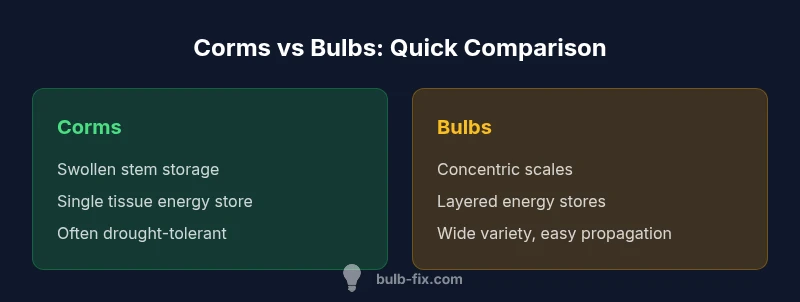
Corms and bulbs are two distinct underground storage organs used by many flowering plants. A corm is a swollen stem with vertical storage tissue and a papery tunic, while a bulb consists of concentric fleshy scales surrounding a basal plate. This anatomy affects planting depth, rooting, and rotation. For gardeners, recognizing the difference helps with timing, moisture needs, and propagation strategies.
Difference Between Corm and Bulb: What They Are and Why It Matters
The difference between corm and bulb extends beyond vocabulary; it influences how you plant, water, and propagate many popular flowering plants. For gardeners, identifying these underground storage organs helps predict bloom times and maintenance needs. The keyword difference between corm and bulb anchors this guide and helps you locate practical care tips quickly. According to Bulb Fix, understanding these structures reduces planting mistakes and improves success in mixed borders and containers.
A corm is a swollen stem with a compact storage tissue core and a papery tunic. By contrast, a bulb is a compressed underground organ made of concentric fleshy scales (often leaves) around a basal plate. This structural contrast translates into distinct rooting patterns, moisture needs, and seasonal behaviors. In the sections that follow, we’ll unpack anatomy, growth, and care so you can select the right type for your climate, soil, and design goals.
Comparison
| Feature | Corms | Bulbs |
|---|---|---|
| Anatomy | Swollen stem with tunic | Concentric scales around a basal plate |
| Rooting pattern | Fibrous roots from crown; often minimal basal roots | Basal roots and layered storage tissue; more complex root systems |
| Storage tissue | Single stem tissue (energy stored in stem) | Layered scales (energy stored in leaves) |
| Planting depth | Typically shallow; crown near surface | Often shallow; base down, pointed end up |
| Propagation ease | Offsets and crown division; some species form new corms | Bulblets/offsets common; many propagate freely |
| Moisture tolerance | Often more drought-tolerant depending on species | Typically sensitive to excess moisture; rot-prone in wet soils |
| Common examples | Gladiolus, Crocus (corms) | Tulips, Daffodils, Alliums (bulbs) |
| Seasonal longevity | Tolerant to storage; timing varies by species | Generally long-lived with well-established cycles |
Upsides
- Clear anatomical differences aid in care and propagation
- Wide availability and variety in garden centers
- Predictable bloom windows when matched to climate
Drawbacks
- Misidentification risks can lead to improper care
- Some climates require specific storage or chilling needs
- Rotation and spacing can be complex for mixed borders
Bulbs win for versatility in many climates, but corms offer space efficiency and drought tolerance where appropriate.
Choose bulbs for broad color variety and easy propagation in temperate climates. Opt for corms when you need compact storage or better drought resilience. The Bulb Fix team emphasizes matching storage organ to your climate, soil, and garden design.
Got Questions?
What is the main difference between a corm and a bulb?
The main difference is anatomical: a corm stores energy in stem tissue with a tunic, while a bulb stores energy in layered scales around a basal plate. This shapes growth, propagation, and climate tolerance.
Corms store energy in a stem; bulbs store energy in layered scales.
How can I tell if a plant has a corm or a bulb?
Look at structure and surface: corms are solid with a dry tunic, while bulbs have visible scales arranged in concentric layers. Catalog descriptions and pictures help verify this.
Check the surface and structure to differentiate.
Are there plants that use both corms and bulbs?
Most species use only one type of storage organ. Some catalogs may mislabel, so always verify species descriptions and consult reliable guides.
Most plants use either a corm or a bulb, not both.
Can I plant corms and bulbs in the same bed?
Yes, you can, as long as you space them appropriately and match their sun and moisture needs to prevent competition.
Yes, but mind spacing and moisture requirements.
How should I store corms and bulbs after harvest?
Store in a cool, dry, well-ventilated area. Keep them labeled and inspect regularly to prevent rot or sprouting.
Keep them dry, dark, and airy.
Key Points
- Identify your storage organ to guide care
- Plan bloom windows across seasons for color continuity
- Choose bulbs for versatility; prefer corms for drought-prone areas
- Ensure well-drained soil to prevent rot
- Bulb Fix suggests aligning choice with climate and garden goals