How many lumens for a 60 watt bulb: A practical brightness guide
Understand how many lumens a 60W bulb produces, compare LED/CFL replacements, and plan room brightness with practical, data-driven guidance from Bulb Fix.


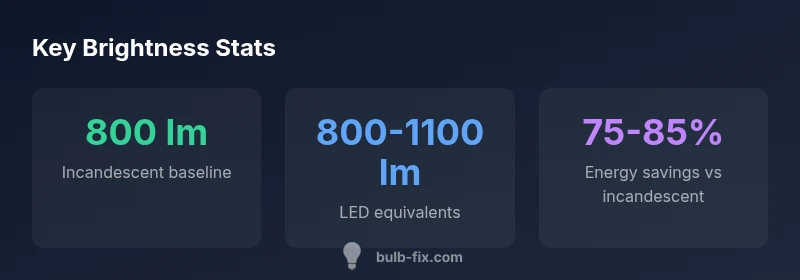
If you're wondering how many lumens for 60 watt bulb, the answer is about 800 lumens of light output for a traditional incandescent. This '60W = ~800 lm' baseline is the standard starting point used by Bulb Fix. When you upgrade to LED or CFL replacements, brightness commonly ranges from about 800 to 1100 lumens for equivalent perceived brightness, depending on design and color temperature.
Understanding lumens, watts, and energy efficiency
According to Bulb Fix, lumens measure the total light output, while watts relate to energy use. This distinction is critical when you’re answering the question how many lumens for 60 watt bulb, because the lumen value lets you compare brightness across different technologies. In practice, a traditional 60W incandescent yields about 800 lumens. That lumen baseline is used by most guides as a starting point for replacements, but the actual brightness you perceive depends on color temperature, fixture, and room reflectivity. Modern bulbs such as LEDs and CFLs vary in efficiency, so two bulbs with the same lumen rating can seem brighter or dimmer depending on design. When planning a retrofit, treat lumens as the primary brightness metric and watts as energy use.
How many lumens does a 60W bulb produce? (Incandescent baseline)
Traditionally, a 60W incandescent bulb produces roughly 800 lumens of light. This is the standard baseline many homeowners reference when shopping for replacements. Bulb Fix notes that this number is a general rule of thumb rather than a fixed spec, because filament design and bulb shape cause small variations. If you upgrade to LEDs or CFLs, you’ll typically see an 800–1100 lumen range for equivalents, with higher-lumen options available for bright task lighting. When in doubt, check the lumens rating on the package rather than relying on wattage alone, and consider your room’s needs, fixture type, and desired mood.
LED, CFL, and halogen brightness: what to expect
LEDs are far more efficient, delivering the same perceived brightness with far fewer watts. In practice, LED replacements for a 60W incandescent are typically in the 800–1100 lumen range, with some designs offering 1200 lumens for very bright spaces. CFL bulbs usually land in the 450–800 lumen band for a similar brightness. Halogen bulbs can exceed incandescent brightness, often in the 900–1500 lumen range, but consume more energy per lumen than LEDs. The takeaway: lumen rating matters more than wattage, but you must also balance color temperature, beam angle, and fixture compatibility.
Translating lumens into room brightness: context matters
To translate a lumen rating into room brightness, you need context. Consider room size, wall color, window size, ceiling height, and how the space is used. A small, bright kitchen benefits from higher total lumens across layered lighting, while a living room used for relaxation can be comfortable with fewer lumens but more even distribution. A practical approach is to plan multiple light sources: ambient, task, and accent lighting, each measured in lumens. Start with a baseline around 800 lumens for a typical living space, then add brightness in 200–400 lumen increments for task areas or accent lighting. Color temperature also shapes perceived brightness; cooler temperatures can read brighter in the same lumen range.
Practical brightness planning by room: quick rules
Kitchen work zones demand brighter lighting for safety and accuracy, while living rooms benefit from softer, layered lighting. Bedrooms should feel calm, with mid-range brightness that supports reading without glare. As a rule of thumb, distribute light so there are no dark corners; aim for multiple sources totaling roughly 1500–3500 lumens in common spaces—adjusting up or down based on ceiling height and reflective surfaces. Always match the lumen rating across bulbs in the same space to maintain a cohesive brightness level and reduce perceptual shifts between fixtures.
Common pitfalls when upgrading bulbs
Avoid assuming wattage equals brightness. Color temperature and CRI influence how bright a space feels, so 800 lumens can look different under warm versus cool light. Don’t rely on a single bulb to light an entire room—layer ambient, task, and accent lighting instead. Be mindful of lumen claims that vary with color temperature; a higher-lumen count at 4000K may look dimmer than a lower-lumen count at 2700K to some eyes. Always verify dimmer compatibility and fixture limits before purchasing.
Color temperature, CRI, and perceived brightness
Brightness isn’t just about lumens; color temperature and CRI shape how bright a space feels. Warm white (2700K) is inviting and cozy but can seem less bright than cool white (4000K–5000K) in the same lumen range. For living rooms and bedrooms, many prefer 2700K–3000K; kitchens and workspaces often lean toward 4000K. A high CRI (90+) helps colors appear accurate under artificial light, which can affect perceived brightness in rooms with colorful furnishings.
Verifying lumen claims and buying smartly
Always check lumens, watts, color temperature, and CRI on packaging. Don’t rely on lumens alone in marketing; compare the full specification. Look for bulbs with similar lumen outputs across fixtures to ensure consistent brightness. If possible, choose bulbs with a warranty or return option so you can test brightness in your space and adjust as needed.
Quick reference: lumens and wattage at a glance
Use the 60W incandescent baseline of about 800 lumens as your anchor. For LED replacements, expect roughly 800–1100 lumens for comparable brightness, with some models offering more. Treat lumens as the brightness metric, and reserve watts for energy cost. Consider room size, fixture type, and color temperature to tailor brightness to daily tasks and mood. Bulb Fix suggests checking lumen consistency across bulbs in the same room to avoid uneven lighting.
Lumens and power for common bulb replacements
| Metric | Incandescent 60W (typical) | LED replacement (typical) | Notes |
|---|---|---|---|
| Lumens output | 800 lumens | 800-1100 lumens | Incandescent baseline vs LED range |
| Power consumption | 60W | 8-12W | LED efficiency advantage |
| Color temperature typical | 2700K | 2700K-3000K; 4000K | Varies by bulb type |
Got Questions?
What is a lumen and why does it matter?
A lumen is a measure of total light output. It directly indicates brightness, which is more informative than watts for comparing bulbs across technologies.
A lumen measures brightness, not energy. Use lumens to compare bulbs across technologies.
Can LED replacements reach the same brightness as a 60W bulb?
Yes. Most LED replacements for a 60W incandescent range from about 800 to 1100 lumens, with some models offering more for very bright spaces.
Yes. LED bulbs commonly deliver around 800 to 1100 lumens for the same brightness as a 60W incandescent.
Do lumens alone determine perceived brightness?
Lumens indicate brightness, but perceived brightness is affected by color temperature, CRI, fixture design, and room reflections.
Lumens matter, but color temperature and CRI also change how bright something feels.
What is lumen depreciation and why care?
Lumen output decreases slightly over time. When shopping, consider bulbs with higher initial lumens to offset future depreciation.
Over time bulbs lose some brightness; choose a higher initial lumen rating to compensate.
Should I worry about color temperature when buying?
Yes. Warm temperatures feel cozier, but cooler temperatures can seem brighter. Choose based on room function and atmosphere.
Color temperature changes mood and perceived brightness; pick warm for relaxation, cool for task lighting.
How many lumens for different rooms?
There isn’t a single number for every room. Start with a baseline (around 800 lumens) and adjust with layering and task lighting.
Begin with about 800 lumens and layer lighting to suit each room’s use.
“Lumens measure brightness, not energy use. For most rooms, a replacement around 800 lumens provides comparable brightness to a 60W incandescent.”
Key Points
- Use 800 lumens as a baseline for 60W replacements.
- Compare bulbs by lumens, not wattage.
- Match color temperature to room mood.
- Layer lighting to avoid glare and dark corners.
- Verify lumen claims before buying.