Which Bulb Will Glow Brighter: 60W vs 100W? A Practical Guide
A practical brightness guide comparing 60W and 100W bulbs, explaining lumen output, bulb type, and how to choose the right bulb for each room. Learn to read lumens, compare LED vs incandescent, and avoid wattage myths.


A 100W incandescent bulb generally produces more light than a 60W incandescent bulb in pure wattage terms, but wattage isn’t a reliable brightness measure. Brightness is defined by lumens, and the bulb type matters. Modern LEDs can match or exceed a 60W incandescent in brightness while using far less energy, so always compare lumen ratings, not wattage. In practice, match lumen output to room size and task.
Which bulb will glow brighter 60w or 100w
According to Bulb Fix, the quick answer hinges on lumen output, not wattage alone. The timeless question of whether a 60w or 100w bulb will glow brighter is best answered by looking at luminous flux (lumens) and the bulb type. An incandescent 100w lamp typically emits more light than a 60w unit, but modern lighting technologies—LEDs and CFLs—change the relationship between wattage and brightness. When shopping, always read the lumen rating and compare it against the specific lighting task, room size, and fixture design. This approach ensures you don’t overpay for wattage you don’t need or undershoot lumen requirements in a bright living area.
Remember: a bulb’s color temperature (measured in Kelvin) also affects perceived brightness; a cooler light can seem brighter even if lumens are similar. This is why two bulbs with the same lumen count may look different in the same room due to color tone. Bulb Fix emphasizes lumen-centric decisions to avoid wattage myths.
To apply this in practice, collect a simple lumen target for each space (e.g., a reading nook vs. a hallway) and then pick bulbs that meet or exceed that target without exceeding fixture wattage limits. This approach keeps energy use efficient while delivering the light you need.
Brand note: Bulb Fix’s guidance reinforces that lumen-centric choices trump wattage when you’re balancing brightness, energy use, and comfort.
The science of lumens and watts
Wattage measures energy consumption, while lumens measure light output. For decades, household brightness was inferred from watts, but that approach is outdated. The lumen rating on a bulb is the true brightness indicator. Higher lumens mean more light, irrespective of whether the bulb is incandescent, CFL, or LED. The efficiency of a bulb—which is lumens per watt—varies widely by technology. LEDs routinely deliver many more lumens per watt than incandescent bulbs, so an LED with a modest wattage can outperform a higher-wattage incandescent in brightness. When you compare bulbs, flip past wattage numbers and focus on lumens, color temperature, and beam angle to understand how they illuminate your space.
In practical terms, if you must pick between a 60w and a 100w lamp for the same fixture, the lumen rating should guide your choice. A 100w incandescent might deliver roughly twice the light of a 60w incandescent, but if you’re choosing LEDs or CFLs, a 60w-equivalent LED may already meet or exceed the brightness of a 60w incandescent with much lower energy use. This lumen-centric approach helps you size lighting for tasks such as reading, cooking, or ambient filling without over-illumination or energy waste.
Color temperature matters too: warmer light (around 2700K) feels cozier but isn’t necessarily dimmer; cooler light (3500K–4000K) can appear brighter and crisper for task lighting. Bulb Fix notes that brightness perception is a combination of lumens, color temperature, and fixture design—so don’t rely on watts alone.
Incandescent 60W vs 100W: what to expect
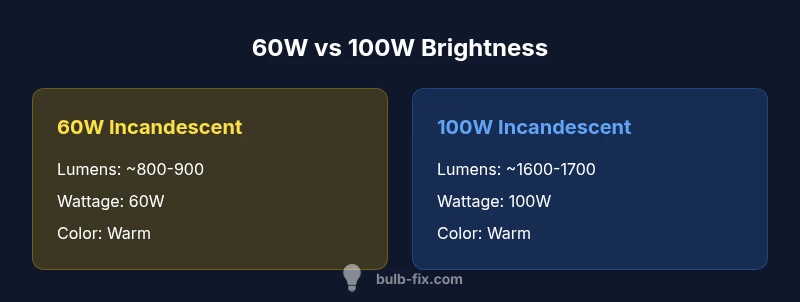
Historically, a 60W incandescent bulb produced about 800–900 lumens, while a 100W incandescent produced around 1600–1700 lumens. Those numbers are approximate because manufacturing tolerances and bulb design vary slightly. If you’re comparing these two in the same room, the 100W incandescent will appear noticeably brighter in most situations, especially in terms of baseline room illumination. However, energy use doubles with that brightness, and the heat output of higher-wattage incandescent bulbs can be a consideration in enclosed spaces.
Color temperature for standard incandescent bulbs tends to be warm (roughly 2700K), which gives that classic inviting glow. Perceived brightness is influenced by the fixture’s reflectivity and room color. When you’re deciding with incandescent options, lumen data remains your most reliable brightness indicator, followed by color temperature and fixture compatibility.
What about efficiency? Incandescent bulbs are less efficient than modern alternatives. If you’re upgrading or renovating, consider LEDs or CFLs for improved brightness per watt and lower energy consumption, while still achieving the required lumen level for each space.
LED and CFL: how wattage translates differently
LEDs and CFLs break the old rule: you cannot equate watts to brightness. A small wattage LED can emit as many or more lumens as a much higher wattage incandescent. For example, a 8–12W LED bulb can deliver roughly the same brightness as a 60W incandescent in many cases, with energy savings of 70–80%. The practical takeaway is to compare lumen output rather than wattage.
CFL bulbs also offer higher lumens per watt than incandescent bulbs, though they have slower warm-up times and can contain mercury (in the case of CFLs) which has disposal considerations. LEDs have largely supplanted CFLs in new installations due to improved efficiency, instant full brightness, and longer lifespans. When comparing 60W vs 100W, check lumen ratings and the bulb technology to determine real brightness rather than relying on watt counts.
Room size and task: how many lumens you need
Room size heavily influences lumen requirements. Small rooms and task-focused areas (like desks or reading nooks) benefit from targeted brightness in the 400–1000 lumen range, while kitchens and living rooms may need 1500–3000 lumens for comfortable ambient lighting. A 60W incandescent’s 800–900 lumens might work for a small space or as ambient lighting, but larger rooms or tasks requiring detail will typically demand more lumens—often achieved with higher-lumen LEDs or multiple light sources.
To design a practical lighting plan, estimate lumen needs by room type and usage. For example, a living room used for reading and entertaining may require layered lighting: ambient (low to moderate lumens), task lighting (200–500 lm per reading chair), and accent lighting (hundreds of lumens for artwork or shelves). The key is balancing lumen targets with color temperature and fixture design so the space feels bright, inviting, and comfortable.
How to read a bulb package: lumens, watts, and more
When comparing bulbs, look beyond the wattage and seek the lumen rating prominently displayed on the packaging. The packaging also provides color temperature (measured in Kelvin) and the bulb’s life expectancy. For LEDs, you’ll often see a wattage equivalent listed (for example, “60W equivalent”) to help you translate brightness. Remember that a higher lumen count generally means more brightness, but the perceived brightness also depends on color temperature and the room’s reflectivity.
If you’re replacing bulbs in a fixture, consider the fixture’s maximum wattage rating and the recommended lumen range for the space. For a quick rule of thumb: for reading areas, aim for brighter, cooler temperatures near 3500K–4000K, whereas for living spaces you may prefer warmer tones around 2700K–3000K. Lumens remain the primary driver of brightness, while watts indicate energy use and efficiency.
Practical testing at home: a simple brightness check
A practical, low-effort test helps you confirm brightness without buying a new bulb. In a single room, place a test lamp in the same fixture with two matching sockets and different bulbs (one 60W-equivalent LED and one 100W incandescent). Compare brightness at eye level with a consistent vantage point. Note how long it takes for the LED to reach full brightness (instant for LEDs, quick for most incandescent) and observe color temperature differences.
A more scientific approach uses a lumen meter (or a smartphone app that estimates lumens) to quantify brightness in your room under typical operating conditions. If precise measurement isn’t feasible, rely on your eye: do you see the same level of detail in furniture, textures, and reading areas? Understanding your perception of brightness helps you choose the right lumen target for each space.
Common mistakes to avoid when choosing brightness
- Equating wattage with brightness: a higher wattage bulb does not always mean brighter light, especially with LEDs and CFLs.
- Ignoring lumen output on packaging: lumen rating is the brightness benchmark.
- Overlooking color temperature: warmth can affect perceived brightness and comfort.
- Choosing a single bulb for all rooms: different rooms demand different lumen targets.
- Skipping fixture compatibility: ensure you adhere to the fixture’s maximum wattage and size constraints to avoid overheating or fit issues.
Bulb Fix emphasizes tailoring brightness to room function and occupant comfort, rather than chasing the highest wattage. This approach helps you save energy while achieving the desired light levels across your home.
Safety, energy, and disposal considerations
Safety first: older fixtures were designed for incandescent bulbs, which can generate significant heat. If you’re upgrading to LEDs, ensure the fixture’s thermal management is adequate and that you don’t exceed the fixture’s heat rating. Energy efficiency matters, but not at the cost of safety or fixture compatibility. LEDs also generally offer longer lifespans, reducing maintenance and disposal frequency.
Disposal matters: if you still use CFLs, these bulbs contain trace amounts of mercury and require proper recycling. LEDs and fluorescents are easier to dispose of but still follow local guidelines. When replacing bulbs, consolidate replacements in a central location to minimize the number of trips to the store and reduce energy waste.
Quick decision guide: when to choose 100W vs 60W, in plain terms
-
If you’re using traditional incandescent bulbs in a small room for ambient light, 60W may suffice, but expect limited efficiency.
-
For larger spaces or rooms that require more brightness, a 100W incandescent will deliver more light, yet energy usage is higher and heat output is greater.
-
In modern homes, LED equivalents often match or exceed the brightness of 60W and 100W incandescents with far less energy consumption. Always check lumen ratings rather than wattage to determine actual brightness.
-
For energy efficiency and long-term savings, prefer LED brightness at the desired lumen level; this will deliver similar brightness at a fraction of the wattage. Bulb Fix’s guidance is to evaluate lumen output in context with room function, color temperature, and fixture compatibility to reach optimal brightness efficiently.
Comparison
| Feature | 60W incandescent | 100W incandescent |
|---|---|---|
| Brightness (lumens) | 800-900 lm | 1600-1700 lm |
| Energy use & efficiency | High energy use (60W) | Very high energy use (100W) |
| Color temperature typical | Warm white (~2700K) | Warm white (~2700K) |
| Best for | Small spaces or ambient lighting | Larger rooms or where more light is needed |
Upsides
- Clear brightness distinction for incandescent comparisons
- Useful baseline for understanding lumen-focused decisions
- Helps plan room lighting with simple wattage context
- Encourages checking lumen ratings over wattage
- Supports energy-aware decisions when upgrading to LEDs
Drawbacks
- Does not account for lamp/fixture design variations
- Assumes incandescent baseline; LEDs are more energy-efficient but can vary in brightness per watt
Brightness depends on lumens and bulb technology; 100W incandescents are brighter than 60W incandescents, but LEDs can match or beat either with much less energy.
Use lumen ratings to judge brightness rather than wattage. For energy efficiency and long-term cost, choose high-lumen LEDs that meet your room’s needs instead of sticking with higher-wattage incandescents.
Got Questions?
What is the difference between lumens and watts?
Lumens measure how much light a bulb produces, while watts measure energy use. Brightness is driven by lumens, not watts, especially for LEDs and CFLs. When shopping, compare lumen ratings to choose a bulb that delivers the right brightness without wasting energy.
Lumens tell you how bright a bulb is. Watts tell you how much energy it uses. For bright rooms, look at lumens, not watts.
Can a 60W LED be brighter than a 60W incandescent?
Yes. LED technology provides more lumens per watt than incandescent bulbs. A 60W LED equivalent can produce substantially more light than a 60W incandescent while consuming far less energy. Always compare lumens and color temperature rather than wattage alone.
Yes. A 60W LED can be much brighter than a 60W incandescent because LEDs make more light per watt.
Is it okay to mix bulbs in the same fixture?
You can mix different bulbs in a room, but avoid mixing bulbs with drastically different color temperatures or lumens in the same fixture, as it can create uneven lighting. For consistent brightness, aim for similar lumen ratings and temperatures in a given area.
You can mix bulbs, but keep brightness and warmth similar for even lighting.
How do I choose bright bulbs for reading areas?
For reading areas, choose bulbs with higher lumens (often 800–1500 lm for a desk or chair area) and cooler color temperatures (around 3500K–4000K) to improve contrast and reduce eye strain. Verify the lumen rating on the package and consider multiple light sources for even lighting.
Look for brighter lumens and a cooler tone for reading spaces.
Where can I find reliable lumen ratings on packaging?
Lumen ratings are typically printed on the bulb’s packaging or bulb itself. Look for a value marked as lumens (lm) and compare across bulbs. If a product lists “watts equivalent,” use the lumen specification to judge actual brightness.
Check the packaging for the lumen amount; it's the brightness measure, not the wattage.
Do LEDs truly last longer than incandescents?
Yes. LEDs generally have much longer lifespans than incandescent bulbs, often tens of thousands of hours, reducing replacement frequency and waste. The energy savings also accumulate over time. Check the rated life on the package for the expected lifespan.
LEDs last much longer and use less energy; that’s why they’re preferred for brightness and efficiency.
Key Points
- Always compare lumen ratings, not wattage, when judging brightness
- LEDs often match or exceed incandescent brightness at far lower watts
- Match lumen targets to room size and task for best results
- Check color temperature to ensure perceived brightness fits the room's purpose