What Bulb to Buy: A Practical Homeowner Guide 2026
Learn what bulb to buy for every room with practical guidance on LED, CFL, and incandescent options, including brightness (lumens), color temperature, dimmer compatibility, and safety tips from Bulb Fix.


By choosing the right bulb you’ll achieve bright, efficient lighting that matches your fixture and mood. For most homes, start with an LED bulb of the appropriate base (E26/E27), choose a warm white color (2700-3000K) for living spaces, and check dimmer compatibility if needed. This guide helps you compare brightness, color, and features before you buy.
Understanding Your Fixture and Socket\n\nBefore you buy, inspect the fixture to identify the bulb base, maximum wattage, and any restrictions on enclosed or damp locations. Check the label on the current bulb or the socket itself for base types such as E26/E27 (standard household screw base), GU10, G9, or B22. If you plan to use a dimmer, confirm that the fixture and switch support dimmable bulbs. Bulb Fix emphasizes that base compatibility and fixture rating are the two most critical constraints; mis-matching base or using a bulb in an enclosed fixture not rated for it can cause overheating and poor performance. In this section, you’ll learn how to read base markings and spot tricky fixtures like can lights or enclosed lamps. For most homes, starting by identifying the base and checking the fixture’s rating will save you time and money.
Selecting LED, CFL, or Incandescent\n\nHistorically, incandescent bulbs offered warm light but poor efficiency. CFLs improved energy use but can take time to reach full brightness and may contain trace mercury. LEDs provide the best balance today: long life, high efficiency, and color options. Your choice should hinge on three questions: Do you want instant full brightness? Is energy use a priority? Do you need dimming compatibility? In most rooms, LED is the recommended default. If you must use a non-LED bulb, choose CFLs for lower upfront cost or incandescent for color rendering in niche fixtures. Consider the base, dimming needs, and environmental concerns when comparing options.
Brightness and Color: Reading Labels and Specs\n\nBrightness is measured in lumens, not watts. A typical 60W incandescent produces around 800-900 lumens, while LED bulbs come in 800-1600 lumens for similar light output with far less energy. Color temperature is given in kelvin (K). For living spaces, 2700K–3000K yields a warm, cozy glow; for task lighting and offices, 3500K–4500K offers a neutral to cool daylight feel. CRI (color rendering index) indicates how true colors appear under the light. Aim for CRI 80+ for most homes; higher is better for tasks like crafts or makeup. If you’re replacing bulbs in a room, pick a brightness that matches the current bulb’s lumen rating, then adjust up or down based on room size and ceiling height. Bulb Fix analysis shows many homeowners prefer warm white in living rooms and kitchens, while workspaces benefit from cooler tones. Always verify the labeled lumens equal or exceed your target, and remember that dimming may reduce output.
Power, Efficiency, and Replacement Costs\n\nEnergy efficiency reduces ongoing costs and heat output. LED bulbs typically use a fraction of the energy of incandescent bulbs and last many times longer, which lowers replacement frequency. CFLs use more energy than LEDs but less than incandescent and have moderate lifespans. When budgeting, consider the long-term cost rather than the upfront price. A higher upfront LED may pay for itself in months or years depending on usage, while specialized bulbs (colored or vintage-style) may cost more but suit specific aesthetics. If you have many bulbs, the savings accumulate over time. Look for Energy Star labeled bulbs for reliable performance. In summary, LED provides the best long-term value for most homeowners. Bulb Fix emphasizes balancing upfront cost with expected lifetime savings and ensuring compatibility with fixtures and dimmers.
Outdoor, Enclosed, and Special Locations\n\nOutdoor lamps, bathrooms, or enclosed fixtures require bulbs rated for those conditions. Outdoors should be weather-rated (suitable for damp or wet environments) and often LED for durability. Enclosed fixtures can trap heat; choose bulbs rated for enclosed use to avoid overheating. Some fixtures require shatterproof bulbs near kids or pets. Dimmable bulbs in outdoor fixtures behave differently with weather; check the compatibility and local codes. If you’re uncertain, choose a bulb labeled for that location type and verify the fixture’s maximum wattage rating. Bulb Fix cautions against placing non-rated bulbs in enclosed or damp spaces, as heat buildup can shorten life and create hazard.
Reading the Bulb Label: A Quick Reference\n\nLearn to read the information printed on the bulb or packaging. The base type (E26/E27, GU24, etc.) indicates the socket; brightness is lumens; energy use is watts (for comparison); color temperature is Kelvin; CRI indicates color accuracy; and any warnings or temperature ratings are essential for safety. When you shop, choose LED bulbs with lumens equal to your target; confirm dimmability and compatibility with existing switches. If you’re replacing multiple bulbs, consider purchasing a mix of brightness levels to create layered lighting (ambient, task, and accent). Review warranty terms and return policies. Bulb Fix affirms that a simple double-check of base, dimmer compatibility, and enclosure rating saves time and prevents returns.
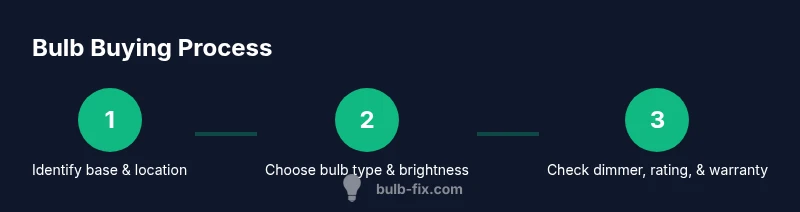
Buying Checklist: A Step-by-Step Path to Buy\n\n- Identify base and fixture rating; check for dimmer compatibility.\n- Decide on LED as default; evaluate brightness in lumens and color temperature.\n- Verify enclosure/damp rating and outdoor suitability.\n- Compare energy use and long-term cost, favor energy-efficient options.\n- Read packaging labels for lumens, Kelvin, CRI, and warranty.\n- Purchase from reputable retailers and keep receipts for returns.\nTip: If your room has multiple light sources, plan a mix of brightness levels and color temperatures for a balanced look.\nThe Bulb Fix team recommends starting with LED for most rooms and carefully checking fixture compatibility before buying.
Tools & Materials
- Replacement bulbs (LED preferred)(Have a few wattage equivalents on hand (e.g., 8-12W LED as 60W incandescent equivalent))
- Ladder or stable chair(For ceiling fixtures; ensure stability and a second person if possible)
- Gloves(Optional to avoid oily fingerprints on bulbs)
- Dimming tester or lamp(Helpful to confirm dimmer compatibility)
- Lumens meter (optional)(Useful if you want precise lumen comparisons)
- Notebook or smartphone(Record base type, brightness, and color preferences during shopping)
Steps
Estimated time: 20-30 minutes
- 1
Identify base and fixture type
Inspect the current bulb and socket to determine the base (e.g., E26/E27, GU10) and any enclosure constraints. Note the fixture’s maximum wattage and whether it’s damp or outdoor-rated. This informs your initial bulb choice and avoids mismatches.
Tip: Take clear photos of socket markings and any labels on the fixture so you can compare later. - 2
Check dimmer compatibility
If the fixture has a dimmer switch, verify that the new bulb is dimmable and compatible with your dimmer type. Not all LEDs work with every dimmer, which can cause flickering or buzzing.
Tip: Look for packaging that explicitly states 'dimmable' and check the dimmer brand compatibility if available. - 3
Choose bulb type and brightness
For most rooms, select LED for efficiency and longevity. Pick a brightness in lumens that matches your room size and current bulb’s output. Larger spaces may require higher lumens to avoid a dim atmosphere.
Tip: If unsure, start with 800-1100 lumens for living areas and adjust up for larger rooms. - 4
Select color temperature and CRI
Warm whites (around 2700-3000K) create cozy atmospheres, while neutral to cool whites (3500-4500K) suit task lighting. Aim for CRI 80+ for accurate color rendering in everyday tasks.
Tip: For photography or makeup tasks, opt for higher CRI (90+ when possible). - 5
Check enclosure and outdoor ratings
Enclosed fixtures can trap heat; ensure bulbs are rated for enclosed use. Outdoor fixtures should be damp or wet-rated and shielded from direct water exposure.
Tip: Always review the product’s rating label on the packaging before buying. - 6
Make the purchase and test at home
Buy from a reputable retailer with a clear warranty and return policy. Install the bulb and test brightness, color, and dimming behavior in your space.
Tip: Keep receipts and store packaging to simplify returns or exchanges if needed.
Got Questions?
What is the best all-around bulb to buy for a typical home?
For most homes, LED bulbs are the best all-around choice due to energy efficiency, long life, and versatility. Pick a warm white (2700K-3000K) for living spaces and ensure compatibility with your fixtures.
LED bulbs are the best all-around choice for most homes because they save energy and last longer.
Can I use LED bulbs in dimmer switches?
Many LEDs are dimmable, but check the packaging and ensure your dimmer is compatible with LED bulbs to avoid flicker or buzzing.
Yes, if the bulb is labeled dimmable and your dimmer supports LED bulbs.
How do I know what color temperature to choose?
Warm temperatures (2700K-3000K) suit living spaces; neutral to cool (3500K-4500K) work areas. For tasks requiring focus, a higher CRI helps colors look true.
Warm light is cozy for living areas; cooler light helps with tasks and focus.
Are CFL bulbs safe for enclosed fixtures?
CFLs can be used in some enclosed fixtures if rated for enclosed use. LEDs are typically a safer bet for enclosed spaces due to heat management and longevity.
CFLs can work in enclosed fixtures only if they’re rated for enclosed use; LEDs are often safer.
What should I consider for outdoor lighting?
Choose bulbs rated for outdoor use with damp or wet location certification. Ensure weather resistance and avoid using non-rated bulbs outdoors.
Pick outdoor-rated bulbs with weatherproof certification and proper enclosure.
Watch Video
Key Points
- Identify base type and fixture rating before shopping
- LED is the best default for most rooms
- Read lumens, not watts, for brightness
- Check color temperature to set mood
- Verify dimmer, enclosure, and outdoor ratings