What Is a 6W Bulb Equivalent To? A Practical Guide
Explore what a 6W bulb is equivalent to in brightness, how to read lumen ratings, and practical tips for selecting LED replacements that save energy and improve lighting.


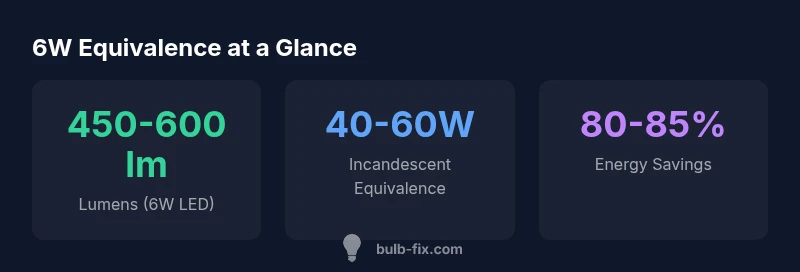
What is a 6w bulb equivalent to? In most homes, a 6W bulb (typically an LED) is roughly equivalent to a 40–60W incandescent in brightness, depending on the lumen output. Modern 6W LEDs generally emit about 450–600 lumens, with higher-end models reaching or exceeding 700 lumens. The key metric is lumens, not watts, because lumens measure perceived brightness. When budgeting for energy savings, aim for a lumen target rather than a wattage target.
What 6W Really Means
If you're asking what is a 6w bulb equivalent to, the short answer is that wattage alone does not tell you how bright a bulb will be. In common household lighting, a 6W bulb—typically a compact LED or similar energy-efficient lamp—aims to deliver brightness comparable to a 40–60W incandescent. The exact brightness depends on the device's lumen rating, which is the true measure of light output. Across 2026 product lines, many 6W LEDs provide roughly 450–600 lumens, though some premium models push toward the upper end of that range. When planning lighting for a room or fixture, prioritize lumens per watt and the target lumen level for the task at hand, not wattage alone. This shift—from watts to lumens—lets you quantify brightness consistently across different bulb technologies.
Lumens, Not Watts: The Brightness Equation
Wattage measures energy use; lumens measure perceived brightness. A 6W bulb may sip electricity, but how bright it looks depends on its lumen output and color temperature. When you compare bulbs of different technologies (LED vs CFL vs incandescent), lumen ratings give you a fair, apples-to-apples comparison. For example, a 6W LED bulb labeled 450–600 lumens will feel similar in brightness to a 40–60W incandescent—but the energy draw is far lower, and the LED typically lasts longer. In practical terms, lumens tell you how a room will feel to your eyes, while watts tell you how much energy you’ll consume. This distinction is foundational to modern lighting choices.
Typical lumen outputs for 6W LEDs
Most 6W LEDs designed for household use fall in a brightness band of roughly 450–600 lumens. In practice, you’ll see a few models around 420–450 lumens for budget lines or dimmable options that reduce output gracefully, and premium variants that push toward 650–700 lumens or more. For reference, a 60W incandescent traditionally provides about 800 lumens, so a 6W LED sits well below that at typical room brightness levels, but the energy savings are substantial. If you’re upgrading multiple fixtures, calculating total lumens across the space is more informative than comparing single-bulb wattages.
How to translate 6W into incandescent equivalents
The rule of thumb is: 6W LED ≈ 40–60W incandescent, with the exact match depending on lumens. The same wattage label can be misleading because two bulbs rated 6W may deliver different lumens. To ensure you’re meeting brightness targets, read the lumen range on the package and, if possible, compare lumen-per-watt efficiency. The LED’s color temperature and beam angle also affect perceived brightness; a 6W bulb with a narrow beam may feel dim in a wide fixture, while a wider beam with higher lumen output will illuminate more of the room. In short, luminosity governs brightness, not wattage alone.
Reading packaging and labels: lumens, not watts
Package labels increasingly emphasize lumens and sometimes “equivalent to” wattage. Look for a lumen range (e.g., 450–600 lm) and a color temperature (2700–3000K for warm light). Some bulbs list an incandescent equivalence (e.g., “equivalent to 40W”). Remember that these equivalence numbers are rough guides; actual brightness varies by LED quality, diffusion, and design. If you’re replacing bulbs in a fixture that relies on precise brightness (reading lamps, task lighting), the safest approach is to match lumen output to the existing bulb rather than chasing a wattage target. This practice reduces under- or over-lighting issues in rooms like kitchens and home offices.
Dimming, color temperature, and beam angle considerations
Dimmability matters when replacing non-dimmable incandescent bulbs. If your fixture uses a dimmer, ensure the 6W bulb is labeled dimmable and compatible with your dimmer type. Color temperature (Kelvin) affects mood; 2700K–3000K produces warm, cozy light, while 4000K–5000K is crisper and closer to daylight. Beam angle dictates how that light spreads; a narrow beam (spotlight) concentrates brightness in one area, while a wide beam fills a room more evenly. When choosing a 6W bulb, align lumens with the fixture’s purpose, select a compatible dimming option, and consider color temperature for the room’s task and ambiance.
Practical examples by fixture type
- Ceiling fixtures in living rooms: aim for 2,000–4,000 lumens total across the space; a mix of 6W LEDs in multiple fixtures can achieve even lighting.
- Kitchen task lighting: higher-lumen task lighting (450–600 lm per fixture) helps with cooking and food prep.
- Bathrooms and vanity mirrors: mid-range lumen levels (400–700 lm) with a warmer color temperature improves clarity without harsh glare.
- Bedrooms: softer ambient lighting (300–500 lm per fixture) creates a relaxing atmosphere.
Common mistakes and quick fixes
- Assuming wattage equals brightness: always check lumens.
- Overrelying on a single bulb: lighting quality comes from multiple sources and proper layering.
- Ignoring dimmer compatibility: use dimmable 6W LEDs with compatible dimmers.
- Not considering color temperature: cooler temperatures feel brighter but may feel less cozy; pick a temperature that suits the room.
How to choose the right 6W bulb for your home
Start by mapping each room’s lighting goals and measuring areas that need task lighting versus ambient light. List required lumens per fixture, check the color temperature for the space, and confirm dimmability if you have adjustable lighting. Compare bulbs by lumen output rather than watts, and verify the base type (E26, GU10, etc.) to ensure a proper fit. If you’re replacing bulbs in a fixture with a dimmer, buy 6W bulbs labeled as dimmable and tested for compatibility with your dimmer switch. Finally, consider longevity and warranty as indicators of overall value, not just initial brightness.
Approximate equivalence by LED wattage
| LED Wattage (W) | Approx Incandescent Equivalent | Typical Lumens | Notes |
|---|---|---|---|
| 6 | 40-60 | 450-600 | Common replacement for compact fixtures |
| 9 | 60-75 | 600-800 | Mid-range brightness |
| 12 | 75-100 | 800-1100 | Bright spaces |
Got Questions?
What lumen range should I expect from a 6W LED bulb?
Most 6W LEDs deliver about 450–600 lumens, depending on efficiency and design.
Most 6W LEDs give roughly 450 to 600 lumens, depending on the model.
Are all 6W bulbs dimmable?
Not all 6W bulbs are dimmable. Check the packaging and choose bulbs labeled as dimmable if you have a dimmer switch.
Not all 6W bulbs are dimmable; look for dimmable labeling if you need dimming.
Can I use a 6W LED in place of a 40W incandescent in all fixtures?
In most cases, yes for brightness, but ensure the socket base and dimmer compatibility match the fixture.
Usually, a 6W LED can replace a 40W incandescent, but check socket type and dimmer compatibility.
How do I know if a 6W bulb fits my fixture?
Check the base type (e.g., E26/E27, GU10) and verify the bulb size fits the fixture housing and shade.
Look at the base type and size to ensure the bulb fits your fixture.
Besides wattage and lumens, what matters most?
Color temperature, CRI (color rendering), and beam angle affect how the light feels and behaves.
Color temperature, CRI, and beam angle matter as much as lumens.
How many lumens do I need for a living room?
Living rooms typically benefit from 2,000–4,000 lumens total, distributed across multiple fixtures depending on room size.
Most living rooms use about two to four thousand lumens in total, spread across fixtures.
“Wattage numbers are a rough guide. For real brightness, look at lumens and how the light is distributed in the space.”
Key Points
- Focus on lumens, not watts, when comparing bulbs.
- A 6W LED commonly equals 40–60W incandescent in brightness.
- Check color temperature and dimmability in addition to lumen output.
- Read packaging for lumen range and base type to ensure a proper fit.
- Plan multi-fixture lighting to achieve even room illumination.