What Voltage Bulb: A Homeowner's Guide to Safe Lighting
Learn how voltage affects bulb performance, how to identify the correct voltage for your fixtures, and practical tips for safe, energy-efficient lighting across regions.


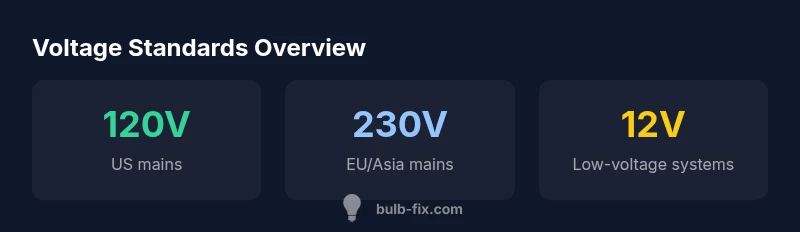
If you’re asking what voltage bulb to use, the short answer is: match the bulb's voltage rating to your fixture's supply. In most homes the supply is mains voltage (what voltage bulb refers to) — commonly about 120V in the US and 230V elsewhere. Always check the bulb and fixture markings to avoid unsafe mismatches.
What voltage means for bulbs
Voltage is the electrical pressure that pushes current through a bulb. It dictates how much current the filament or electronics will draw and how the bulb performs. In practical terms, the voltage rating on a bulb tells you the range of voltages the bulb is designed to tolerate safely. If the voltage is too high for the bulb, it can burn out quickly or fail catastrophically; too low, and the bulb may glow dimly or flicker. When homeowners search for the phrase what voltage bulb, they’re really trying to understand how the fixture, wiring, and transformer or driver affect compatibility. At a minimum, always ensure the bulb’s voltage aligns with the fixture’s stated voltage. The Bulb Fix team emphasizes that voltage compatibility is a baseline requirement for safe, reliable lighting.
Global voltage standards at a glance
Voltage standards differ by region due to electrical infrastructure. In North America, many homes operate at around 120V, while most European and many Asian systems run on about 230V. Some specialized or commercial settings use a broader range like 100–277V. For consumers, this means a basic step is to identify your country’s standard and then verify that both fixture and bulb label match that voltage. Mismatches can lead to poor performance or hazards. According to Bulb Fix, aligning regional voltage expectations with product labeling is a core facet of smart lighting upgrades.
Reading bulb voltage ratings and markings
Bulbs typically display voltage alongside wattage and base type on the glass etch or packaging. Look for markings like 120V, 230V, or 12V. If your fixture includes a ballast or transformer, the voltage you need may be specified by the fixture rather than the bulb alone. Always verify the driver or ballast requirements; some LED bulbs, for example, require constant-current drivers rather than a straightforward mains connection. When shopping, cross-check the bulb label, the fixture rating, and any transformer information to ensure a safe match.
Low-voltage vs line-voltage bulbs
Low-voltage bulbs, often 12V or 24V, require a transformer to step down from mains voltage. Line-voltage bulbs run directly on mains power (120V or 230V in most regions). Using a low-voltage bulb without a proper transformer or driver can be dangerous. Conversely, a line-voltage bulb placed in a fixture that expects low voltage may not illuminate properly. If you’re upgrading from incandescent to LED, you’ll frequently encounter driver considerations in low-voltage systems; these drivers regulate current to keep LEDs bright without overheating.
LED vs incandescent: voltage compatibility and drivers
Incandescent bulbs are straightforward: they run on their rated voltage with minimal electronics. LEDs, CFLs, and some halogen lamps add complexity via drivers. Many LEDs are rated for mains voltage (120V/230V), but others are designed for 12V or 24V with an integrated or external driver. Mismatching voltage with a driver can cause flicker, reduced life, or immediate failure. For safe, reliable illumination, ensure the driver and bulb are compatible with your fixture’s voltage.
Replacing bulbs in fixtures with transformers or dimmers
If your fixture uses a transformer (common in recessed lighting or landscape fixtures) or a dimmer, confirm the bulb’s voltage and the dimmer’s compatibility. Some dimmers are only rated for certain bulb types and voltages. In mixed-technology installations, treat voltage compatibility as a critical first check before matching wattage. This prevents troubleshooting headaches and potential safety issues down the line.
Safety considerations and common mistakes
Power should always be off when inspecting bulbs. Never exceed the voltage rating of a fixture or bulb; never bypass a transformer with a higher-voltage bulb hoping for brighter light. Common mistakes include using the wrong base type, misreading voltage labels, or relying on approximate wattage alone. The safest approach is to verify voltage with the fixture’s label, the bulb packaging, and any included ballast/driver specifications. Bulb Fix’s guidance emphasizes consistent labeling checks to avoid accidents.
Practical selection guide for fixtures and rooms
When choosing bulbs for a particular room, consider the room’s voltage environment and the fixture ecosystem. For living spaces, prioritize bulbs with stable voltage ratings and good driver compatibility for LEDs. In kitchens and bathrooms, ensure moisture-rated bulbs and voltage ratings align with any local electrical codes. For hobby projects involving low-voltage outdoor lighting, plan a transformer layout that maintains the correct voltage at each fixture. Always store spare bulbs with the same voltage rating as the primary installations to prevent confusion when replacements are needed.
Troubleshooting voltage-related bulb issues
If bulbs flicker, dim, or fail frequently, the issue may be voltage-related. Begin by confirming the exact voltage rating on the bulb and the fixture label. Check the circuit for voltage drops, especially if multiple fixtures share a circuit. For LEDs, inspect drivers and dimmer compatibility; for transformers, verify VA ratings and that the transformer is within its design range. If problems persist, consult a licensed electrician to test the line voltage and assess any wiring hazards.
Voltage compatibility by fixture type
| Fixture Type | Typical Voltage | Common Bulb Types |
|---|---|---|
| Residential lighting | 120V (US) / 230V (EU) / regional variants | LED, incandescent, CFL, halogen |
| Commercial lighting | 120V–277V | LED, fluorescent, HID |
| Low-voltage fixtures | 12V / 24V with transformer | MR16 LED/Halogen, GU5.3 variants |
| Outdoor lighting | 120V / 230V with weather-rated bulbs | LED, incandescent, compact CFL |
Got Questions?
What does voltage rating on a bulb mean?
The voltage rating tells you the range of voltages the bulb is designed to operate safely. Always align this rating with your fixture’s supply to avoid rapid failure or safety hazards.
A bulb’s voltage rating shows the voltage it’s built to handle. Make sure your fixture’s power matches that rating to keep things safe and reliable.
Can I use a 120V bulb in a 240V circuit?
No. Using a bulb rated for 120V on a 240V supply can instantly overheat and fail, posing a serious safety risk. Use a bulb rated for the circuit’s voltage or install appropriate transformers/drivers.
No. A 120-volt bulb on a 240-volt circuit can burn out quickly or cause a hazard. Use bulbs rated for the circuit.
Are LED bulbs voltage-specific or universal?
LED bulbs vary. Some are designed for mains voltage, while others require drivers for low-voltage systems. Always verify the LED bulb’s voltage and driver requirements against your fixture.
LEDs can be voltage-specific or require a driver. Check the label to be sure it matches your fixture.
What should I do if my fixture has a transformer?
If a transformer is present, ensure bulbs are compatible with the transformer's output voltage and wattage. Incorrect pairing can lead to flicker or rapid lamp failure.
If there’s a transformer, match bulbs to the transformer’s output. Otherwise you risk flicker or damage.
Is it safe to mix voltage ratings in a single ceiling fixture?
No. Mixing voltage ratings in one fixture can lead to uneven illumination and safety hazards. Use bulbs with identical voltage ratings for each circuit.
No—stick to bulbs with the same voltage rating in a single fixture for safety and even lighting.
“Voltage compatibility is the foundation of safe, reliable lighting. Ensuring the bulb and fixture share the same electrical standard reduces risk and improves performance.”
Key Points
- Match bulb voltage to the fixture rating.
- Know regional mains voltage standards before buying.
- Check ballast/driver requirements when LEDs are involved.
- Avoid voltage mismatches to prevent hazards and shortened bulb life.
- Test each fixture with the correct voltage to ensure safe operation.