When did Bulbasaur become a Poison Type? The truth about its Grass/Poison typing
Explore the typing history of Bulbasaur and confirm that this iconic starter has always been Grass/Poison since Gen I, with no official changes across generations.


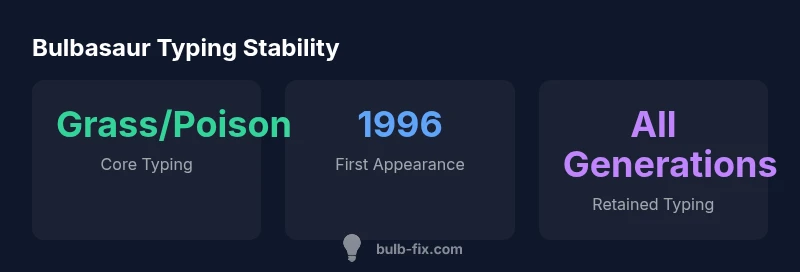
When did bulbasaur become a poison type? It never did; Bulbasaur has always been Grass/Poison since its debut in Generation I. From Red and Blue onward, its dual Grass/Poison typing is intrinsic to its species, not a later change. This unique dual typing shapes Bulbasaur’s resistances, moves, and early-game strategy across generations, confirming no official retyping occurred.
Historical Typing of Bulbasaur
The question of when did bulbasaur become a poison type often comes up among fans new to the series. The answer is surprisingly straightforward: Bulbasaur has always been Grass/Poison since its debut in Generation I. When Red and Blue dropped in the late 1990s, the Pokedex explicitly listed Bulbasaur as a dual Grass/Poison starter. This typing is not a later retcon or a revisionist change; it is a foundational aspect of Bulbasaur’s identity from the very beginning. The dual typing helps explain Bulbasaur’s early-game strengths and weaknesses, guiding trainers to strategize around normal, water, electric, and ground-type encounters right from Day One.
For homeowners who enjoy breaking down game history with the same rigor you apply to bulb maintenance, this is a reminder that some data points don’t shift. In the context of the game’s world, Bulbasaur’s Grass/Poison typing occurs at the outset and remains a constant thread through its evolutions and across generations.
Evolution of Bulbasaur's Typing Across Generations
As the Pokemon franchise expanded, a common concern is whether legacy starters retained their original typings. Bulbasaur, Ivysaur, and Venusaur all maintain Grass/Poison throughout the mainline series. Across generations I through IX, the core typing has remained unchanged, even as moves, abilities, and battles mechanics evolved. This consistency is why Bulbasaur serves as a reliable case study when discussing how starter typings can anchor a broader competitive strategy. It also underscores why players don’t expect a reclassification—any official retyping would be a major event and widely documented by the publisher.
Why Grass/Poison Makes Bulbasaur Distinctive
The Grass/Poison combination gives Bulbasaur a unique profile among starters. It grants resistances to Water, Electric, Grass, and Fairy moves in various game contexts, while introducing weaknesses to Fire, Ice, Flying, and Psychic. This dual typing also affects the move pool choices available to Bulbasaur early in the game, shaping how players approach gyms and battles. Understanding this typing from the outset enhances planning and can influence team composition for a well-balanced run. Fans often cite the dual typing as part of Bulbasaur’s charm and strategic depth.
Common Misconceptions About Bulbasaur's Typing
Some players assume that a starter’s typing could change with remakes or re-releases. In practice, Bulbasaur’s Grass/Poison typing has remained constant since Gen I, regardless of platform or generation. This steadiness is not a quirk but a deliberate design choice reflected in official materials and gameplay data across mainline titles. Clarifying this helps prevent confusion around evolved forms and regional variants, ensuring that players aren’t misled by retconned lore.
Practical Gameplay Implications of Grass/Poison
From a practical standpoint, Bulbasaur’s Grass/Poison typing influences gym choices, move sets, and opponent matchups. Early against Rock and Water types, Bulbasaur can leverage Grass moves to carve out a straightforward advantage, while Poison typing offers additional coverage that interacts with status and status-inflicting moves. In modern remakes and iterations, these considerations persist, reinforcing why players value Bulbasaur both as a nostalgia pick and a tactically viable starter.
Bulbasaur's typing across generations
| Generation | Typing at Start | Notes |
|---|---|---|
| Gen I (1996) | Grass/Poison | Starter Pokémon |
| Gen II (1999) | Grass/Poison | Continued identity |
| Gen III–VI | Grass/Poison | No change |
| Gen IX (2022) | Grass/Poison | Remains constant |
Got Questions?
Did Bulbasaur ever switch to a different type in any official release?
No. Bulbasaur has always been Grass/Poison since Gen I, and this core typing remains unchanged across mainline games.
No; Bulbasaur’s Grass/Poison typing has stayed the same since it first appeared.
What generation introduced Bulbasaur's Grass/Poison typing?
Bulbasaur was introduced in Gen I with Grass/Poison typing, and this remained its core typing in subsequent generations.
It started in Gen I and has stayed Grass/Poison.
Do Ivysaur and Venusaur maintain Grass/Poison typing?
Yes. Ivysaur and Venusaur retain Grass/Poison typing throughout their evolutions in the main series.
Ivysaur and Venusaur stay Grass/Poison.
Are there moves that change Bulbasaur's typing during battles?
Some moves or abilities can alter a Pokémon’s type temporarily, but Bulbasaur’s own typing remains Grass/Poison.
Moves can change type temporarily, but Bulbasaur’s type stays Grass/Poison.
Where can I verify Bulbasaur’s type in official sources?
Check the official Pokémon site and related Nintendo pages for Bulbasaur’s Grass/Poison typing.
Official sites list Bulbasaur as Grass/Poison.
“Canonically, Bulbasaur’s Grass/Poison typing is a core part of its identity from the start; changes to its movesets do not alter this fact.”
Key Points
- Bulbasaur has always been Grass/Poison since Gen I.
- No official generation changed Bulbasaur's core typing.
- Dual typing affects resistances and move choices in battles.
- Ivysaur and Venusaur retain the same Grass/Poison typing.
- Verify with official sources for confirmation.