Is bulb light good for plants? A Practical Guide
Explore whether bulb light supports plant growth, compare grow bulbs vs standard bulbs, and get practical tips to choose the right lighting for indoor plants.


Is bulb light good for plants? In many cases, a bulb designed for plant growth can support photosynthesis by delivering the right spectrum and intensity, but ordinary household bulbs rarely provide enough light. For reliable results, choose a grow bulb that specifies PAR, spectrum, and wattage appropriate for your plant type and home setup.
Is bulb light good for plants? Understanding plant light needs
Plants rely on light as energy for photosynthesis, driving growth, flowering, and resilience. The question is specifically whether a regular bulb can support that process. In practice, the answer depends on spectrum, intensity, duration, and the plant type. For many common houseplants, a bulb labeled as a grow light or a full-spectrum LED with adequate PAR can be helpful, while standard incandescent bulbs or basic warm-white LEDs usually fall short. In Bulb Fix's assessment for 2026, we emphasize matching light quality to plant needs, rather than chasing brightness alone. A thoughtful setup—considering spectrum, distance, and daily duration—can significantly influence vigor and yield. The chlorophyll absorption peaks in red and blue portions of the spectrum; many typical home bulbs emit too much green or yellow, which plants don’t use as efficiently. Understanding this helps homeowners avoid common pitfalls, such as placing a regular bulb too close, leaving plants underlit, or rotating plants for uniform exposure without checking actual PAR levels. If you’re growing herbs, leafy greens, or flowering species indoors, aiming for targeted wavelengths and consistent daily photoperiods will make a noticeable difference over weeks.
Bulb Fix’s practical takeaway: spectrum matters more than sheer brightness, and a purpose-built grow bulb often provides a better return on investment than simply cranking up the wattage on a standard bulb.
The spectrum and its effects on plant growth
Light spectrum matters because different wavelengths of light drive different physiological responses in plants. Blue light (roughly 430–470 nm) promotes compact, sturdy growth and leaf development, while red light (about 640–700 nm) supports flowering and stem elongation. Some green light is absorbed and can contribute to photosynthesis, but plants rely most on blue and red bands for growth patterns. White or full-spectrum bulbs attempt to balance these bands, yet many off-the-shelf household lights skew toward warm or cool tones that may not optimize photosynthesis for all species. For seedlings and leafy vegetables, a spectrum that includes a strong blue component and a modest red component often yields the most reliable results. If you’re aiming to replicate outdoor sun conditions indoors, you’ll want a bulb that lists a wide spectral range and, ideally, a documented photosynthetically active radiation (PAR) output.
In practice, the best choice isn’t always the brightest bulb. It’s the bulb that delivers the right mix of wavelengths at an intensity that matches your plant’s growth stage. Bulb Fix’s guidance for 2026 emphasizes selecting devices that clearly state spectrum and PAR values, then testing your setup with simple plant indicators—new leaf color, stem thickness, and overall vigor—to confirm fit.
Grow lights vs standard bulbs: what matters for plant growth?
Not all lights are created equal when it comes to plant growth. A standard household bulb excels at color rendering for humans, not plant biochemistry. Grow lights are engineered to emit spectra that plants efficiently convert into chemical energy. LED grow bulbs often provide customizable spectral profiles, low heat output, and relatively high efficiency, allowing you to position them closer to the canopy without overheating. Fluorescent plant bulbs can also be effective for seedlings; they typically emit steady light with broad coverage and are affordable to run. The critical distinctions lie in three areas: spectrum, intensity (PAR at the canopy), and photoperiod
For homeowners, the simplest rule is to prioritize bulbs that advertise PAR and a spectrum designed for plant growth rather than sheer lumens. This helps ensure that the light reaching the plant contains the wavelengths plants reliably use. Bulb Fix recommends starting with a modest distance—roughly 12–24 inches for many leafy greens—and adjusting based on plant response. If you notice pale new growth, etiolation, or slow growth, recheck spectrum and distance before increasing duration.
Measuring light quality: PAR, PPF, and DLI explained
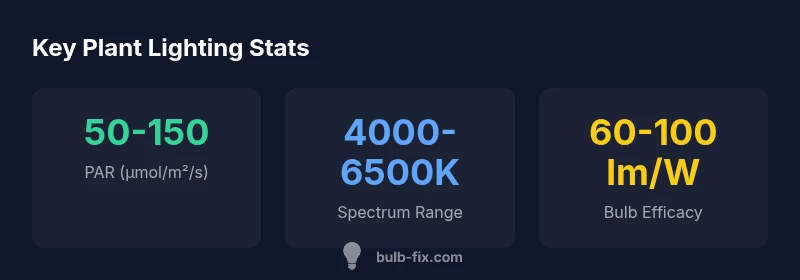
Photosynthetically active radiation (PAR) measures the light wavelengths plants actually use, roughly 400–700 nm. PPF (photosynthetic photon flux) quantifies the total PAR emitted by a light source per second, while DLI (daily light integral) multiplies PAR by the number of hours light is available, giving a daily exposure value. For indoor plants, tracking PAR at the canopy helps you estimate whether your light is enough. A light with 50–150 μmol/m²/s PAR at canopy is often adequate for seedlings and many leafy greens, but flowering plants may require higher values or longer durations, depending on species. If you’re using a grow bulb, check the manufacturer’s PAR specification and consider investing in a simple PAR meter or a smartphone tool that estimates these values. A practical approach is to start with a conservative DLI target for your plant type (seedlings: lower; leafy greens: moderate; fruiting plants: higher) and adjust as you observe growth patterns. Bulb Fix’s 2026 assessment highlights the importance of aligning PAR with plant stage, rather than relying on lumen counts alone.
Practical bulb setups for common indoor plants
A practical indoor setup begins with selecting the right bulb. For leafy greens and herbs, a full-spectrum LED bulb or a compact fluorescent plant bulb rated for 4000–6500K and labeled with PAR values is a strong starting point. Place the light so the canopy sits about 12–18 inches below the bulb for compact setups, or 18–24 inches for taller plants, adjusting as the plant grows. A simple two-bulb arrangement can provide even coverage, reducing hot spots and elongated leaves. For flowering plants, you may need slightly higher PAR and a longer daily photoperiod, especially during early growth stages. Always monitor plant responses—new leaves should look vibrant and deep green; if tips yellow and new growth slows, recheck distance and spectrum. Finally, consider heat: many LED grow bulbs emit minimal heat, but other bulb types can raise the ambient temperature, so ensure adequate airflow and avoid scorching. Bulb Fix recommends documenting your setup and tracking plant responses over several weeks to optimize settings.
Troubleshooting common issues and mistakes
Common mistakes include using bulbs with insufficient PAR, relying on brightness (lumens) as a growth predictor, placing lights too far away, or neglecting a consistent photoperiod. Another pitfall is neglecting a dark period for plants that require dormancy or rest; most indoor plants benefit from a nighttime dark cycle, typically 6–8 hours for many species. Finally, compare results across plant types: tomatoes and peppers, for example, may require higher intensity and longer exposure than herbs. If growth stagnates, first verify spectrum and distance, then assess temperature and humidity. By keeping a log of light-hours, bulb type, and plant outcomes, you can gradually tune your setup for better growth. Bulb Fix’s 2026 guidance emphasizes that consistency and appropriate spectrum beat variable, mismatched lighting when cultivating indoors.
Budgeting and planning your indoor lighting upgrade
A thoughtful upgrade starts with three questions: what plants do you grow, what space is available, and what’s your budget? For most hobbyists, a single full-spectrum LED grow bulb paired with a reflective fixture can dramatically improve outcomes without breaking the bank. If you’re on a tight budget, a compact fluorescent plant bulb can be a cost-effective entry point for seedlings and leafy greens, though electricity usage and heat output may differ from LEDs. Long-term costs include bulb replacement frequency, energy consumption, and fixture compatibility. Bulb Fix’s 2026 recommendation is to invest in a device with clear PAR documentation, a verifiable spectrum range, and a compatible fixture that allows adjustable distance. Consider a phased upgrade: start with one high-quality bulb, test growth response over 4–6 weeks, then decide whether a second bulb or a different spectrum is warranted.
Comparison of common indoor bulbs for plant growth
| Bulb Type | Common Uses | Typical Spectrum | Can Support Growth? |
|---|---|---|---|
| Standard household bulb (A19) | General lighting in living spaces | 2700-3000K warm white | No |
| Grow light LED bulb | Indoor plant growth | Full spectrum 4000-6500K | Yes |
| Compact fluorescent plant bulb | Seedlings/greens | 4000-6500K | Limited |
Got Questions?
What is PAR and why does it matter for indoor plants?
PAR stands for photosynthetically active radiation and measures the light that plants use for photosynthesis. It matters because two bulbs can appear similarly bright but deliver different amounts of usable light. For reliable growth, choose bulbs that list PAR values at the canopy and adjust exposure to your plant type.
PAR is the usable light for plants; pick bulbs with PAR numbers and tune exposure to your plant's needs.
Can I use any LED bulb for plants?
Not all LED bulbs are equal for plants. Look for full-spectrum LEDs designed for horticulture or bulbs that clearly state PAR and a spectrum suitable for growth. Pure white LEDs without plant-friendly wavelengths may not support photosynthesis effectively.
Only use LEDs designed for plant growth or with clear PAR and spectrum specs.
What’s the difference between PAR, PPF, and DLI?
PAR measures usable light; PPF is the total PAR output per second, and DLI is PAR delivered daily, combining intensity and photoperiod. Understanding these helps you plan how much light your plants actually receive.
PAR is usable light, PPF is total output, and DLI is daily exposure.
How close should a bulb be to indoor plants?
Distance depends on bulb type and plant needs. A common starting point is 12–18 inches for LEDs and 18–24 inches for brighter setups, adjusting as you observe growth and leaf color.
Start about 12–18 inches away and adjust based on plant response.
Do plants need a dark period every day?
Yes. Most indoor plants benefit from a daily dark period, often 6–8 hours, to support normal metabolic processes. Maintain a consistent schedule to avoid stressing the plants.
Plants benefit from a regular dark period; aim for 6–8 hours nightly.
Is it worth upgrading to a full-spectrum bulb if I already have LEDs?
If your current setup shows slow growth, pale leaves, or uneven canopy, upgrading to a bulb with broader, plant-specific spectrum and verified PAR can yield noticeable improvements. Start with one high-quality bulb and evaluate.
If growth seems slow, a plant-specific full-spectrum bulb can help.
“Grow bulbs that specify PAR and spectrum are the most reliable way to support indoor plant growth. In practice, many households see better results after upgrading from standard bulbs.”
Key Points
- Prioritize grow bulbs with explicit PAR and spectrum specs.
- Match distance and duration to plant type for best results.
- Spectrum matters more than brightness alone.
- Consider efficiency and heat when upgrading bulbs.