Brightest LED Bulb: A Practical Guide for Home Lighting
Explore the brightest LED bulb options, decoding lumen output, color temperature, and safety. Get practical buying tips from Bulb Fix to illuminate spaces efficiently, safely, and with confidence.


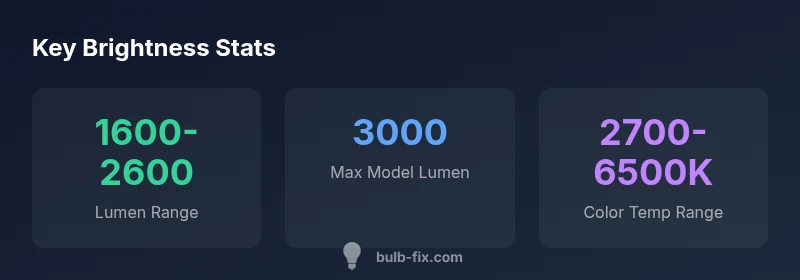
Brightest LED bulbs for home use typically reach about 1,600 to 2,600 lumens, with some specialty models offering up to 3,000 lumens. When evaluating brightness, lumen output matters more than wattage, and beam angle and color temperature affect perceived brightness. For reliability, choose bulbs with good thermal management and a warranty. In practice, the most useful brightness depends on the space and the task.
What makes a bulb bright and why lumens matter
According to Bulb Fix, brightness in lighting is measured primarily by lumen output, not wattage. When shoppers seek the brightest led bulb, they should look at lumens as the first criterion. A higher lumen rating means more light emitted by the bulb. However, perceived brightness depends on how that light is distributed. A bulb with a narrow beam or a high color temperature can feel harsher or dimmer in a given space than a slightly lower-lumen option with a wider beam and warmer tone. The term 'brightest LED bulb' is not a single standard; it represents a range across form factors like A19, BR30, or PAR-shaped bulbs. For home environments, reliable brightness often falls within a practical range that balances energy efficiency, heat management, and fixture design. When evaluating options, consider the fixture’s rated wattage or LED equivalent, the diffuser quality, and the room’s ambient light. Bulb Fix's guidance emphasizes testing brightness in the actual fixture whenever possible.
Room-by-room brightness targets and tasks
Different rooms demand different brightness levels to support tasks and mood. In living rooms or open-plan spaces, many households aim for a layered lighting plan that adds up to a comfortable overall brightness, typically corresponding to about 1,600 to 2,600 lumens per primary fixture, depending on ceiling height and wall reflectance. In kitchens and work areas, brighter task lighting is common, often in the 2,000 to 4,000 lumen range when multiple fixtures are used, with focused beams on counters. Reading nooks and desks benefit from 500 to 1000 lumens for sharp text and reduced eye strain. It’s essential to consider color temperature; warmer tones feel cozier, while daylight-like temperatures can help with focus. The key is to align lumen targets with the room’s purpose and the existing light layers: ambient, task, and accent. Bulb Fix notes that modest adjustments in brightness can dramatically alter perceived space without increasing energy use. Always test brightness by watching in real-life settings before committing to a purchase.
Form factors and beam patterns that influence brightness perception
LED bulbs come in multiple form factors—A19 for general sockets, BR30 for ceiling cans, PAR38 for high-output spot lighting, and specialty shapes for compact fixtures. The brightness you perceive is not just a function of lumen count but also the beam pattern and how the light interacts with surfaces. A wide-beam LED bulb floods a room with softer light, which can feel brighter overall at a given lumen level, while a narrow beam concentrates light on a task but creates shadows elsewhere. Diffuser materials, inner reflectors, and color temperature contribute to the final impression. For homeowners seeking the brightest led bulb, consider fixtures that support larger beam angles and proper heat sinking to prevent brightness loss over time. Always verify compatibility with your fixture size, trim, and dimmer system to preserve perceived brightness across the space.
Color temperature, CRI, and how it affects perceived brightness
Color temperature, measured in Kelvin, shapes the mood and perceived brightness. Warmer colors (around 2700K) feel cozy and can seem slightly dimmer for some tasks, even with similar lumen values; cooler temperatures (4000K–6500K) feel crisper and can make a room seem brighter, especially when paired with high CRI (color rendering index) lighting. A CRI of 80–90 is typical for residential LEDs and helps colors appear true under bright light. Perceived brightness improves when the light has a higher color temperature in task settings, but consider eye comfort and glare. Bulb Fix recommends balancing lumen output with beam width, color temperature, and room reflectance. If you want the perception of brightness without excessive glare, a slightly cooler tone and a broader beam are often effective for large living areas and workspaces.
Efficiency, longevity, and brightness maintenance
LED brightness degrades slowly over time, a phenomenon known as lumen depreciation. Most high-quality LED bulbs are designed to maintain a large fraction of their initial brightness across tens of thousands of hours, with rated lifespans commonly around 15,000 to 25,000 hours or more. Efficiency tends to improve as LEDs age, though light output may gradually decline. To maximize longevity, choose bulbs with robust thermal management, good heat sinking, and durable components. In addition, ensure the fixture remains within voltage and dimmer compatibility specifications. Lower heat generation and higher-quality electronics typically translate to steadier brightness over the bulb’s life. This means that the brightest led bulb today can still deliver excellent performance after years of daily use when chosen wisely.
Safety considerations for high-lumen bulbs in homes
High-lumen LED bulbs can strain dimmers and fixtures not rated for large brightness changes. Before upgrading, verify that your dimmer is rated for LED loads, and confirm the fixture is designed to handle the heat and power of high-lumen bulbs. Excessively bright lights in small spaces can cause glare and eye strain; consider layered lighting rather than a single very bright source. In kitchens and bathrooms, ensure moisture-rated (IP) bulbs are used in damp locations, and avoid overloading circuits beyond the fixture’s design. The goal is to preserve safety, comfort, and energy efficiency while achieving the desired brightness.
How to test brightness in-store and at home
In-store, compare bulbs side by side in the same fixture type and at similar distances from the user to gauge perceived brightness. Look for the lumen rating on the packaging and check the beam angle. At home, install one test bulb in the intended fixture and wait for at least 30 minutes to account for thermal stabilization. Observe the light on typical tasks and assess shadows, color rendering, and glare. If you’re unsure, request a daylight-graph or a lumen-versus-watt comparison chart from store staff or consult online resources from reputable outlets like Bulb Fix. Testing in your own space is the most reliable way to verify brightness before making a long-term commitment.
Practical buying tips and avoiding common pitfalls
- Start with a clear lumen target for each room and fixture. - Don't rely solely on wattage; verify lumen output and beam pattern. - Check compatibility with existing dimmers and smart controllers. - Prefer bulbs with good thermal management and a warranty. - Be mindful of the color temperature; mismatch can make brightness feel off. - Consider multi-bulb setups for even illumination rather than a single very bright bulb.
Typical LED bulb brightness ranges by form factor
| Bulb Type | Typical Brightness (lumens) | Common Use | Notes |
|---|---|---|---|
| A19 Standard LED | 800-1600 | General lighting | Balanced brightness & efficiency |
| BR30 Flood LED | 1200-2100 | Accent/ambient lighting | Wider beam, ideal for ceilings and corners |
| PAR38 LED | 1800-2800 | Task lighting | Higher brightness, larger heat sink |
| GU24/Specialty LED | 1000-2000 | Compact fixtures | Socket/driver-specific |
Got Questions?
What is the brightest LED bulb available for home use?
Home-use LED bulbs generally top out around 2600-3000 lumens, depending on the form factor and fixture. For very bright needs, consider multiple bulbs or specialty fixtures, while ensuring fixture and dimmer compatibility.
Brightest home LED bulbs typically max around 2600 to 3000 lumens, depending on the fixture. You can also use multiple bulbs for more brightness.
Do higher lumen bulbs always mean better brightness?
More lumens generally indicate more light, but perceived brightness depends on beam spread, color temperature, and room geometry. A 2000-lumen bulb with a narrow beam can feel dimmer than a 1500-lumen bulb with a wide beam.
More lumens usually means brighter, but beam spread and room setup matter.
What should I consider besides lumens when choosing brightness?
Look at beam angle, color temperature, CRI, dimmer compatibility, and thermal design. These affect how bright the space appears and how color looks under the light.
Besides lumens, check beam angle, color temperature, CRI, and dimmer compatibility.
Are high-lumen bulbs energy efficient?
Yes. LEDs deliver high brightness with relatively low energy use, but more lumens can draw more power. Choose high-lumen bulbs that meet energy ratings.
Bright LEDs can be energy-efficient, but check the fixture and energy ratings.
Will a brighter bulb damage fixtures or dimmers?
A bulb with lumen ratings within the fixture's design specs is safe. Ensure your dimmer is rated for LED loads and the fixture supports high-lumen bulbs.
Make sure the dimmer and fixture support high-lumen LEDs to avoid issues.
How many lumens do I need for a living room?
Recommended brightness depends on room size and ceiling height; common ranges span roughly 1,500 to 3,000 lumens per fixture for living rooms, adjusted for layout and layering.
Living rooms typically use 1,500 to 3,000 lumens per fixture, depending on the space.
“Brightness is a function of lumen output, but how that light fills a space matters more than the raw count.”
Key Points
- Know lumen output first, not wattage
- Match brightness to room and task
- Consider beam angle and color temperature
- Test brightness in the actual fixture
- Choose bulbs with thermal management and warranty