LED Bulb Equivalent to 100W: A Practical Home Lighting Guide
Discover how a LED bulb labeled as a 100W equivalent compares to incandescent bulbs, covering wattage, lumens, color temperature, energy savings, and selection tips.


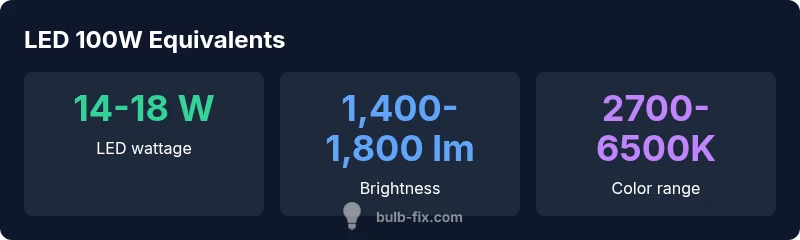
A 100W-equivalent LED bulb typically uses about 14–18 watts and delivers roughly 1,400–1,800 lumens, depending on efficiency and design. This brightness matches a traditional 100W incandescent while using far less energy, making it a common replacement for living rooms, kitchens, and lamps. When shopping, look for the lumen rating alongside the '100W equivalent' label to ensure you get the desired brightness for your space.
Why a led bulb equivalent to 100w matters
According to Bulb Fix, homeowners planning a lighting refresh often see bulbs labeled as a led bulb equivalent to 100w and wonder what that means for daily use. In practice, this phrase signals brightness, not power draw. An LED version typically uses far less energy while delivering light output close to a 100-watt incandescent. This distinction matters for energy costs, bulb replacements, and room mood. For accurate planning, focus on lumen output, not wattage alone, and read the packaging to verify lumens, color temperature, and dimming compatibility.
A typical led bulb equivalent to 100w consumes about 14–18 watts to produce roughly 1,400–1,800 lumens, depending on efficiency and design. That brightness range covers most living rooms and kitchens in homes built in the last two decades. When shopping, compare lumen ratings and color temperature in addition to the '100W equivalent' label to avoid under-lighting a space or choosing bulbs that are too harsh. In summary: watts describe energy use; lumens describe brightness, and for a given space, lumens determine light levels you perceive.
How Brightness Maps: Incandescent 100W vs LED 100W-equivalent
To compare fairly, translate every bulb to lumens rather than watts. A traditional 100W incandescent typically delivers around 1,600 lumens, while an LED labeled as a 100W-equivalent usually falls in the 1,400–1,800 lumen range. The differences come from LED efficiency and beam design. When you see '100W equivalent,' use the lumen figure on the packaging to judge brightness. Color temperature and CRI also influence perceived brightness; a cool 4,000–5,000K LED can look brighter than a warm 2,700K LED even if lumen output is similar. In homes, about 1,500 lumens is enough for general lighting in a standard living room, while task areas may benefit from brighter LEDs near 1,800 lumens. Finally, consider dimming compatibility; many LED bulbs maintain brightness smoothly across a dimmer range, but not all dimmers are compatible.
Key specs to compare beyond watts
Beyond watts, pay attention to:
- Lumens: the actual light output that affects perceived brightness.
- Color temperature (K): determines warm vs. cool lighting and influences room mood.
- CRI: how accurately colors appear under the light.
- Dimmability: ensure compatibility with your dimmers if used.
- Beam angle: wide angles fill space; narrow beams focus light on tasks.
- Lifespan and warranty: longer lifespans reduce maintenance costs.
When choosing, aim for a lumen target suited to the room and a color temperature that matches activities there. For living areas, many homeowners prefer 2700–3000K; for kitchens or task work, 3500–5000K can feel brighter and more energizing. If you’re unsure, run a quick test with two bulbs in a single fixture to compare real-world brightness and mood before committing to a bulk replacement.
Practical steps to choose the right LED replacement
Here’s a practical checklist you can follow:
- Determine the room’s lumen needs: map the size of the area to a lumen target (e.g., 1,500–2,000 lumens for a living room).
- Pick a color temperature by room function: warm whites for living rooms, cooler whites for kitchens and workspaces.
- Check efficiency: compare lumen-per-watt ratings; higher efficiency means lower energy costs for the same brightness.
- Verify compatibility: ensure the LED is compatible with fixtures, dimmers, and voltage in your home.
- Consider beam pattern: diffuse for ambient lighting; focused for task lighting.
- Compare warranties and vendor safety certifications.
With these steps, you’ll reduce under- or over-lighting and ensure a comfortable, energy-efficient space.
Common myths and pitfalls
- More watts always mean more brightness: watts measure energy use, not brightness. In LEDs, lumen output is the true brightness metric.
- All 100W-equivalent LEDs are the same brightness: lumen values vary by model; always read lumens rather than relying solely on the label.
- Higher color temperature equals cooler color only: higher Kelvin values also alter mood; choose based on activity and space.
- Dimming works with all LED bulbs: not all bulbs are compatible with every dimmer—check the dimmer type and bulb specs.
Room-by-room guidance for selecting LED bulbs
- Living room: aim for around 1,500–1,800 lumens total with 2700–3000K warmth for a cozy feel. Use multiple light sources to avoid harsh shadows.
- Kitchen: bright task lighting around 3,000–4,000K; consider under-cabinet LEDs with higher lumens per watt for clarity.
- Bedroom: softer lighting around 2,000–2,700K with layered lighting (ambient + task).
- Hallways/entryways: use mid-range temps (3,000K) and cumulative brightness from several fixtures to avoid dark corners.
- Home office/study: aim for 3,500–4,000K for alertness with even distribution and minimal glare.
Economic considerations: energy savings and payback
Energy savings from switching to LED bulbs accumulate over time. The exact payback period depends on your usage pattern, local electricity costs, and the number of fixtures replaced. In general, homes see substantial annual savings when replacing frequent-use incandescent bulbs with LED equivalents. Bulb Fix analysis notes that many households recoup costs within months to a few years, especially where bulbs are left on for extended periods. When evaluating a project, calculate the total number of bulbs, average daily usage, and local energy prices to estimate payback precisely.
Comparison: incandescent 100W vs LED 100W-equivalent bulbs
| Aspect | Incandescent 100W | LED 100W-equivalent | Notes |
|---|---|---|---|
| Wattage (consumed) | 100 | 14-18 | LED watts to reach similar brightness |
| Brightness (lumens) | 1,600-1,800 | 1,400-1,800 | Lumens vary by model; choose based on target room |
| Energy cost/year | Higher | Lower (depends on usage) | LED saves energy over time |
| Lifespan (hours) | 1,000-2,000 | 15,000-25,000 | Longer lifespan reduces replacements |
Got Questions?
What does '100W equivalent' mean for LED bulbs?
The phrase indicates the LED bulb produces roughly the same brightness as a 100-watt incandescent, based on lumens rather than wattage. It helps you estimate light output, but always confirm the lumen rating on the package.
It means similar brightness to a 100W bulb; check the lumen rating to compare.
How many watts does a 100W-equivalent LED typically use?
Most 100W-equivalent LEDs use about 14–18 watts. Exact wattage varies by efficiency and design, so always check the lumen output to gauge brightness.
Usually 14 to 18 watts; look at lumens as well.
Are there differences in color temperature for 100W-equivalent LEDs?
Yes. LEDs come in warm, neutral, and cool temperatures. For living spaces, warm white (2700–3000K) is common; for task lighting, 3500–5000K can feel brighter and crisper.
Yes—pick warm or cool temps based on the room.
Can I replace a 100W incandescent with a dimmable LED?
Most 100W-equivalents are dimmable, but confirm compatibility with your dimmer switch and keep wattage within the dimmer's range.
Yes, many are dimmable; check dimmer compatibility.
What should I consider besides watts when choosing LED bulbs?
Look at lumens, color temperature, CRI, beam angle, and warranty. A higher lumen rating with appropriate color temperature achieves the desired brightness.
Check lumens, color, CRI, and beam angle, not just watts.
“LED technology has matured enough to reliably deliver brightness at a fraction of the energy used by incandescent bulbs, making the 100W-equivalent label a practical brightness proxy for most homes.”
Key Points
- Start with lumens, not watts, when shopping.
- Choose color temperature to match room mood and task needs.
- Check dimmer compatibility for any LED used with controls.
- Compare life expectancy to minimize replacement costs.