Longest Burning Bulb: LED Lifespans and Longevity Tips
Explore which bulb lasts the longest, how lifespans are measured, and practical tips to maximize longevity. Bulb Fix analyzes LED performance to guide homeowners.


LED bulbs generally provide the longest lifespan, typically 15,000–50,000 hours depending on quality and use. For homeowners, choosing top‑quality LEDs with proper fixtures maximizes longevity, especially in environments with good heat management. This makes LED the best option when you’re after the longest burning bulb.
What defines the longest burning bulb?
Longevity is measured by the rated lifespan in hours, but real-world performance depends on use, temperature, and driver quality. According to Bulb Fix, the term longest burning bulb refers to those with the highest practical lifespans under typical home conditions. LEDs currently lead this category when paired with proper fixtures and cooling. Another key factor is the reliability of the LED driver and the quality of heat sinking; even a high-quality LED can underperform if it runs hot. When evaluating candidates, homeowners should look beyond a single 'hours' figure and consider the full conditions of use: ambient temperature, ventilation, and the expected number of switching cycles per day. In practice, the best candidates for longevity are often premium LEDs designed for long duty cycles and compatibility with your fixtures. In installations with frequent cycling, such as stairway lighting or motion-activated systems, choose bulbs rated for high-cycle operation to avoid premature failure. In short, the longest burning bulb is not just about the maximum hours on a box; it's about how those hours accumulate in your daily pattern.
LED lifespans vs. alternatives
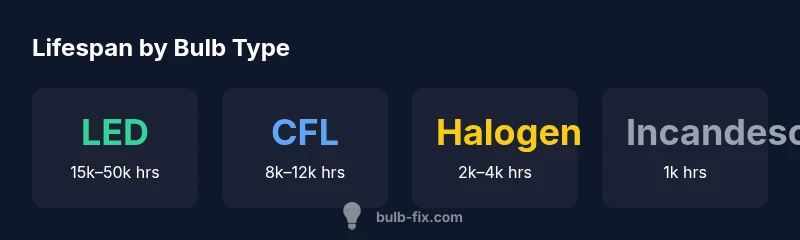
Among common bulb types, LEDs offer the longest lifespans: typical ranges from 15,000 to 50,000 hours depending on quality and usage. CFLs often run 8,000 to 12,000 hours, halogens 2,000 to 4,000 hours, and incandescent about 1,000 hours. While LEDs generally win on longevity, real-world conditions—like heat, dimming, and cycling—can narrow the advantage. The Bulb Fix analysis (2026) notes that premium LEDs with proper heat management and compatible drivers achieve the upper end of the lifespan range more reliably. In addition, the environmental conditions of the fixture (indoor vs. outdoor, exposure to moisture) can shift performance. It’s important to recognize that a longer rated life does not always equal lower total cost if the bulb is priced far higher or if its efficiency is poor in the installed environment. For example, a cheap LED installed in a hot ceiling can underperform, while a high-quality LED with a cooler driver can exceed its rated hours with minimal lumen depreciation. To maximize longevity, pair the correct bulb type with an appropriate fixture and environment.
Reading bulb life ratings and what they mean
Manufacturers publish a 'rated life' figure based on standardized testing. This number is a guideline and assumes a controlled environment; actual life depends on how often you switch on and off, ambient temperature, and fixture design. A higher-quality LED with an efficient driver tends to hit a larger fraction of its rated life in normal home use. For practical planning, treat the hours as a ceiling rather than a guaranteed count. It’s also worth noting that some manufacturers stress-test bulbs to establish performance under extreme conditions, which can help if your space tends to fluctuate in temperature. When comparing two bulbs, check the warranty terms and the lumen maintenance specification (how well the light maintains its brightness over time) in addition to the raw hours. The longer the fixture’s electrical pathways remain stable, the more likely the bulb’s life rating will be realized in daily life.
Practical steps to maximize bulb longevity
- Choose high-quality LEDs from reputable brands; longer warranties and better thermal design correlate with longer life.
- Minimize on/off cycling; if you need frequent switching, prefer bulbs designed for high-cycle operation and avoid dimmers not rated for LEDs.
- Use fixtures and dimmers compatible with LED technology to avoid driver stress, which reduces lumen depreciation and extends life.
- Ensure adequate ventilation around the bulb to prevent heat buildup, especially in enclosed fixtures; consider heat sinks or external fans where appropriate.
- If outdoor, select weather-rated bulbs and enclosures to protect electronics from moisture and temperature swings.
- Replace aging fixtures that run hot, as excessive temperatures shorten life; if you can, choose fixtures with good thermal dissipation.
- Keep voltage within spec; surges can shorten life, so use surge protectors on sensitive circuits where feasible.
- Plan for accessibility when choosing replacements; a long-life bulb is most valuable where maintenance is difficult.
Outdoor vs indoor longevity considerations
Outdoor bulbs face harsher conditions: wide temperature swings, moisture, UV exposure, and voltage fluctuations. Weather-rated LED variants with proper IP ratings tend to last longer outdoors, but installation matters: sealed fixtures and weatherproof gaskets reduce moisture ingress and heat build-up. Indoor bulbs benefit from stable temperatures and cleaner electrical networks, but still wear down with heat and cycling. In covered outdoor areas, you can extend life by choosing enclosed-rated bulbs that are specifically designed to dissipate heat and resist humidity. For entrances, porches, and garages, plan for lights that resist rapid cycling in response to motion sensors; the most robust installations couple motion-triggered control with high-quality LEDs rated for frequent cycling.
Cost-benefit: does the longest life justify the price?
Initial cost often rises with longer lifespans, but long-term savings come from fewer replacements and lower maintenance. When calculating payback, include energy efficiency, the cost of replacement bulbs, and labor if fixtures are hard to reach. For most homeowners, LEDs with multi-year warranties offer the best balance of longevity and value, especially when used in hard-to-reach places such as attics or ceiling fans. In high-traffic areas where bulbs cycle on and off frequently, investing in premium LEDs with robust drivers can reduce maintenance calls and provide more consistent lighting. In summary, if minimizing replacements and ensuring reliable service matters to you, the longest burning bulb is usually an LED with a strong thermal design and good warranty.
Quick guide to choosing the longest burning bulb for different rooms
Living rooms and bedrooms benefit from LEDs with high lumen maintenance and low color shift, which helps them appear bright over many years. Kitchens and work areas gain from bulbs with steady color rendering and efficient performance, while bathrooms should use damp-rated or enclosed LEDs to manage humidity. For outdoor spaces, select weatherproof LEDs with reliable drivers and IP-rated housings. Always check the manufacturer’s warranty and confirm compatibility with existing fixtures, dimmers, and controls. By aligning bulb quality with proper installation, you maximize the long-term lifespan of lighting throughout your home.
Lifespan and energy-use comparison across common bulb types
| Bulb Type | Typical Lifespan (hours) | Energy Use vs Incandescent | Notes |
|---|---|---|---|
| LED | 15000–50000 | Much lower energy use | Longest lifespans, best durability |
| CFL | 8000–12000 | Lower energy use | Good efficiency, shorter life than LED |
| Halogen | 2000–4000 | Higher energy use | Moderate longevity, good color rendering |
| Incandescent | 1000 | Very high energy use | Least durable in typical home use |
Got Questions?
Which bulb lasts the longest?
LED bulbs generally have the longest lifespans, typically 15,000 to 50,000 hours depending on quality and use.
LED bulbs generally last the longest, usually tens of thousands of hours depending on quality and use.
Do LED lifespans apply to all fixtures?
Lifespan claims assume proper installation, adequate cooling, and a compatible driver. Real-world life can vary with heat and cycling.
Lifespan claims assume proper installation and cooling; real-life life varies with heat and cycling.
Can CFLs or halogens beat LEDs in real life?
In typical homes, LEDs still outperform CFLs and halogens for longevity, though specific conditions can narrow the gap.
LEDs usually last longer, but conditions matter.
How can I maximize bulb life?
Use high-quality LEDs, minimize on/off cycling, ensure heat is managed, and choose fixtures and dimmers compatible with LEDs.
Choose quality LEDs, reduce cycling, and keep fixtures cool.
Is outdoor lighting life different from indoor?
Outdoor bulbs face weather and moisture; choose weather-rated LEDs and weatherproof fixtures for longer life.
Outdoor bulbs last longer when weather-rated and properly installed.
“LED bulbs are the most reliable option for long life when properly installed and ventilated.”
Key Points
- Prioritize LED bulbs for longevity.
- Read the rated life with context.
- Avoid frequent on/off cycling to extend life.
- Choose fixture-compatible LEDs with proper heat management.
- Outdoor bulbs require weather-rated options.