Understanding 800 lumens to watts: a homeowner's guide
Learn how to convert brightness (lumens) to energy use (watts) for LED, CFL, and incandescent bulbs. This guide covers practical formulas, typical lm/W ranges, a ready-to-use calculator, and tips to plan lighting by brightness rather than wattage.


What 800 lumens to watts means for home lighting
Brightness is measured in lumens, while energy use is measured in watts. When you hear the phrase 800 lumens to watts, you’re looking at how many watts are required to produce a given brightness, which depends on the bulb’s luminous efficacy (lm/W). According to Bulb Fix, understanding this relationship helps homeowners compare modern LEDs with older incandescent options without guessing from wattage alone. A higher lm/W means you need fewer watts to achieve the same brightness, but factors like ballast, driver efficiency, and color temperature can shift the real-world result. In practical terms, 800 lumens is a common brightness target for living rooms, bedrooms, and task lighting, and knowing the approximate wattage helps you plan fixtures, replacements, and energy use more accurately.
How lumens and watts relate in everyday lighting
- Lumens describe brightness; watts describe energy consumption.
- The same 800 lumens can come from a very low-watt LED or a higher-watt incandescent, depending on lm/W.
- Modern LEDs typically deliver more lumens per watt than incandescent bulbs, enabling significant energy savings.
- When planning a room, focus on lumens as the target brightness and use lm/W to estimate wattage.
##1. A practical framework for planning lighting goals
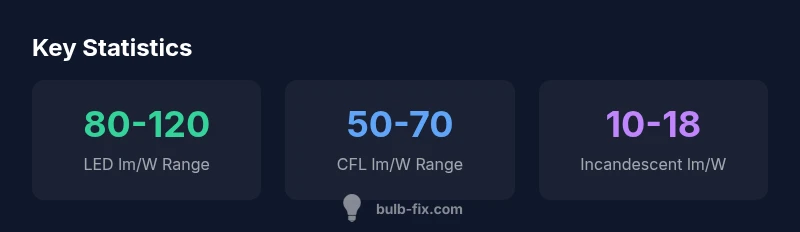
If you aim for 800 lumens in a reading nook, for example, you can estimate required wattage by dividing 800 by an assumed lm/W value. For LEDs, a typical range is roughly 80–120 lm/W, with many common bulbs around 85–100 lm/W. CFLs may sit around 50–70 lm/W, and incandescent bulbs around 10–18 lm/W. This framework helps you translate brightness goals into fixture choices without getting lost in watt labels alone.
Quick takeaway
- LED: ~6–10 W for 800 lm (depending on exact lm/W)
- CFL: ~11–16 W for 800 lm
- Incandescent: ~45–80 W for 800 lm
This section also notes that real-world results can vary due to build quality, temperature, and fixture design, so use the calculator to fine-tune estimates.
##2. Real-world factors that affect brightness-to-wattage estimates
Color temperature, beam angle, and fixture efficiency can influence perceived brightness. A bulb labeled 800 lumens may look brighter in a cool white beam focused narrowly than in a warm, diffuse spread. Dimmers, smart bulbs, and multiple bulbs in a fixture also change total wattage for the same lumen target. For accurate planning, assemble a small set of lamps and test in the actual room rather than relying on a single spec sheet. Bulb Fix emphasizes testing in place as a best practice for consistency across spaces.
Practical steps
- Use the lumen target as your guiding metric, not watts alone.
- Check lm/W ranges from manufacturer specs, especially for LEDs and CFLs.
- Factor ballast or driver losses into your wattage estimates for non-LED bulbs.
##3. Quick planning examples for common rooms
For a cozy reading corner aiming at 800 lumens, an LED bulb around 8–10 W is typically sufficient in many fixtures. A bright kitchen task light may require a similar lumen level but a cooler color temperature for clarity, potentially using a slightly higher wattage LED if the lm/W rating is at the lower end of the spectrum. In contrast, an older fluorescent setup with 800 lumens can come from a higher wattage than a modern LED solution. The key is to anchor decisions to lumen output and use lm/W to translate that brightness into energy use.
##4. How to use this guide with your fixtures
Start by identifying the lumen rating on a prospective bulb, then estimate the wattage using its lm/W figure. If you’re choosing between LED options, compare the lm/W across models rather than chasing lower watts alone. For dedicated tasks (reading, desk work, cooking), keep lumen targets close to 800 lm per area and adjust with lamps or fixtures to balance shadows and diffusion. Bulb Fix suggests documenting lumen targets room by room for consistent comfort and energy savings.