Calculate Wet Bulb Temperature at Home
Learn how to calculate wet bulb temperature using a simple, educational formula. This guide explains the concept, shows a home-friendly calculator, and offers practical tips for comfort and humidity control.


What wet bulb temperature is and why it matters
Wet bulb temperature (WBT) is a practical measure of the lowest temperature air can reach through evaporation. In homes, this value helps you gauge comfort, humidity control, and drying potential for fabrics or paints near lighting and HVAC equipment. For DIY enthusiasts, knowing how to calculate wet bulb temperature supports safer, more efficient decisions about fans, humidifiers, and ventilation. According to Bulb Fix, grasping this concept empowers homeowners to optimize indoor environments while avoiding over-drying or high humidity, which can affect electrical safety and lighting performance.
The mathematics behind a practical estimate
Calculating wet bulb temperature relies on a combination of the current air temperature and moisture content. In simple terms, WBT reflects how much cooling evaporation can occur when air is cooled and humid air is allowed to evaporate moisture. A quick, classroom-friendly way to approximate WBT uses a two-step mental model: first, determine how much water vapor the air can hold at the current temperature (saturation), then scale that by the actual humidity. This approach emphasizes the relationship between temperature, humidity, and evaporation, which is central to comfort and drying dynamics around home lighting and appliances.
The Stull approximation explained
One widely used quick estimate for wet bulb temperature is the Stull approximation. It is formulated for temperatures in Celsius and uses relative humidity in percent. The core idea is to combine arctan terms that capture the nonlinear relationship between temperature and humidity. While the formula is an approximation, it provides a fast, intelligible number that homeowners can rely on for planning ventilation, dehumidification, and cooling strategies. Remember: this is an educational tool, not a substitute for precise meteorological measurements.
Step-by-step calculation using the calculator
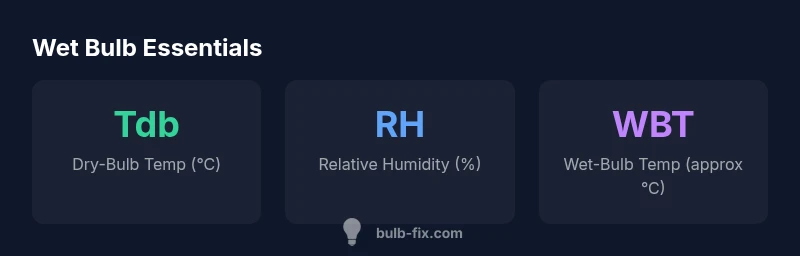
- Gather inputs: the dry-bulb temperature (°C) and relative humidity (%). 2) Enter these values into the calculator. 3) The tool applies the Stull-based approximation and rounds the result to two decimal places, returning a wet bulb temperature (°C). 4) Interpret the result as an estimate of how cool the air could become through evaporation under current conditions. 5) Use the result as a planning aid for fans, humidifiers, or ventilation updates. This workflow makes the concept approachable for DIY projects and basic comfort adjustments.
Example scenario: a common indoor setting
Suppose you measure a dry-bulb temperature of 25°C with 50% relative humidity. Using the Stull-based estimate, the wet bulb temperature is approximately 23–24°C. This means evaporative cooling could realistically lower perceived temperature by several degrees under typical indoor airflow. This example illustrates how WBT informs decisions about window opening, fan placement, and moisture management around lighting and electronics. The goal is to give you a tangible sense of how humidity steers comfort.
Limitations, accuracy, and practical considerations
The Stull approximation is a convenient educational tool, but it has limits. It assumes standard atmospheric pressure near sea level and typical indoor air movement. At high altitudes or unusual pressure, the estimate may deviate from a true psychrometric calculation. For safety-critical tasks—such as equipment placement or dehumidification for sensitive processes—rely on calibrated sensors and professional guidance in addition to the WBT estimate.
Tips for homeowners and DIY enthusiasts
- Use WBT as part of a broader humidity strategy, not as a standalone control. - Compare wet bulb, dry bulb, and dew point to build a fuller picture of indoor air. - Pair the calculator with a simple hygrometer to monitor real-time conditions. - Re-check WBT after changes in ventilation, occupancy, or weather to see how the system responds. - When in doubt, opt for conservative humidity targets to protect finishes and electronics.