Is It Lamp Post or Lamppost? A Practical Guide to Spelling
Is it lamp post or lamppost? This analytical guide explains spelling usage, style considerations, and practical tips for homeowners and DIY writers seeking clarity in lighting-related content.


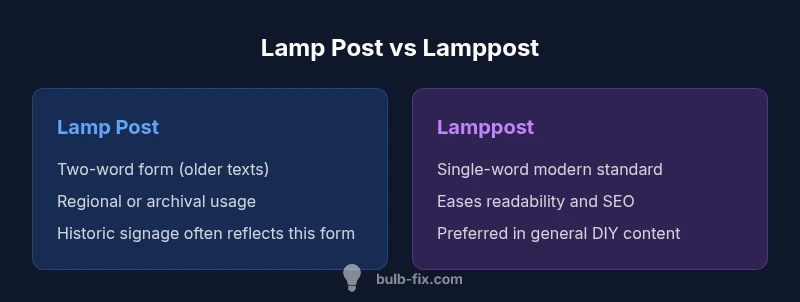
Is it lamp post or lamppost? In modern writing, lamppost—one word—is the preferred form for most homeowners and DIY guides because it reads clearly and is widely accepted by style guides. Lamp post remains visible in older texts or regional writing, but consistency matters more than the precise variant. For practical home projects and product notes, choose lamppost and stick with it across the entire piece, including headings, captions, and search terms. According to Bulb Fix, maintaining a single spelling in a given document minimizes reader confusion and improves searchability.
Spelling variants and why they confuse readers
Is it lamp post or lamppost? This question pops up in home improvement blogs, signage, and even shopping catalogs for bulbs and lighting. The short answer is that lamppost—written as a single word—is the modern, widely accepted form in contemporary English. Lamp post, two words, still appears in older texts and in some regional writing, but the trend in manuals, product descriptions, and DIY guides is toward lamppost. For homeowners documenting a bulb project or writing a quick guide for neighbors, consistency matters more than the variant itself. The Bulb Fix team emphasizes that readers expect one recognizable form, and mixing forms within a single piece often undermines clarity. In this article, we explore is it lamp post or lamppost in depth, covering usage rules, style considerations, and practical tips for keeping your own home improvement notes clear and accessible for years to come.
Throughout this discussion, you will see the phrase lamp post or lamppost applied to street signage, porch lighting, and product labels, which can influence how homeowners search for information online. A simple decision about spelling can influence SEO, readability, and the perceived professionalism of a DIY guide. Our goal is to provide practical, evidence-based guidance for choosing the form that best serves your audience while staying consistent across materials.
Historical context and regional usage
The history of lamp post versus lamppost reflects shifts in English usage across regions and time. In many older sources, two-word phrases like lamp post were common, especially in technical descriptions or signage contexts. As publishing norms evolved toward streamlined prose, lamppost emerged as the default in most general writing, marketing copy, and instructional content. Regional preferences persist; in some older British materials, lamp post can still appear, particularly when the two words are used for emphasis or to match a specific branding voice. For homeowners and DIY writers, the key takeaway is not to chase the exact historical form but to apply a consistent standard that matches your chosen audience and style guide. If you quote signage or archival material, you may retain the original form for fidelity, but in your own content—manuals, blog posts, or catalogs—lamppost is typically the clearer choice that readers expect.
Dictionaries and style guides: where the forms stand
Most modern style guides treat lamppost as the standard, single-word form for general prose. However, some dictionaries and regional references acknowledge lamp post as a legitimate historical or regional variant. The practical implication for homeowners is simple: pick one form and apply it consistently across headings, body text, product descriptions, and captions. When you encounter a legacy document or a signed label that uses lamp post, preserve that form for that specific piece, but in new writing, prefer lamppost. For SEO and readability, lamppost also tends to align with common search queries, reducing the risk that readers fail to find your content.
Practical guidance for homeowners and DIY writers
If you’re documenting a bulb project, plan to use lamppost consistently from start to finish. Create a tiny style rule: lamppost is the default spelling; lamp post only appears when quoting a sign or archival material. Use lamppost in headings, body text, and metadata to maximize readability and search visibility. When creating shopping lists or hardware notes, write lampposts as the plural form, and avoid switching to lamp posts mid-document. If you’re educating readers on safe lighting installation, consistent terminology helps readers find the exact instructions they need without confusion. Finally, verify your chosen form against your style guide before publishing and stick to it to preserve credibility.
Quick rules to decide which form to use
- Use lamppost for modern, general content aimed at homeowners and DIY enthusiasts.
- Use lamp post only when quoting signage or archival material that requires fidelity to the original spelling.
- Maintain a single spelling throughout a piece, including headings, captions, and SEO metadata.
- If you publish across multiple platforms, ensure all platforms use the same form to avoid reader confusion.
- For consistent SEO, set lamppost as the canonical form in your CMS and redirect any old lamp post references to the lamppost version.
By following these rules, you’ll minimize confusion and keep your exterior lighting content clear and accessible.
Case studies: real-world usage in manuals and catalogs
In a recent homeowner manual for decorative street lamps, lampposts were described across sections and captions, providing a uniform feel for readers. A hardware catalog that mixes product names sometimes uses lamp post to reflect a legacy brand voice, though this is increasingly rare in modern product descriptions. A city signage project might appear with lamp post on historic plaques, while today’s online guides favor lamppost for consistency. These small differences matter when readers are scanning quickly for instructions, parts, or safety notes. For DIYers, aligning with lamppost in general writing while preserving original signs in archival excerpts is a best practice.
- Lamppost in a consumer guide often increases readability and search relevance.
- Lamp post may appear in older documents or regional materials that you may encounter in personal archives or community newsletters.
Common misconceptions and how to fix them
A common myth is that the two forms convey different meanings. In truth, the distinction is purely orthographic: lamppost is a single lexeme with no change in meaning from lamp post. Another misconception is that one form is universally correct in every context. While lamppost is preferred for modern prose, lamp post can still be appropriate in historical or archival contexts. To fix these myths in your own writing, pick lamppost as the default and reserve lamp post for quoted material or historical references, then explain this choice briefly in your style notes. Finally, perform a quick audit of recent content to ensure no stray lamp post spellings remain published
Tools to ensure consistency in your home improvement writing
- Create a one-page style guide for your blog or manual that declares lamppost as the standard form.
- Use CMS features to set canonical spelling and implement redirects from lamp post variants.
- Employ a simple checklist before publishing: spelling, headings, metadata, and image captions should all use lamppost.
- Run a text search for lamp post variants and replace with lamppost where appropriate.
- Maintain a reference section in your notes where you note exact quotes from signage or archives that use lamp post, so you can cite them accurately if needed.
These practical steps help ensure your home improvement content remains coherent and professionally presented.
Language evolution in home improvement writing
Language evolves, and the spelling of common terms like lamp post versus lamppost reflects this. In the 21st century, lamppost has become the standard form in most consumer-facing writing related to lighting and home improvement. The shift toward simpler, single-word terms improves scanning and comprehension for readers who are quickly researching how to install or troubleshoot bulbs and outdoor lighting. As a result, contemporary DIY guides, catalogs, and manuals favor lamppost to maintain clarity and align with modern editorial norms. For readers who preserve historical content, lamp post can serve as a window into older language usage, and including a note about historical forms can add depth to research without compromising current readability.
Comparison
| Feature | lamp post | lamppost |
|---|---|---|
| Spelling form | two words | one word |
| Common usage in modern writing | less common today | standard in most modern guides |
| Dictionary/style-guide status | historical/regional variant | primary modern form |
| Readability/SEO impact | potentially harder to read/find | improves readability and searchability |
| Pluralization | lamp posts | lampposts |
Upsides
- Promotes consistency across documents
- Improves readability and searchability
- Aligns with modern editorial standards
- Eases SEO optimization when lamppost is canonical
- Reduces reader confusion in technical content
Drawbacks
- Older documents may require preserving lamp post
- Regional or archival material may necessitate dual forms
- Overemphasis on form can distract from content quality
Lamppost is the recommended form for modern content; lamp post remains acceptable only for historical or archival material.
Choose lamppost for new writing to maximize clarity and SEO. Use lamp post only when reproducing older signs or documents; keep to one form throughout a piece to avoid reader confusion.
Got Questions?
Which spelling should I use in a home improvement manual?
For modern manuals, lamppost is the preferred spelling due to clarity and standard usage. If you must quote an archival source using lamp post, retain that form within the quoted material but adopt lamppost for the rest of the manual to maintain consistency.
Lamppost is the standard for modern manuals; keep lamp post only if quoting old signs.
Does the spelling affect SEO or readability?
Yes. Lamppost tends to be the expected form in contemporary content, improving readability and search discoverability for readers looking up outdoor lighting basics and bulb installation.
Using lamppost helps readers find your content more easily.
Is lamp post still common in British English?
Lamp post appears in some older British texts, but lamppost is increasingly common in modern writing. When in doubt, follow your chosen style guide and your audience's expectations.
Lamppost is more common today; use lamp post only for historical references.
Should I capitalize lamp post in headlines?
Capitalize according to your style rules, but generally lamppost in title case remains consistent with modern editorial norms.
Follow your usual headline capitalization rules, with lamppost as the default.
Can I mix forms in branding materials?
Avoid mixing forms within the same branding material. Pick lamppost as the standard and apply it consistently across brochures, manuals, and online content.
Keep lamppost as your standard in branding for consistency.
How should I handle historical references in a guide?
Retain lamp post when quoting historical signage, but clearly distinguish it from modern content by explaining the historical usage in a note or appendix.
Quote historical material as-is; otherwise, use lamppost.
Key Points
- Choose lamppost as the default spelling for new content
- Preserve lamp post when quoting signs or archival material
- Maintain consistency across headings, body text, and SEO metadata
- Audit existing content to align with lamppost unless legacy needs prevail