Lamp or Lamb: Distinguishing Terms in Home Lighting
Explore the differences between lamp and lamb, pronunciation, spelling, and usage in home lighting. This Bulb Fix guide clarifies language for homeowners and DIY enthusiasts.


TL;DR: Is it lamp or lamb? In everyday lighting contexts, lamp is the correct term for the light fixture, while lamb refers to the animal. The two words are easy to confuse due to similar pronunciation for some speakers, but context usually makes the intended meaning clear. This comparison helps homeowners avoid miscommunication when shopping for lamps or discussing bulbs.
is it lamp or lamb: The roots of a linguistic confusion
According to Bulb Fix, everyday speech often blurs near-homophones, and 'lamp' and 'lamb' sit squarely in that zone for many English speakers. The question is not merely about spelling; it touches pronunciation shifts, regional accents, and the way our brains map sounds to meanings. In homes and hardware stores, people frequently mix up terms during conversations about light fixtures, replacements, and installation steps. This guide digs into the why, the how, and the practical implications, so homeowners can communicate clearly when selecting a lamp, replacing a bulb, or reading product labels. By understanding the roots of the confusion, you can reduce miscommunication and save time when shopping for lighting. The discussion also touches on how the same pattern appears in other minimal pairs, which helps you apply the lesson beyond this pair. The core takeaway is simple: context guides interpretation, but precision reduces errors, especially for DIY projects where hardware compatibility matters.
This topic matters for Bulb Fix readers who want to speak confidently about fixtures, bulbs, and installations. Is it lamp or lamb? The quick answer is to rely on context first, then confirm the product name if you’re unsure. In daily life, treating lamp as the standard term for a lighting device helps keep conversations efficient and purchases accurate.
Phonetic differences and pronunciation guidance
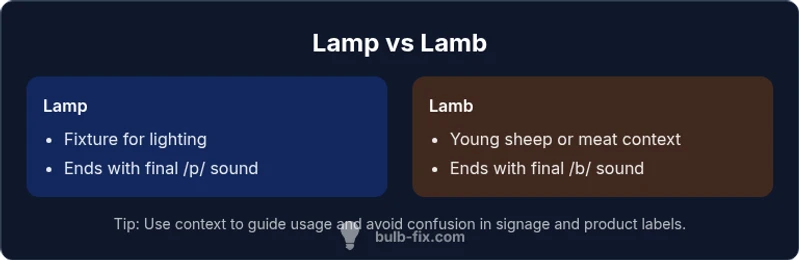
The pair lamp / lamb sits in the realm of minimal pair phonology. In many dialects, the vowel sound in both words is the same family, but the final consonant makes all the difference: lamp ends with an unvoiced p, while lamb ends with a voiced b. This voicing distinction is one of the most reliable cues listeners use to separate the words in rapid speech. For speakers who rely on regional vowel shifts, you might hear subtle differences in the middle vowel as well, though the core difference remains the p vs. b ending. A practical exercise is to say the words aloud with deliberate emphasis on the final consonant: lamp (p) versus lamb (b). In quieter settings, this small distinction can be the difference between requesting a lamp and accidentally asking for something else. If you’re teaching children or non-native speakers, practice with simple sentences like “Put the lamp on the table” and “the lamb grazes in the field” to reinforce sound-meaning mapping. Remember that many native listeners rely on context more than perfect articulation, but clear pronunciation remains a best practice in signage and shopping.
Spelling patterns and common pitfalls
Spelling is one of the most straightforward differentiators: lamp ends with a silent? not silent—an audible /p/ sound in most varieties, while lamb ends with a /b/ sound. The difference in the final consonant is the primary cue that separates the words in print and in handwriting. A common pitfall is writing lamb when you mean lamp, especially in speed writing on shopping lists or product labels. Conversely, some signage uses stylized fonts where the final consonant is not immediately legible, increasing the chance of misinterpretation. For proofreading, a reliable rule is to check the final letter: -p in lamp for fixtures, -b in lamb for the animal. In technical manuals and packaging, this distinction is reinforced by adjacent words like “lamp shade” or “lamb meat.” Finally, watch out for fonts that render p and b similarly at small sizes; in these cases, re-check product descriptions or images to confirm the intended meaning.
Context matters: when you mean lamp vs when you mean lamb
Context is a powerful disambiguator. If the sentence describes lighting, fixtures, or electrical components, lamp is almost always the intended word. If the sentence discusses animals, meat, farms, or signs in a butcher’s shop, lamb is the correct choice. Even small phrases like “lamp store” vs. “lamb store” reveal the speaker’s intent. In bilingual households, code-switching can blur this distinction further, so speakers should consider the audience and setting. A quick test is to substitute a clarifying phrase: “the lamp fixture” vs. “the lamb animal.” If the sentence still makes sense, your context is likely clear. A practical tip for DIY enthusiasts is to include product names on shopping lists and boxes, which reduces ambiguity at checkout. Remember that most confusion arises when rapid speech compresses consonants, so taking a moment to articulate the final sound can save time and reduce mistakes.
Real-world scenarios: signage, instruction, and casual speech
In signage, “Lamp” is a common noun under lighting sections, and a sign that reads “Battery for Lamp” clearly signals a lighting-related item. In instructional contexts, phrases like “install the lamp” refer to the fixture; “lamb” would never appear in that context. Casual speech often lacks careful enunciation, so listeners rely on context: a home improvement show host might say lamp repeatedly, while a farm scene would use lamb. In customer support chats, avoid abbreviations that could blur the final consonant; spelling out the word when you place an order reduces miscommunication. If you’re discussing product names, refer to the exact item code or model name to prevent cross-communication errors. This approach protects you from ordering the wrong component or misreading a label at checkout.
How to communicate clearly in home lighting projects
Clear communication begins with precise vocabulary. Use “lamp” when referring to fixtures, lampshades, and replacement units, and reserve “lamb” for animals or meat contexts. Create a simple internal glossary for family members and DIY teammates. When shopping, copy product names exactly as shown on packaging or the retailer’s site—this reduces ambiguity that comes from homophones. For signage or instructions that come from contractors, ask for a written list of items with exact names and model numbers. Finally, practice pronunciation during installation tasks to reinforce recognition: lamp, lamp shade, lamp post, vs. lamb in related animal contexts. A consistent approach to terminology saves time, reduces returns, and keeps your project on track.
Bulb Fix perspective: practical guidance for homeowners
At Bulb Fix, we emphasize practical language as part of safe, effective lighting projects. Using precise terms like lamp for fixtures and avoiding conflation with lamb helps homeowners select the correct products, read labels accurately, and communicate with store staff or electricians with confidence. Our team notes that miscommunication often leads to ordering errors or delays, especially when new homeowners or multilingual households are involved. By adopting a simple rule—lamp for fixtures, lamb for animals—you’ll improve not only shopping accuracy but also on-site safety, because installers can quickly confirm the correct part without second-guessing. For ongoing lighting problems, pairing terminology with clear measurements and product names creates a robust framework for DIY success.
Advanced nuances: dialects, borrowed terms, and cross-cultural considerations
Dialects shape how closely lamp and lamb are perceived as distinct. In some regional varieties, rapid speech can compress consonants to the point where the p and b become less perceptible, increasing the risk of confusion. Borrowed terms or brand names can blur this boundary further; for instance, a store might market a “Lambent” lamp as a decorative nod to the word lamb, requiring careful reading. Cross-cultural communication adds another layer: non-native speakers may rely more on context, so speakers should enunciate final consonants clearly and avoid rapid listing in shopping contexts. Educational materials that illustrate the pair with images—showing a lamp fixture beside a lamb animal—can reinforce correct associations. These strategies help everyone, regardless of dialect, to understand and be understood when discussing lighting.
Common mistakes and quick fixes
Common mistakes include writing lamb when lamp is intended, or mixing up the two in checklists and installation notes. A quick fix is to double-check the context of the sentence: if you’re describing a lighting accessory, replace the word with the noun you intend and verify it with the product description. Another fix is to use a clarifying phrase, such as “the lamp fixture” or “the lamb animal,” when room for doubt exists. For signages and labels, ensure the final letter is clear by testing the font at the intended display size. Finally, encourage others in your home to adopt the same terminology standard, especially when teaching children or guests who are learning English as a second language. Consistency reduces miscommunication and supports smoother DIY experiences.
Summary: rules of thumb and memory aids
Rule of thumb: lamp = lighting device; lamb = animal. When in doubt, read the surrounding words and look for contextual cues like “shade,” “bulb,” or “meat.” A simple mnemonic is to pair lamp with light and lamb with land or farm contexts. In day-to-day home projects, this quick mental check will help you articulate needs clearly, read product labels accurately, and avoid ordering errors. Frequent practice with minimal pairs strengthens listening skills and reduces misunderstandings during purchases, installations, and troubleshooting.
Comparison
| Feature | Lamp | Lamb |
|---|---|---|
| Part of speech | Noun (fixture) | Noun (animal) |
| Common meanings | Light fixture; lighting accessory | Young sheep; meat |
| Pronunciation cue | Ends with /p/ (unvoiced) | Ends with /b/ (voiced) |
| Spelling clue | Ends with 'p' | Ends with 'b' |
| Best for | Home lighting contexts | Agricultural or meat contexts |
| Example usage | Install the lamp on the table | The lamb grazes in the field |
Upsides
- Clarifies communication in everyday talk
- Supports accurate shopping and labeling
- Aids language learning and literacy
- Reduces misinterpretation in signage
Drawbacks
- Can feel pedantic in casual conversation
- May confuse non-native speakers during rapid speech
- Limited practical impact outside language or signage contexts
Lamp is the standard term for lighting fixtures; lamb refers to the animal. Use context to decide, and prefer precise product names when shopping.
In home lighting conversations, lamp should be used for fixtures, while lamb applies to animals. The two are distinct in context, spelling, and pronunciation, and clarity improves shopping accuracy and project efficiency.
Got Questions?
What is the difference in pronunciation between lamp and lamb?
Lamp ends with an unvoiced 'p' sound, while lamb ends with a voiced 'b' sound. In rapid speech, the final consonant can blur, which is why context matters. Practicing the two words aloud helps reinforce the distinction.
Lamp ends with a soft 'p' sound, lamb ends with a soft 'b' sound; context matters when listening quickly.
Why do some speakers confuse lamp and lamb?
Homophony across dialects, fast speech, and similar vowel sounds contribute to confusion. Visual context, like product labels or animal signs, typically resolves the ambiguity.
Dialects and quick speech can blur final sounds, but context usually clears it up.
Is there a spelling rule for lamp vs lamb?
The difference is the final consonant: lamp uses 'p', lamb uses 'b'. A practical approach is to memorize that lamp = lighting, lamb = animal, and verify with the surrounding text.
Final letter 'p' signals lamp; 'b' signals lamb.
How can I avoid miscommunication when buying lighting fixtures?
Always read the exact product name and model number, ask for confirmation, and use precise phrases like 'the lamp fixture' to avoid confusion with lamb in non-light contexts.
Quote the exact product name and ask for confirmation when you’re unsure.
Does 'is it lamp or lamb' appear in branding or signage?
Less common in branding; it’s more likely to appear in educational or linguistic content. Retail signage will use lamp for fixtures and lamb for animal contexts.
Branding rarely blends these terms; signage usually uses lamp for lighting.
Are there regional variations in pronunciation of lamp and lamb?
Yes, dialectal differences can reduce the audible contrast between final consonants, increasing potential confusion. Context and clear articulation help mitigate this in diverse regions.
Dialects may blur the end sounds; context helps keep meaning clear.
Key Points
- Use lamp for fixtures and lamb for animals.
- Pronounce final consonants clearly to avoid confusion.
- Double-check product names to prevent mistakes.
- Context is the best disambiguator, but precision saves time.
- Adopt a simple terminology rule across the home.