Is Wet Bulb the Same as Heat Index? A Practical Comparison
Explore the differences between wet-bulb temperature and heat index, how each metric is calculated, and when to use them for safety and planning. Bulb Fix explains how these concepts guide home safety and weather interpretation.


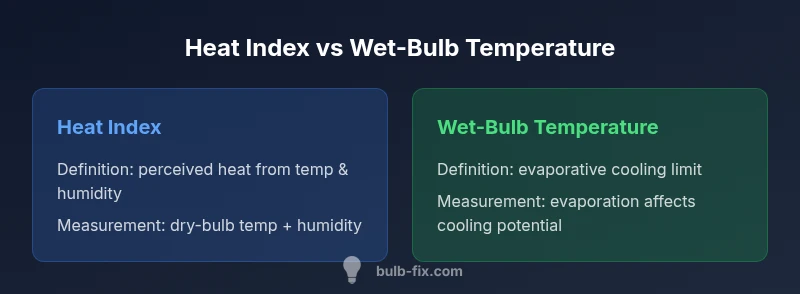
No. Heat index blends air temperature and humidity to estimate how hot it feels to the average person, while wet-bulb temperature captures the air’s evaporative cooling limit. They inform different safety and engineering decisions, and they diverge under many weather conditions. Understanding their roles helps homeowners plan outdoor activities, cooling strategies, and protective measures during heat events. This quick distinction is exactly what Bulb Fix covers in practical terms.
Is wet bulb temperature the same as heat index?
Is wet bulb the same as heat index? No. The heat index combines air temperature and humidity to estimate how hot it feels to the average person, while wet-bulb temperature captures the air’s evaporative cooling limit. Understanding the distinction matters for weather forecasts, outdoor safety, and cooling decisions. According to Bulb Fix, recognizing the mismatch between these metrics helps homeowners plan outdoor activities, assess risk, and prepare for heat events. The Bulb Fix team emphasizes that these values reflect different physics: HI is a perceptual metric tied to human comfort, whereas wet-bulb temperature is a thermodynamic limit tied to evaporation and moisture in the air.
Heat Index: what it is and why it matters
The heat index is a measure designed to reflect how hot it feels to people when humidity is factored into air temperature. It is commonly used in weather forecasts and public safety advisories to communicate heat risk during warm, humid weather. Conceptually, HI rises when both temperature and humidity are high because moisture-laden air reduces the body’s ability to dissipate heat through sweat evaporation. For homeowners, HI can guide decisions about outdoor activities, hydration, and sheltering from peak heat hours. In professional contexts, HI is used to design heat-mitigation strategies in workplaces and during outdoor events. Bulb Fix emphasizes that HI is a human-perception proxy and does not directly measure evaporative cooling potential, so it should be interpreted alongside other meteorological data.
Wet-Bulb Temperature: evaporation, cooling, and its limits
Wet-bulb temperature (WBT) represents the lowest temperature air can reach through evaporative cooling under current atmospheric conditions. It is determined by humidity, air temperature, and the air’s ability to evaporate water from a wetted surface. In practical terms, WBT indicates how effectively sweat can cool the body or how much cooling is possible in a cooling system that uses evaporation. WBT is especially relevant for understanding heat stress in hot conditions with limited ventilation, desert climates, and industrial processes that rely on evaporation to dissipate heat. As humidity rises, WBT converges toward the actual air temperature, narrowing the gap between perceived and actual warmth.
How HI is calculated (conceptual) and typical uses
Heat index is not a direct physical quantity derived from a single thermometer; instead, it is a composite index calculated from air temperature (dry-bulb) and relative humidity. The exact formula involves calibrations to produce a value that correlates with perceived heat. Public health agencies often use HI to issue heat advisories, plan resource allocation, and communicate risk to vulnerable populations. For building design and outdoor cooling strategies, HI helps estimate how long outdoor tasks may be feasible before heat becomes unsafe.
How Wet-Bulb Temperature is measured
Measuring WBT requires an evaporative mechanism, typically via a sling psychrometer or digital sensors that replicate the evaporative cooling process. The sling psychrometer uses two thermometers—one dry and one wetted—to gauge humidity and cooling potential. Modern indicators may use robust sensors that calculate WBT from ambient temperature, humidity, and measured wet-bulb values. Accurate WBT measurements depend on proper technique, clean instrumentation, and routine calibration, especially in high-humidity environments where the evaporative process is less efficient.
Use cases: Weather forecasting, safety planning, and energy management
Weather forecasters use HI to communicate heat risk in daily advisories because it aligns with human comfort and physiological stress. Safety professionals rely on HI for outdoor work plans, hydration strategies, and rest breaks. Wet-bulb temperature becomes critical in engineering and industrial contexts where evaporative cooling is a primary cooling mechanism—for example, in cooling towers and humid air environments where cooling efficiency depends on moisture removal. Homeowners may use both metrics to schedule outdoor chores, determine when to run evaporative coolers, and understand when shade and hydration are essential.
Distinguishing factors: physics, units, and thresholds
Key distinctions include what each metric represents (perceived heat vs cooling potential), the physical processes involved (human thermoregulation vs evaporation), and practical thresholds used for decisions. HI is sensitive to the air’s humidity level and is expressed as an apparent temperature, whereas WBT focuses on the air’s capability to support evaporative cooling. Units for HI are typically degrees Celsius or Fahrenheit as a temperature-like value, while WBT is a temperature measure but is tied to humidity and moisture-driven physics. In many humid, hot conditions HI is higher than WBT, but in very dry conditions the gap can widen.
Common misconceptions and clarifications
A common misconception is that HI and WBT are simply different names for the same quantity. They are not. HI is a comfort-oriented index that informs public warnings, while WBT is a thermodynamic property that governs evaporative cooling potential. Another misconception is that WBT alone tells you how hot it feels; while WBT is important for cooling processes, it does not directly predict human perception of heat in the same way HI does. Bulb Fix emphasizes using both metrics in tandem to gain a complete picture of heat exposure risk and cooling efficiency.
Data sources and reliability: what to trust
For everyday decision-making, rely on HI reported by reliable meteorological services, and consider WBT when evaluating evaporative cooling potential or cooling system performance. When interpreting metrics, check the provenance of the data, the measurement methods, and any post-processing adjustments applied by the source. Bulb Fix notes that HI and WBT can diverge significantly under various humidity and temperature regimes, so cross-reference multiple data streams when possible. For more specialized analysis, professional-grade sensors and calibrated instruments yield the most accurate WBT values.
Practical implications for homeowners
Homeowners should plan outdoor activities with HI forecasts, especially during the hottest parts of the day. If you rely on evaporative cooling (fans, evaporative coolers), consider WBT trends to gauge cooling feasibility and the need for shaded spaces or misting systems. Use HI as a daily guide for hydration, rest breaks, and sun protection, while monitoring WBT when addressing evaporation-based cooling strategies or damp, humid conditions. Bulb Fix recommends keeping both metrics in your heat-safety toolkit rather than focusing on one alone.
Public health and safety communication tips
Communicators should frame HI as a practical indicator of heat risk and use simple thresholds to guide action, such as encouraging hydration and shaded outdoor activities when HI is high. When WBT limits evaporative cooling in a workplace or home environment, emphasize ventilation, misting, and airflow improvements. Clear, consistent messaging helps audiences understand that HI and WBT address different heat dimensions, and that combining both enhances safety planning.
Monitoring HI and WBT at home: steps and best practices
Install or access reliable weather data sources that report HI and ambient humidity. For DIY monitoring, use consumer-grade weather stations that provide reliable humidity readings and compare them against online HI forecasts. When running evaporative cooling devices, monitor WBT alongside indoor room temperatures to determine whether cooling methods will be effective. Regularly calibrate sensors, shield devices from direct sun, and verify device operation after seasonal changes. Bulb Fix's guidance is to treat HI and WBT as complementary rather than interchangeable.
Authority sources and further reading
For deeper understanding and professional guidance, consult public health and meteorology sources. Key references include the National Weather Service, the National Institute of Standards and Technology, and peer-reviewed meteorology literature. These resources help interpret HI and WBT within broader climate and health contexts. Bulb Fix encourages readers to cross-check guidelines with local weather services and to use both metrics in heat risk planning.
Quick recap of practical guidance
- Use HI for forecasts and safety advisories; use WBT for cooling potential assessments.
- Measure or reference reliable HI and WBT data, and understand when each metric provides unique insights.
- Combine both metrics with common-sense steps like hydration, shade, and ventilation to stay safe during heat events.
Authority sources and further reading (continued)
- National Weather Service: Heat Index (https://www.weather.gov/), NOAA: Humidity and Heat (https://www.noaa.gov/), NIST: Thermodynamics and Humidity (https://www.nist.gov/)
The Bulb Fix approach to heat metrics
The Bulb Fix approach emphasizes clarity over complexity. By explaining what HI and WBT each measure, homeowners can make informed decisions about outdoor activities and cooling strategies. The key takeaway is that both metrics matter—and in many scenarios, using them together provides the most accurate picture of heat risk and cooling potential.
Comparison
| Feature | Heat Index | Wet-Bulb Temperature |
|---|---|---|
| Definition | Perceived outdoor heat based on temperature and humidity | Minimum possible air temperature achievable via evaporative cooling under current conditions |
| Measurement basis | Dry-bulb temperature + humidity | Air temperature + humidity + evaporation potential |
| Common units | °C/°F (apparent temperature) | °C/°F (evaporative cooling limit) |
| Data availability | Widely available in forecasts and public advisories | Used in engineering and HVAC contexts; less common in everyday forecasts |
| Typical uses | Public health advisories, outdoor planning | Design of cooling systems, evaporative cooling assessments |
| Health risk focus | Represents human-perceived heat stress | Represents cooling capacity and thermodynamic limit |
| When to use it | General heat risk and outdoor activity planning | Cooling system design and evaporative cooling optimization |
Upsides
- HI is widely understood and used for public safety guidance
- WBT informs evaporative cooling potential and cooling system performance
- Both metrics provide complementary perspectives for heat risk planning
- HI data is widely available in weather forecasts and apps
- WBT helps in industrial and HVAC contexts where evaporation dominates
Drawbacks
- HI can overestimate heat risk in very dry climates
- WBT measurements require careful instrumentation and calibration
- HI does not account for actual cooling efficiency or ventilation
- WBT data is less commonly reported in everyday forecasts
Use HI for public heat-risk guidance and planning; use WBT when evaluating evaporative cooling potential or cooling-system performance.
HI and WBT measure different facets of heat. HI guides safety decisions for people; WBT informs cooling capacity in evaporative processes. Together they provide a complete picture.
Got Questions?
Are heat index and wet-bulb temperature interchangeable?
No. They measure different physical phenomena: heat index estimates how hot heat feels to people by combining temperature and humidity, while wet-bulb temperature reflects the air’s evaporative cooling limit. Each metric serves different decisions and should be interpreted in its own right.
No—HI and WBT aren’t interchangeable; they reflect different physics and are used for different purposes.
How is heat index calculated?
Heat index is derived from air temperature and relative humidity. The calculation uses a calibrated formula to convert those two meteorological variables into a single apparent temperature value that correlates with human heat perception.
It’s a calculation based on temperature and humidity to reflect how hot the air feels.
How is wet-bulb temperature measured?
WBT is measured with devices that simulate evaporative cooling, typically a sling psychrometer or calibrated sensors. The measurement relies on how rapidly moisture can evaporate from a wetted surface under current atmospheric conditions.
Measured with a device that understands how evaporation cools air.
Can wet-bulb temperature exceed heat index?
The relationship depends on humidity and temperature. In many hot, humid conditions, HI is higher than WBT, but scenarios exist where the two metrics diverge in direction or proximity. Use both to interpret heat risk and cooling potential.
Sometimes they move in different directions, so use both.
What should I monitor for outdoor safety?
Monitor the heat index forecasts for overall heat risk and consider wet-bulb temperature when planning activities involving sweating, evaporation-based cooling, or evaporative cooling devices. Hydration, shade, and ventilation remain essential.
Watch HI for safety, and WBT for cooling feasibility.
Key Points
- HI informs public heat-risk guidance and outdoor planning
- WBT highlights evaporative cooling potential and cooling-system performance
- Both metrics are complementary and should be used together for comprehensive heat-risk assessment
- Accurate data and proper measurement are essential for reliable readings
- Always consult trusted meteorological sources for HI and WBT values