Wet Bulb vs Dew Point: Key Differences and Uses in Practice
A precise comparison of wet bulb and dew point, explaining definitions, measurement methods, and practical uses for HVAC design, weather interpretation, and indoor air quality. Learn when each metric matters and how to use them together for better climate decisions.


Wet bulb temperature shows how cold air can get via evaporation, while dew point is the saturation temperature at which moisture begins to condense. In practice, dew point is easier to interpret for everyday humidity control, whereas wet bulb readings are crucial for evaporative cooling effectiveness and specialized industrial applications. Together, they provide a fuller picture of air moisture dynamics in homes and equipment.
Understanding the Core Concepts
In everyday weather discussions and building performance planning, the phrase wet bulb vs dew point captures two foundational psychrometric metrics. According to Bulb Fix, those two numbers answer different questions about humidity dynamics: wet bulb temperature reflects evaporative cooling capacity in air streams, while dew point marks the saturation threshold of moisture in the air. Understanding both helps homeowners and professionals interpret comfort, indoor air quality, and energy performance. The terms are related, but each responds differently to temperature changes, ventilation, and moisture sources. This article explains each metric, how they’re measured, and how to use them together for practical decisions.
This overview sets the stage for real-world application: when you read weather data, run HVAC calculations, or judge humidity risks in a greenhouse, you’ll benefit from tracking both metrics in concert. The distinctions matter across seasons, climates, and occupancy patterns, because each metric responds to different physical processes. By the end, you’ll be able to decide which metric to rely on in a given scenario and how to interpret occasional conflicts between them.
How Wet Bulb Temperature Is Measured
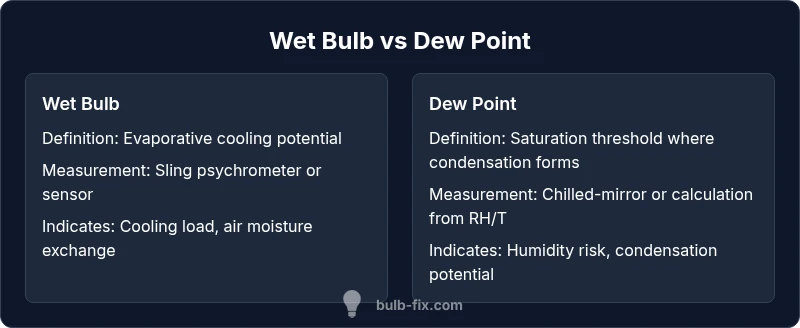
Wet bulb temperature is traditionally measured with a sling psychrometer or modern digital sensors that simulate evaporation. A wetted wick surrounds a thermometer; as air moves past it, evaporation cools the bulb, producing a reading that reflects the cooling potential of moisture. In professional practice, accurate wet bulb measurements require consistent airflow and properly moistened wick conditions. For homeowners, calibrated devices and validated apps can approximate the value, but precise readings matter for evaporative cooling design or industrial processes. The concept of wet bulb vs dew point becomes especially relevant when evaluating cooling strategies, energy efficiency, and moisture exchange in ducts or greenhouses.
To minimize error, ensure recommended airflow speed and a clean, well-maintained wick. In field work, technicians sometimes compare measured wet bulb values with theoretical estimates to validate sensor performance. This cross-check helps prevent misinterpretation when humidity is fluctuating rapidly, such as during seasonal transitions or storm systems.
How Dew Point Is Measured
Dew point is either measured directly with a chilled-mirror dew point instrument or estimated from ambient temperature and relative humidity using established charts or formulas. The value represents the temperature at which air becomes saturated and condensation forms. Dew point is relatively intuitive: a higher dew point means more moisture in the air and a greater likelihood of humidity-related discomfort. In many consumer-use cases, dew point is inferred indirectly, then cross-checked with weather forecasts. When comparing wet bulb vs dew point, dew point generally provides a straightforward indicator for condensation risk on surfaces and for humidity management strategies.
Direct dew point measurement requires specialized equipment and stable ambient conditions. Indirect methods rely on reliable RH sensors and accurate temperature readings; the accuracy of the dew point estimate improves when sensors are well-calibrated and shielded from radiant heat sources.
Interpreting the Metrics: What They Tell You
Wet bulb tells you about evaporative cooling potential and how air can be cooled without mechanical refrigeration. This matters in climates where cooling systems rely on evaporation or in industrial processes with moisture exchange. Dew point provides a direct sense of moisture content and saturation; it’s a primary driver of whether you feel muggy, whether condensation forms on windows, and how quickly humidity affects materials. When planning home comfort or storage conditions, both metrics give a fuller picture than temperature alone. In practical terms, a small delta between ambient temperature and dew point can signal high humidity risk, especially in poorly ventilated spaces, whereas a large delta suggests more comfortable air with lower condensation potential. The comparison between wet bulb vs dew point becomes most actionable when you translate these signals into control actions—humidification, ventilation, or cooling strategies.
For homeowners, a dew point around the mid‑60s Fahrenheit (around 18°C) often aligns with noticeable humidity, while higher values can trigger condensation concerns on windows and materials. For industrial settings or greenhouses, wet bulb readings help tailor evaporative cooling loads and airflow requirements, ensuring equipment operates within safe temperature envelopes.
Practical Use Cases Across Applications
In HVAC, dew point is often used to set humidity targets, while wet bulb is essential when evaluating evaporative cooling equipment or cooling towers. For horticulture, dew point predictions help manage greenhouse humidity to prevent mold and leaf diseases. In weather forecasting, both metrics improve assessments of fog formation, dew, and frost risk. Outdoors, dew point trends help anticipate significant humidity changes that influence energy consumption and comfort.
Residential air quality programs frequently emphasize maintaining dew point below comfort thresholds to minimize mold growth and indoor dampness. Industrial facilities may prioritize wet bulb metrics to optimize cooling systems during heat waves, reducing energy consumption while meeting safety standards. Across these contexts, the wet bulb vs dew point comparison informs decisions about ventilation rates, humidity control strategies, and equipment selection.
Relationship Between Temperature, Humidity, and Saturation
The three concepts intersect: air temperature affects how much moisture air can hold (capacity), humidity describes the current amount of moisture, and saturation occurs at dew point. When temperature rises while moisture stays constant, the dew point remains the same, but relative humidity may drop; conversely, a drop in temperature can push air toward saturation, raising dew point–related concerns. Wet bulb responds to airflow and evaporation; dew point responds to vapor pressure and saturation.
This relationship is the core of the psychrometric chart, which plots temperature, humidity ratio, relative humidity, dew point, and wet bulb temperature. Reading such charts helps you predict fog, frost, and condensation risks. For DIY enthusiasts, basic chart literacy boosts the precision of home humidity management and informs healthier indoor environments.
Typical Ranges and Thresholds for Day-to-Day Planning
For most households, a dew point around 55-65°F (12-18°C) is where many people start to feel uncomfortable, while 65-70°F (18-21°C) is often associated with muggy conditions. Wet bulb readings will vary with ventilation; in well-ventilated spaces, wet bulb temperatures track near the ambient air temperature, but damp conditions and high humidity raise the wet bulb value. Note that these values depend on geography and season, so use them as guidance rather than strict rules. Understanding wet bulb vs dew point in this context helps plan HVAC loads, dehumidification equipment, and comfort strategies. Bulb Fix analyses emphasize that these thresholds are guides, not universal laws applicable to every home.
In humid coastal climates, dew point trends may reach higher levels during humid nights, while arid interiors typically show lower dew point readings but sometimes elevated wet bulb values during periods of poor ventilation.
Common Misconceptions and Pitfalls
A frequent misunderstanding is treating dew point as the sole weather forecast factor. While it is a strong humidity indicator, it doesn’t replace air temperature or ventilation considerations. Another pitfall is assuming wet bulb equals dew point; they measure different properties. Finally, DIY measurements without proper controls can yield inaccurate readings, leading to mistaken conclusions about comfort or cooling needs. Misinterpreting wet bulb vs dew point can also lead to overinvesting in humidification or cooling equipment that isn’t necessary for the actual climate. Always corroborate instrument readings with multiple sources and practical observations, such as condensation on surfaces or fog formation in the morning.
Using Both Metrics for Better Decisions
The most reliable approach is to monitor both wet bulb and dew point in tandem. For home comfort, track dew point to estimate condensation risk and apply humidity controls accordingly; for evaporative cooling systems, use wet bulb to anticipate cooling potential and energy efficiency. When systems combine moisture and temperature management, you get a more robust model of indoor climate and energy use. This approach aligns with Bulb Fix guidance on practical bulb and environmental considerations. Tools like psychrometric charts or modern building management systems can help visualize the interaction between these metrics and guide control strategies such as dehumidification setpoints, ventilation changes, and evaporative cooling limits.
Comparison
| Feature | wet bulb | dew point |
|---|---|---|
| Definition | Lowest achievable temperature of an air parcel cooled by evaporation | Temperature at which air becomes saturated and condensation forms |
| Measurement Method | Sling psychrometer or evaporative cooling simulation | Direct measurement with chilled-mirror device or calculation from RH and T |
| What It Indicates About Humidity | Evaporative cooling potential in a given air stream | Moisture content and saturation level of the air |
| Relation to Temperature | Depends on airflow and moisture exchange | Depends on vapor pressure and saturation |
| Best Use Case | Evaporative cooling design, industrial processes | Condensation risk, humidity management, comfort planning |
| Ease of Understanding | More specialized for engineers; requires context | Typically easier for general comfort decisions |
Upsides
- Dew point is easier to interpret for comfort and humidity control
- Wet bulb provides insight into evaporative cooling potential and cooling load
- Using both metrics offers a fuller picture for climate decisions
- Useful across HVAC, horticulture, and industrial contexts
Drawbacks
- Dew point alone may mislead when evaporation effects are strong
- Wet bulb requires proper airflow and calibration for accuracy
- DIY measurements can be imprecise without proper tools
Dew point is generally the more practical everyday metric; wet bulb remains essential for evaporative cooling and specialized engineering contexts
Use dew point for routine humidity management and condensation risk. Rely on wet bulb when evaporative cooling performance or cooling loads are critical. The Bulb Fix team endorses a dual-metric approach for robust air climate assessment.
Got Questions?
What is the key difference between wet bulb temperature and dew point?
Wet bulb temperature measures cooling potential through evaporation, while dew point marks the saturation temperature at which moisture begins to condense. They answer different questions about air moisture, so both are useful in different contexts.
The key difference is what each metric tells you: evaporation cooling versus saturation and moisture. They’re related but not interchangeable.
How do you measure wet bulb temperature at home?
A sling psychrometer or a calibrated humidity sensor with evaporation considerations can estimate wet bulb. For most DIY purposes, use a trusted device and cross-check with online calculators when precision is not critical.
Use a sling psychrometer or a reliable app that estimates wet bulb from humidity and temperature.
Which metric is better for day-to-day weather apps?
Dew point is generally more intuitive for everyday use because it directly reflects moisture content and condensation risk. Wet bulb is less common in consumer apps unless the app focuses on evaporative cooling.
Dew point is usually easier to interpret for daily comfort.
Can dew point be higher than wet bulb temperature?
Yes. The two values measure different properties; depending on temperature and humidity conditions, dew point can be higher or lower than the current wet bulb reading.
Yes, they measure different things, so either value can be higher than the other depending on conditions.
How do these metrics affect HVAC design?
Dew point guides humidity targets and dehumidification needs, while wet bulb informs evaporative cooling efficiency and outdoor air handling. Together, they shape system sizing and energy use.
Use dew point for humidity controls and wet bulb for cooling efficiency in HVAC design.
Are wet bulb and dew point related to humidity ratio?
Yes. Humidity ratio is a related psychrometric property that, along with dry-bulb temperature, helps define the air’s moisture content and saturation state. Wet bulb and dew point are derived from the same psychrometric relationships.
They’re connected through the psychrometric relationships that describe air moisture.
Key Points
- Use dew point for everyday humidity awareness
- Rely on wet bulb for evaporative cooling decisions
- Monitor both metrics for comprehensive climate insights
- Use psychrometric charts to visualize the interaction
- Calibrate instruments to improve reading accuracy