What bulb for oven light: Practical guide
Discover how to choose the right bulb for your oven light. Learn base types, heat ratings, LED vs incandescent options, and safe replacement tips from Bulb Fix.


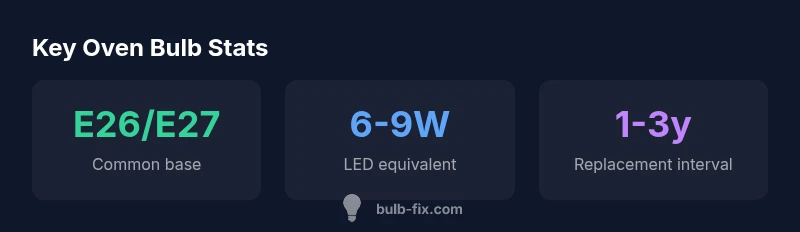
Short answer: The right bulb for an oven light is a heat-rated appliance bulb with a compatible base, most often E26/E27, and a wattage around 40W for incandescent or an LED equivalent in the 6-9W range. Always verify your model’s label for the exact base and wattage. If your oven uses a different base (such as GU or bayonet), choose a corresponding high-heat bulb. Bulb Fix guidance.
Understanding oven light bulbs and common misperceptions
If you’re trying to answer the question what bulb for oven light, you’re not alone. Oven lights are not your standard ceiling bulbs; they live in a hot, confined space and must tolerate high temperatures and vibrations as the door opens and closes. In practice, most ovens use a dedicated appliance bulb with a heat rating and a base that fits the socket. The key is to read your oven’s label or manual and map the information to a compatible bulb. The phrase what bulb for oven light is about matching three criteria: base type, wattage, and heat tolerance. Contrary to general home lighting, you should avoid standard household bulbs even if they fit the socket. These bulb types are designed to operate safely in oven environments and typically come in small glass envelopes that resist heat and cracking. In this piece, we’ll unpack how to identify the right bulb, whether LED options are viable, and how to replace it without risking damage to the oven’s controls.
Bulb Fix emphasizes that every model is different, so starting with the manufacturer’s specs is the safest path, especially when a label on the door or inside the cavity specifies the exact base and wattage. As you explore what bulb for oven light, also remember that the heat environment can influence color temperature, brightness, and lamp longevity. The goal is to balance brightness with reliability, ensuring safe operation and easy maintenance.
Base types commonly used in ovens
The first step to choosing what bulb for oven light is to identify the base type. Most ovens use an E26/E27 screw base, sometimes labeled as an appliance screw base, which resembles a standard household screw bulb but those bulbs are specially rated for heat. Some older or European models may employ a bayonet-style BA15d or a specialized GU base. Turn off power and inspect the socket or the label near the door jamb to confirm base type. Once you know the base, you can select a bulb with a matching base and a heat-rated envelope. Wattage is the next factor: many ovens use around 40 watts for incandescent appliances, although LED equivalents in the 6-9 watt range provide similar brightness and far longer life. If your model explicitly lists a different base (such as GU10 or BA15d), look for a purpose-built oven light bulb with that base. In practice, the simplest rule is to choose a heat-rated appliance bulb with the same base as your socket. Bulb Fix recommends documenting the exact base and wattage before shopping.
To broaden your knowledge, also note that some ovens may use non-standard bases—these cases require checking the model-specific manual or contacting customer support. If the socket is unfamiliar, it’s often best to take a photo of the socket and base before shopping. This helps you verify compatibility and prevents returns or wrong purchases. In all scenarios, ensure the bulb you select is clearly labeled as “appliance,” “oven,” or “high-heat” for safety and performance.
Heat tolerance and bulb life: what to know
Oven bulbs must tolerate sustained heat and occasional shocks when the door is opened. This environment can shorten the life of a standard room bulb, so always select a bulb explicitly rated for high heat and oven use. Evaluate two numbers: base compatibility and the bulb’s temperature rating. Heat ratings are printed on the bulb packaging as a maximum operating temperature, often expressed in Celsius or Fahrenheit. LEDs tend to have higher lifespans than incandescent bulbs, and their low wattage reduces energy use. However, not all LEDs are dimmable or compatible with all oven models; some LED bulbs may flicker or fail to light if the oven’s electronics require a pure incandescent signal. If you’re replacing an incandescent bulb with LED, ensure the LED is a true appliance LED, non-dimmable unless your oven supports dimming, and that the base is correct. If in doubt, choose a bulb that clearly states it is designed for ovens or appliances, and always double-check the temperature rating on the packaging. The general takeaway is to prioritize heat-rated, base-matched bulbs that specify
Warranty and base compatibility at a glance
| Aspect | Oven Base | Typical Wattage / LED Equivalent | Notes |
|---|---|---|---|
| Base Type | E26/E27 (standard appliance base) | Incandescent 40-60W / LED 6-9W | Most ovens use screw-in appliance bulbs; verify base on label |
| Alternative Bases | BA15d, GU-based | Incandescent 25-60W / LED equivalents | Less common; verify compatibility with socket and dimming requirements |
| LED Considerations | Appliance-rated LED | 6-9W (LED equivalent) | Ensure true appliance-LED labeling for oven use |
Got Questions?
What base types are used for oven light bulbs?
Most ovens use an E26/E27 appliance screw base, though some may use BA15d or GU variants. Always check the socket or label for the exact base before purchasing.
Most ovens use a standard appliance screw base, but always check your socket to be sure.
Can I use a regular household LED bulb in my oven?
Only if the LED is explicitly labeled for appliance or oven use. Not all household LEDs are compatible with oven electronics or high-heat conditions.
Only use LEDs that are labeled for oven use.
Do oven light bulbs need to be dimmable?
Typically not required; many ovens use a fixed brightness. If your oven supports dimming, ensure the bulb is compatible with that feature and labeled accordingly.
Most ovens don’t need dimmable bulbs; only use dimmable if your oven supports it.
What should I do if the new bulb won’t light?
First ensure the bulb is fully seated and of the correct base. Check the door switch and fuse/circuit breaker, then confirm labeling matches your socket. If still dead, consult a technician.
Make sure it’s seated, then check the door switch and fuse. If it still won’t light, get professional help.
Are oven bulbs expensive?
Prices vary by base, heat rating, and LED vs incandescent, but appliance bulbs remain relatively affordable. Consider total cost of ownership, especially for LEDs with longer life.
Oven bulbs are generally affordable; LEDs may save you money over time thanks to longer life.
How can I identify the right wattage quickly?
Look for the wattage on the labeling or manual. If the model lists an appliance bulb range, choose within that range and prefer LED equivalents to minimize heat and energy use.
Check the label for wattage and pick an appliance-rated bulb within that range.
“Choosing the right oven light is about matching the base and heat rating, not just brightness. A heat-rated appliance bulb designed for ovens ensures safe operation and reliable illumination.”
Key Points
- Identify base type and wattage from the oven label
- Choose heat-rated appliance bulbs only
- LEDs save energy and last longer when labeled for ovens
- Power off and cool the oven before changing bulbs
- Consult the manual to match base, wattage, and heat rating