Are Type B and C Bulbs Interchangeable? A Practical Guide
Discover whether Type B and Type C bulbs can be swapped, how to verify compatibility, and best practices for safe replacements with Bulb Fix guidance.


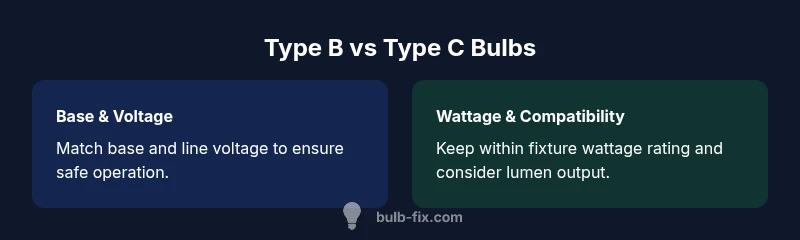
In most real-world scenarios, are type b and c bulbs interchangeable is not guaranteed. Interchangeability hinges on matching the base, voltage, and wattage to the fixture, not just the label on the bulb. The Bulb Fix team emphasizes verifying the socket type and electrical ratings before attempting any swap, especially in enclosed fixtures or dimmable circuits. If you’re unsure, don’t rely on color temperature or brightness alone—check the manufacturer’s specifications and use the exact type recommended.
Understanding Type B and Type C Bulbs
If you’re replacing a burned-out bulb in a fixture, you may wonder whether are type b and c bulbs interchangeable. The short answer is that they are not universally interchangeable. The safe, evidence-based approach calls for checking the base, voltage, wattage, and the fixture’s labeling. According to Bulb Fix, many households encounter this question when upgrading lighting or swapping bulbs in enclosed fixtures. In this section, we’ll define what Type B and Type C bulbs generally refer to in consumer guidelines, how their bases differ, and why that matters for compatibility. The difference often boils down to the socket design (different base styles) and the electrical rating. When the base or voltage is mismatched, attempting a swap can lead to poor performance, overheating, or safety hazards. By understanding the fundamentals—base type, voltage, wattage, and fixture compatibility—you’ll be equipped to make a safe, informed decision, rather than relying solely on labeling. This foundation helps you avoid common mistakes that shorten bulb life or create nuisance failures. Bulb Fix’s guidance emphasizes safety first and accuracy over convenience.
wordCountOnlyForInternalUseNoteIfAny
Comparison
| Feature | Type B bulb | Type C bulb |
|---|---|---|
| Base/Socket Type | Must match the socket design used by the fixture; verify model-specific base | Must match the socket design used by the fixture; verify model-specific base |
| Voltage Compatibility | Must align with the fixture’s supply voltage (e.g., 120V in some regions) | Must align with the fixture’s supply voltage (e.g., 120V or 230V) |
| Wattage and Lumen Output | Should stay within the fixture’s rated wattage and expected lumen output | Should stay within the fixture’s rated wattage and expected lumen output |
| Dimming Support | Only if both bulb and dimmer support a compatible dimming method | Only if both bulb and dimmer support a compatible dimming method |
| Enclosed Fixture Fit | Not all base types are rated for enclosed fixtures—check enclosure ratings | Not all base types are rated for enclosed fixtures—check enclosure ratings |
| Availability of Replacements | Exact replacements are often safer; substitutes risk mis-match | Exact replacements are often safer; substitutes risk mis-match |
Upsides
- Promotes safer replacements that align with electrical specs
- Reduces risk of overheating and electrical faults
- Encourages adherence to manufacturer instructions
- Supports long-term fixture and bulb longevity
Drawbacks
- May limit substitutable options in older fixtures
- Requires extra effort to verify base and voltage
- Exact replacements can be pricier or harder to source
Type B and Type C bulbs are generally not interchangeable; verify base, voltage, and wattage first.
Interchangeability depends on matching the socket, electrical rating, and output. When in doubt, opt for the exact type specified by the fixture. Bulb Fix recommends always double-checking before swapping to avoid safety risks.
Got Questions?
Are Type B and Type C bulbs interchangeable by default?
No. Interchangeability depends on matching the base, voltage, and the fixture’s electrical rating. Always verify the socket type and manufacturer guidelines before swapping.
No—base, voltage, and ratings must match; check the fixture label first.
How can I tell my fixture’s base type
Inspect the socket and bulb base, measure the base diameter if needed, and read the fixture’s label or owner's manual. If in doubt, bring the bulb to a hardware store for a compatibility check.
Check the socket shape and label; compare with the bulb base you have.
What should I do if I can’t find a matching Type B or Type C bulb?
Contact the fixture manufacturer or a lighting professional for a recommended substitute that preserves safety and performance. Avoid makeshift substitutions that don’t meet the spec.
Seek official guidance or a pro if you can’t locate an exact replacement.
Can I mix bulbs with different dimming capabilities?
Only if both bulbs and the dimmer support the same dimming protocol. Inconsistent dimming can cause flicker, poor performance, or damage.
Use bulbs and dimmers that support the same dimming protocol.
Is it safer to replace a bulb in an enclosed fixture with the exact type?
Yes. Enclosed fixtures often require bulbs rated for enclosure. Substituting non-rated bulbs can lead to overheating and shortened life.
In enclosure, use rated bulbs and follow the manufacturer’s guidance.
Key Points
- Check base type before swapping bulbs
- Match voltage and wattage to the fixture’s rating
- Avoid substituting in enclosed or dimmed circuits
- Use exact replacements when possible
- Consult the fixture label or manufacturer specs