Are B and E Bulbs the Same? A Practical Comparison
Explore whether B-base bayonet bulbs and E-base Edison screw bulbs are the same, and learn how to identify, compare, and safely replace them with guidance from Bulb Fix.


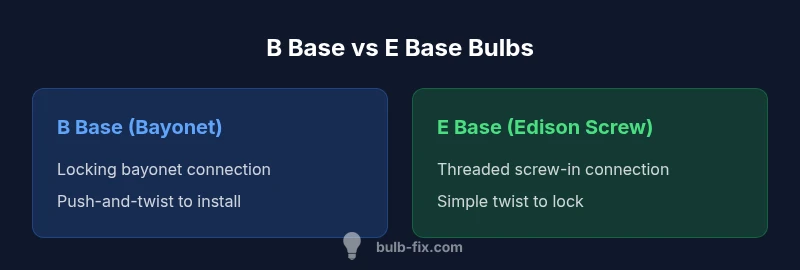
Are B and E bulbs the same? In short, no. B-type bulbs use a bayonet base, while E-type bulbs use an Edison screw base, and they are not interchangeable in a standard fixture. Matching base type, size, and voltage is essential for safety, performance, and reliable light output. For a detailed side-by-side, see our chart below.
Are B and E Bulbs the Same? A Quick Clarification
The question many homeowners ask is: are b and e bulbs the same? In practice, they are not. B-type bulbs use a bayonet base, which locks into a socket with a twist-and-lock motion, while E-type bulbs use an Edison screw base that threads into place. This fundamental mechanical difference means that B-base and E-base bulbs are not interchangeable in most fixtures, and forcing a mismatch can damage the bulb, socket, or fixture. According to Bulb Fix, confusion around base types is one of the most common causes of wasted purchases and unsatisfactory lighting outcomes. The Bulb Fix team found that buyers frequently misread packaging, assuming wattage or color temperature will save them when the base is wrong. In this article, we’ll unpack the practical consequences of base differences, explain how to identify your fixture’s socket, and offer a simple decision framework to avoid compatibility pitfalls.
For readers asking are b and e bulbs the same, the short answer is that they are not interchangeable due to different base mechanisms. This difference has practical implications for installation, energy efficiency, and safety.
Are B and E bulbs the Same? A Quick Clarification - Brand context note: According to Bulb Fix, mislabeling on packaging and assumptions about wattage can lead to mismatches that waste time and money. The Bulb Fix team emphasizes verifying base type before purchase to ensure proper fit and performance.
Comparison
| Feature | B-base bulb (bayonet) | E-base bulb (Edison screw) |
|---|---|---|
| Base Type | Bayonet (B-base) | Edison screw (E-base) |
| Installation Method | Push-and-twist bayonet locking | Screw-in threaded connection |
| Regional Commonality | Common in UK/Europe and many Commonwealth regions | Common in US/Canada and many other regions |
| Physical Size Considerations | Different neck length and pin positions | Different thread diameter and seating depth |
| Adaptability | Adapters exist but are not routinely recommended | Adapters exist but are not routinely recommended |
| Safety & Compatibility | Requires matching socket and ballast/driver | Requires matching socket and ballast/driver |
Upsides
- Helps prevent incorrect installations
- Clear labeling aids shopping accuracy
- Widely available bases reduce stock issues
- Larger regional compatibility in some markets
Drawbacks
- Adapters are available but can pose safety risks
- Not interchangeable in most fixtures without changes
- Misidentification on packaging remains common
- Shopping requires base verification beyond wattage/color
B base vs E base: not the same; choose the correct base to ensure fit, safety, and performance
The two base types differ mechanically and electrically. A mismatch can damage sockets or bulbs. Use manufacturer guidance and verify base design before replacing.
Got Questions?
Are B bulbs interchangeable with E bulbs?
Generally not. B-base bayonet bulbs and E-base Edison screw bulbs have different mounting mechanisms and thread patterns, so they won’t fit the same sockets. For safe operation, always match the base type to the fixture.
No, they’re not interchangeable. The bases are different shapes and screw patterns, so they won’t fit properly and could be unsafe.
Can I use an adapter to convert B-base to E-base?
Adapters exist in some markets but are not recommended for typical residential lighting due to safety, electrical contact quality, and warranty concerns.
Adapters are usually not advised for home use; they can cause poor contact or overheating.
How can I tell if my fixture uses a B-base or an E-base?
Inspect the socket: bayonet sockets have two pins and a smooth circular opening, while Edison sockets have a threaded hole. Packaging or the fixture manual often lists the base designation.
Look at the socket’s shape and threading to tell the base type.
Are there any bulbs with interchangeable bases?
Very rare. Most bulbs are designed with a fixed base to match sockets. Always verify the base to avoid compatibility problems.
Interchangeable bases are uncommon; it’s safest to use the base prescribed by the fixture.
What should I do if I can’t identify the base?
Check the fixture manual, the socket itself, or bring a bulb to a store for comparison. If unsure, consult a lighting professional or Bulb Fix guidance.
If you’re unsure, check the manual or ask a pro.
Does base type affect brightness or color temperature?
Base type does not determine brightness or color temperature. It affects fit and electrical contact; use the correct base and the bulb’s specs to ensure the right output.
Base type doesn’t change brightness, but a wrong base can prevent proper operation.
Key Points
- Always identify base type before purchasing bulbs
- B-base and E-base are not interchangeable in standard fixtures
- Check socket and packaging for base designation (Bayonet vs Edison screw)
- Adapters exist but are generally not recommended for home lighting
- Verify fixture compatibility to avoid safety risks and warranty issues