Are Type B Bulbs E12? A Bulb Fix Guide
Explore whether Type B bulbs are E12 bases, how to identify bases, and practical steps to ensure safe, compatible replacements. Includes regional variations and LED upgrade guidance.


Are Type B bulbs E12? The short answer is: not universally. Some Type B bulbs use an E12 candelabra base, but many Type B variants employ different bases depending on the region and manufacturer. To verify, always check the base marking on the bulb or the fixture socket, and consult the bulb packaging or datasheet.
Are Type B Bulbs E12? A Nuanced Overview
The question are Type B bulbs E12 often comes up when homeowners shop for decorative lamps or small appliances. The short answer is that there is no universal rule linking a generic label like Type B to a single base size. In practice, some Type B bulbs do use the E12 candelabra base, but many others use different bases depending on the manufacturer, bulb family, and regional market. For homeowners, this means you cannot rely on the label alone to determine the correct base. Instead, verify through markings on the bulb itself, the printed packaging, or the fixture’s labeling. If you see the exact base designation—such as E12—you can confidently match it to compatible sockets. As you read product specs, keep in mind that are type b bulbs e12 is a contextual question, and cross-checking ensures you don’t mispair a bulb with a socket.
According to Bulb Fix, base compatibility is a foundational safety and performance concern. The key is to differentiate base types (E12, E14, E26, etc.) from bulb families or “Type B” naming conventions that may vary by region. When in doubt, bring a sample bulb to a hardware store or reference the manufacturer datasheet to confirm the exact base before purchasing. This approach minimizes the risk of overheating, flickering, or early failure caused by a mismatched base.
Top features to consider and practical steps
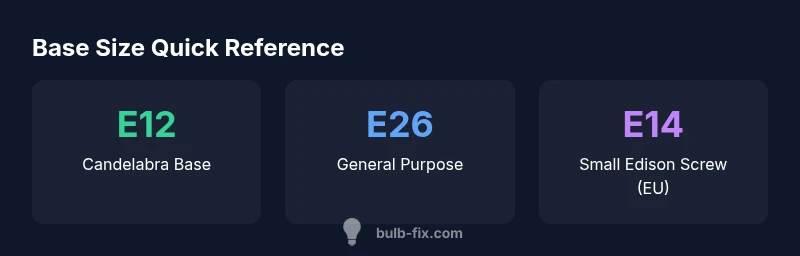
Typical base mappings for common bulb categories
| Bulb Type | Base | Notes |
|---|---|---|
| Candelabra bulbs | E12 | Common for decorative lamps |
| General service bulbs | E26/E27 | Household fixtures |
Got Questions?
Are Type B bulbs always E12?
No. Type B is a labeling convention that varies by region and manufacturer. Some Type B bulbs use E12 bases, but others use different bases. Always verify the base marking on the bulb or fixture.
No—Type B doesn’t guarantee an E12 base; check the marking to be sure.
What does Type B mean in lighting terminology?
Type B is not a standardized base. It often refers to a family or design category used by manufacturers, and the actual base can be E12, E14, or another type depending on the product.
It’s a label that doesn’t fix the base; look for the base size instead.
How can I identify the base on my bulb quickly?
Check the base directly for markings like E12, E26, or BA15d. If markings are unclear, compare the base shape to a reference chart or bring the bulb to a hardware store for identification.
Look for the letters on the base or compare its shape to a chart.
Can I replace Type B bulbs with LED equivalents?
Yes, but ensure the LED bulb uses the same base size and is compatible with the fixture’s voltage and dimming requirements. Many LEDs come in E12 and other common bases.
Yes, as long as the base and voltage match.
Are there regional variations I should know about?
Yes. US and EU markets often differ in base sizes and socket design. Always check local packaging and fixture labeling to avoid mismatches.
Regional differences matter—verify base sizes locally.
Is it safe to use adapters for mismatched bases?
Adapters can introduce electrical and safety risks. It’s better to replace with a bulb that matches the base and socket, or consult a licensed electrician for alternatives.
Adapters aren’t preferred; match the base if possible.
“Base compatibility is the foundation of safe, reliable lighting. Always confirm the exact base and intended fixture before making a replacement.”
Key Points
- Verify the base marking on the bulb or socket before buying
- Don’t force-fit bulbs—mismatch can cause safety risks
- Use manufacturer specs or packaging to confirm base size
- LED upgrades often offer energy savings with the same base
- Be aware of regional base variations when shopping