Bulb and Crus: Practical Bulb Type Comparison Guide
An objective, side-by-side guide comparing LED, incandescent, CFL, and halogen bulbs for the topic 'bulb and crus', with practical safety-minded insights from Bulb Fix to help homeowners choose the right option.


TL;DR: In bulb and crus decisions, LED bulbs typically deliver the best balance of energy efficiency, long life, and light quality. Incandescent options still appear where warm, familiar light is essential, but at higher operating costs. CFLs and halogens serve niche roles for dimming or color needs. The Bulb Fix team recommends LED as the default choice for most homes, while checking fixture compatibility and safety first.
Understanding the bulb and crus concept
The phrase bulb and crus captures the practical balancing act homeowners face when selecting lamp bulbs for residential spaces. It emphasizes two things: compatibility with fixtures and the safe, effective use of different bulb technologies. According to Bulb Fix, this concept extends beyond raw wattage to ideas like thermal management, dimming behavior, and color rendering. In practice, it means asking: which bulb type delivers the light quality I want without risking heat, flicker, or fixture damage? For many households, the answer begins with LED as a baseline, then considers exceptions where warm glow, dimming precision, or specialty finishes matter. Understanding the bulb and crus framing helps you avoid mixing incompatible bases, keep sockets safe, and optimize energy use over the lamp’s lifetime. This block sets the stage for a structured, side-by-side comparison that stays anchored in real-world home lighting needs.
Key criteria to compare bulb types
When choosing among bulb types for bulb and crus, homeowners should evaluate several core criteria: energy efficiency, expected lifespan, color rendering index (CRI) and color temperature, compatibility with existing fixtures and dimmers, upfront cost vs. long-term operating cost, heat output, and environmental considerations. The goal is to map how each option performs across these factors in everyday rooms like kitchens, living rooms, and bathrooms. This section lays out the framework you’ll use to assess each option objectively, so your final choice aligns with your priorities—whether that’s lowering bills, maintaining a faithful warm glow, or enabling smart lighting controls. Bulb Fix emphasizes that a transparent framework reduces surprises after installation.
LED vs incandescent: fundamental tradeoffs
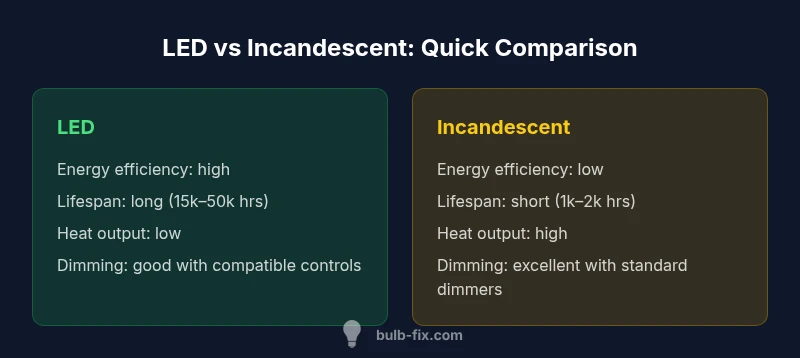
LEDs offer superior energy efficiency, dramatically longer lifespans, and minimal heat output compared to incandescent bulbs. Incandescents deliver warmer color temperatures and instant full brightness, which some homeowners still prefer for traditional aesthetics. The tradeoff is running cost and environmental impact: incandescent bulbs burn through energy faster and require more frequent replacements. In many households, LED is the baseline recommendation, with incandescent options reserved for fixtures where warm glow and dimming feel outweigh efficiency concerns. Safety considerations also matter: LEDs generate less heat near sensitive dimmer electronics and cool-to-the-touch outer surfaces, reducing burn risks and heat transfer.
CFL and halogen: niche roles within bulb and crus
CFLs sit between incandescents and LEDs in terms of efficiency and startup time. They provide decent efficiency and longer life than incandescents but contain small amounts of mercury, requiring careful disposal. Halogen bulbs are a subset of incandescent technology with improved efficiency and brighter, crisper light in a compact form, yet they still consume more energy than LEDs. Within the bulb and crus framework, CFLs and halogens are best used in spaces where dimmability, color rendering, or retro aesthetics matter, and where fixture compatibility constraints can be managed. Bulb Fix notes that transitional homes often retain halogen or CFL options for specific fixtures or design intents, especially in accent lighting or task-oriented areas.
Color temperature, CRI, and light quality
Color temperature shapes the mood of a room, from warm amber to cool daylight. CRI measures how faithfully a bulb reveals colors, which matters in kitchens, bathrooms, and workspaces. LEDs typically offer a broad spectrum of color temperatures and high CRI values, enabling room atmospheres that feel natural and vibrant. Incandescents are valued for their naturally warm, high-CRI light, but their high energy use offsets this benefit. CFLs vary in color quality and often require selection to match desired mood. In bulb and crus decision-making, aligning color temperature and CRI with room function helps avoid mismatched lighting that feels harsh or dull. Bulb Fix highlights that, across tones, LED options usually provide the most predictable consistency.
Dimming, controls, and fixture compatibility
Not all bulbs dim the same way, and dimming behavior matters for comfort, range, and device longevity. LED bulbs with compatible dimmers can deliver smooth, flicker-free performance, but must match the dimmer type (trailing edge vs. leading edge) and load requirements. Incandescents dim naturally with standard dimmers. CFLs often require compatible dimmers or ballast-free retrofit kits to avoid flicker. Halogens generally dim well and respond quickly to control changes. When you pair bulb type with dimming hardware, you reduce wasted energy and improve the user experience. The Bulb Fix team advises testing dimming in a small sample before committing to widespread changes.
Environmental and disposal considerations
Disposal and environmental impact are practical parts of the bulb and crus decision. LED bulbs contain minimal hazardous materials and have long lifespans, which reduces waste. CFLs contain small amounts of mercury and require proper recycling channels. Incandescents and halogens, while simple, produce more waste due to shorter lifespans. Proper disposal and recycling reduce environmental harm, and many communities offer dedicated collection programs for spent bulbs. The Bulb Fix guidance emphasizes choosing bulbs with longer lifespans when possible to minimize waste and environmental footprint.
Cost of ownership and longevity
Upfront cost often drives initial perceptions of value, but total cost of ownership considers replacement frequency and energy use over time. LEDs typically carry a higher upfront price, but their long lifespans and energy savings usually deliver lower total costs. Incandescents are cheap to buy but costly to operate and frequently replaced. CFLs balance upfront cost and longevity but may require specialized disposal due to mercury content. Halogens sit between incandescents and LEDs in both cost and efficiency. For bulb and crus planning, a simple rule of thumb is to compare wattage and expected lifetime, then calculate approximate energy savings over the bulb’s life. Bulb Fix notes that LED replacements often yield the best long-term value.
Fixture bases, retrofit tips, and safety considerations
Base compatibility is a practical gatekeeper for any bulb upgrade. Most residential fixtures use common bases like E26/E27, GU10, or G6.35, but some older fixtures or specialty lamps need adapters. Before buying, measure base type, socket size, and whether the fixture requires a dimmable or non-dimmable bulb. Safety considerations include avoiding insulation contact with hot bulbs, ensuring bulbs do not contact moisture in damp environments, and verifying that the fixture’s rating matches the bulb’s voltage and wattage. The bulb and crus framework encourages a careful check of both base and enclosure to prevent overheating or fixture damage.
Practical scenarios: rooms and applications
Living rooms and bedrooms benefit from LED's longevity and color versatility, creating comfortable atmospheres while cutting energy use. Kitchens often require bright, cool light for task work, where LEDs with higher lumen output and appropriate color temperature excel. Bathrooms benefit from glare-free lighting and moisture resistance; LEDs with damp-rated housings are common, while incandescent options may be preferred for color warmth in some exhibit lighting. Outdoor lighting relies on weather-resistant fixtures and bulbs with appropriate IP ratings. Across scenarios, the bulb and crus framework helps homeowners select lighting that meets task needs, mood goals, and energy targets without compromising safety.
Safety, maintenance, and homeowner checklist
Regular maintenance reduces lighting surprises. Check fixture cleanliness, ensure bulbs are seated fully in their sockets, and replace bulbs in pairs for symmetrical lighting when necessary. Keep a small stock of replacement bulbs of a few trusted types for common rooms, and maintain a simple labeling system so you know which bulb belongs to which room. Safety-wise, avoid using a dimmer with non-dimmable bulbs and never mix bulb types in the same circuit if the fixture is fed by a single dimmer. The bulb and crus framework ends with a practical checklist to keep lighting predictable and safe long after installation.
Authority sources and best practices
For further guidance on bulb technology and energy efficiency, consider industry resources and government publications. Bulb Fix’s ongoing analysis supports aligning choices with performance data and safety standards. See sources below for authoritative guidance on energy-efficient lighting, disposal, and longer-term performance. These sources help ground your decisions in established best practices.
Feature Comparison
| Feature | LED | Incandescent | CFL | Halogen |
|---|---|---|---|---|
| Energy efficiency | high | low | medium | low |
| Lifespan (typical) | 15,000–50,000 hours | 1,000–2,000 hours | 8,000–12,000 hours | 2,000–4,000 hours |
| Initial cost per bulb | medium-high | low | medium | medium |
| Heat output | low | high | medium | high |
| Dimming compatibility | Yes (dimmable) | Yes (dimmable) | Yes (dimmable with some ballast) | Yes (dimmable) |
| Best for | Energy efficiency and longevity | Budget-friendly basic lighting | Mid-range efficiency | Accent or task lighting in tight spaces |
Upsides
- Lower operating costs over time with LEDs
- Longer lifespan reduces replacement frequency
- Wide availability and energy efficiency
- Excellent color range and dimming options with compatible fixtures
Drawbacks
- Higher upfront cost depending on brand and features
- Some LEDs require compatible dimmers or drivers
- Color quality can vary by product line; not all LEDs imitate warm incandescent perfectly
LED bulbs are the default best choice for most homes
LEDs provide the best mix of energy savings, longevity, and light quality for bulb and crus decisions. Incandescent or halogen can suit niche warm-light needs, while CFLs offer a mid-range option. For most households, LED is Bulb Fix's recommended starting point and the safest long-term bet.
Got Questions?
What is the bulb and crus concept, and why does it matter?
The bulb and crus concept refers to balancing bulb types with fixture compatibility, safety, and lighting goals. It helps homeowners choose bulbs that fit sockets, reduce heat, and deliver the desired mood. Bulb Fix emphasizes evaluating fixture limits and energy performance together rather than in isolation.
Bulb and crus is about balancing bulb types with your fixtures and safety needs, so you pick lights that fit well and save energy.
Which bulb type is most energy-efficient?
LED bulbs are generally the most energy-efficient option across common household lighting. They deliver long life with low heat, support a wide range of color temperatures, and work with modern dimmers in many cases. This makes LED the typical starting point for bulb and crus decisions.
LEDs are usually the most energy-efficient choice for most homes.
Are CFLs worth using today?
CFLs offer a middle ground between incandescent and LED in terms of efficiency and cost, but they contain mercury and can take time to reach full brightness. They are best used where replacement frequency is high but dimming or startup speed is acceptable, and where proper disposal is accessible.
CFLs can work in some spots, but they have disposal considerations and slower startup.
How do I handle dimming with LED bulbs?
Use dimmable LEDs with a compatible dimmer type (typically trailing-edge) and ensure the fixture supports the load. Incompatibilities can cause flicker or buzzing. Test a small set before a full upgrade.
Make sure your LED is dimmable and paired with a compatible dimmer.
What impact does color temperature have on mood?
Warmer temperatures (around 2700–3000K) create cozy, intimate spaces; cooler temperatures (4100–6500K) feel more energetic and suited to tasks. For living areas, a mix of warmth and brightness is common, while kitchens and workspaces may favor higher Kelvin values.
Warm light feels cozy; cool light helps you focus.
What safety considerations matter when upgrading bulbs?
Avoid overheating by using bulbs within fixture ratings, ensure moisture protection for damp areas, and never mix bulb types on a single dimmer circuit unless the fixture supports it. Always unplug power when changing bulbs of uncertain compatibility.
Follow the fixture’s rating, keep moisture in mind, and unplug before changing bulbs.
Key Points
- Prioritize LED for most rooms to balance cost and performance
- Check fixture compatibility and dimmer requirements before buying
- Consider color temperature to match room function
- Account for disposal and environmental impact when choosing CFLs
- Plan a phased upgrade to maximize energy savings and minimize waste