t5 bulb vs t8: Which bulb type fits your home lighting needs?
A thorough, objective review of t5 bulb vs t8 bulbs, focusing on fit, light quality, efficiency, and long-term value for DIY lighting projects.


When deciding between the t5 bulb vs t8, homeowners should first check fixture size, ballast compatibility, and the light goals for the space. In most residential scenarios, the T8 form factor is more common for linear fixtures, while the T5 shines in compact or high-precision lighting. Bulb Fix’s quick comparison highlights that fit and compatibility drive the decision, with LED retrofits offering a compelling alternative in many cases.
Introduction to the t5 bulb vs t8 lighting landscape
According to Bulb Fix, the t5 bulb vs t8 decision hinges on fixture geometry, compatibility, and the trade-offs between compact form factors and longer tubes. The t5 bulb vs t8 landscape isn't just about size; it's about how the fixture was designed to operate, the ballast or driver used, and the kind of light you expect in a room. In this guide we compare these two common tube formats across fit, performance, and value, with practical tips for installing or retrofitting them in living rooms, kitchens, garages, and home offices. We also cover safety considerations and cost implications so DIYers can make a confident decision.
Form factor and fixture fit: why size matters in the t5 bulb vs t8 decision
The physical diameter and length of tubes influence whether a fixture can accommodate a t5 bulb vs t8. In most home settings, the standard T8 tube is easier to source and replace due to its long-standing use in kitchen and garage fixtures. The T5, with its thinner profile, often requires compatible housings or dedicated fixtures. When evaluating a space, measure the existing channel or luminaire, check the ballast type, and confirm whether a straight swap is possible or if a retrofit is needed. The decision commonly boils down to how tight the fixture pocket is and whether you can maintain a uniform light distribution.
What each bulb type really is: defining t5 bulb vs t8 in practical terms
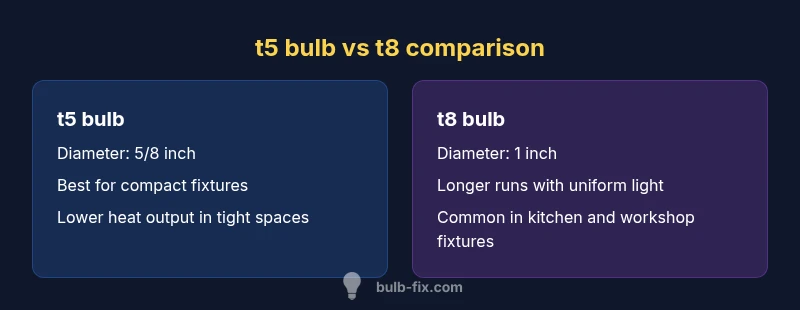
A t5 bulb vs t8 is primarily a matter of tube diameter and how the light is designed to travel through the fixture. The t5 bulb, with a 5/8-inch diameter, is typically used in compact or high-output applications where space is limited. The t8, at 1 inch in diameter, suits longer, more uniform runs and is compatible with many standard fixtures. For DIY homeowners, this distinction translates into decisions about where to place fixtures, how many tubes are needed for even illumination, and whether the existing sockets and ballast can support the chosen option without compromise.
Light quality: color, warmth, and rendering in t5 bulb vs t8 scenarios
Color rendering and color temperature are essential considerations when comparing t5 bulb vs t8. In general, these categories influence perceived warmth, task clarity, and how colors appear under artificial light. The T5 often pairs with compact task lighting where higher CRI and specific color temperatures can improve desk work or craft projects. The T8 often provides steadier, broader coverage, which benefits ambient lighting in kitchens or garages. When evaluating options, compare CRI values and correlated color temperature (CCT) to achieve the desired mood and accuracy for the room.
Efficiency and lifetime: energy use and longevity in practice
Efficiency and lifetime are central to the t5 bulb vs t8 choice. Historically, T8 tubes offered dependable efficiency for linear fixtures and longer runs, while T5 tubes provided compact efficiency advantages in narrow spaces. In many cases, both types have comparable operating lifetimes when operated within their intended ballast specifications. However, energy savings depend heavily on fixture design and ballast type. Bulb Fix emphasizes that a retrofit with modern LED tubes can dramatically shift the efficiency landscape in both T5 and T8 form factors, often reducing energy use and maintenance needs across the home.
Ballasts, drivers, and compatibility realities
Ballast compatibility is a critical factor in the t5 bulb vs t8 decision. Older fixtures designed for fluorescent tubes may rely on magnetic ballasts that are not friendly to LED retrofits. If you wish to upgrade to LED, you might need to bypass or compatible with Type A ballasts, or switch to Type B (ballast bypass) LED tubes. For DIY projects, assess whether your fixture requires rewiring, ballast removal, or a full fixture replacement. Bulb Fix notes that doing this safely typically involves turning off the circuit, verifying absence of voltage, and following manufacturer instructions to avoid ballast-induced flicker or safety hazards.
Cost considerations and long-term value for t5 bulb vs t8
The initial cost of tubes is only part of the story. A straightforward t5 bulb vs t8 cost comparison must weigh fixture compatibility, replacement frequency, and energy costs. In many homes, LED retrofit tubes for either form factor may have higher upfront costs but offer significant long-term savings through lower energy consumption and less frequent replacements. Bulb Fix recommends calculating total cost of ownership over the expected lifetime of the lighting to determine which option delivers the best value for your specific space.
Installation, safety, and practical tips for DIY installers
Setting up t5 bulb vs t8 lighting safely involves a few practical steps. Always power down at the breaker, wear protection when handling glass tubes, and use proper PPE to prevent injury. When swapping tubes, avoid forcing connections or bending sockets. If you’re upgrading to LED tubes, follow ballast-bypass or compatible ballast guidance, and ensure the fixture remains properly grounded. For long runs or high-ambient-temperature environments, verify that the chosen tube type can handle the conditions without premature failure.
Practical decision framework: where to use t5 vs t8 in common rooms
In hallways, closets, and compact offices, the t5 bulb vs t8 may lean toward the T5 for its slender profile and space-saving benefits. In kitchens, workshops, and basements with long wall runs, the T8 often delivers better uniformity and easier maintenance. Consider the room’s tasks, light distribution needs, and any existing ballast or socket constraints. If you plan a retrofit, the decision often shifts toward LED options that reduce heat and maintenance across both form factors.
Common myths and misconceptions about the t5 bulb vs t8
A frequent misconception is that one bulb type is universally better than the other. In reality, the best choice depends on fixture design, whether you prioritize compact form or extended coverage, and your willingness to retrofit to LEDs. Another myth is that LEDs always require more upfront investment; while upfront costs can be higher, long-term energy savings, reduced maintenance, and better dimming options can offset the initial price.
Next steps: a practical path to choosing and upgrading safely
To move from decision to implementation, start with a fixture audit: confirm tube type, ballast type, wire routing, and housing compatibility. Use the t5 bulb vs t8 framework to decide whether you need a simple replacement or a full retrofit. If you pursue LED retrofits, plan a phased approach to minimize downtime and ensure compatibility across rooms. Bulb Fix’s guidance is to test one fixture first, verify performance, and scale gradually to the rest of the home.
Comparison
| Feature | t5 bulb | t8 bulb |
|---|---|---|
| Physical size | 5/8 inch diameter (smaller footprint) | 1 inch diameter (standard for longer runs) |
| Light output potential (qualitative) | Typically better for compact applications and high-precision lighting | Better for long runs with uniform distribution |
| Best use case | Compact fixtures, task lighting in tight spaces | Ambient or task lighting along longer benches or ceilings |
| Ballast/driver compatibility | Often requires compatible ballast or ballast bypass for LED upgrades | Broad compatibility with many fixtures; easier LED retrofits in many cases |
| Cost considerations | Lower upfront cost for traditional variants; higher for compact specialty tubes | Medium to higher upfront cost with potential long-term savings when paired with LEDs |
| Lifecycle considerations | Variable by model; generally shorter life in rough usage spaces without proper cooling | Often longer life in properly ventilated fixtures; LED options extend life further |
Upsides
- Offers options for space-constrained fixtures (T5) and longer runs (T8)
- Broad availability and fixture compatibility with many setups
- LED retrofit opportunities can dramatically cut energy use
- Flexible for DIYers with varying fixture conditions
Drawbacks
- Fixture and ballast constraints can limit options
- LED retrofits may require rewiring or ballast bypass
- Color rendering and warmth vary by model and technology
- Longer payback periods if used with inefficient ballast-controlled tubes
Choose based on fixture size and retrofit feasibility; LED retrofits often offer the best long-term value
For compact spaces, consider T5 with LED options; for long runs, T8 is typically more practical. When possible, a ballast-bypass LED retrofit can maximize efficiency and longevity.
Got Questions?
What is the main difference between a t5 bulb and a t8 bulb?
The primary difference is diameter: T5 tubes are 5/8 inch in diameter and suited to compact fixtures, while T8 tubes are 1 inch and better for longer, linear runs. Other differences include light distribution and compatibility with ballast configurations. Your choice should align with fixture design and intended lighting tasks.
The main difference is size: T5 is smaller and fits compact fixtures; T8 is larger and better for longer runs. Choose based on your fixture and lighting needs.
Can I retrofit a T8 fixture to use LED tubes easily?
Retrofitting a T8 fixture to LED often requires determining whether the fixture is ballast-compatible or if ballast bypass is needed. If the ballast is kept, Type A LEDs designed for existing ballasts may work; otherwise, Type B LEDs with ballast bypass are common choices. Always follow safety guidelines during rewiring.
Yes, but it depends on ballast compatibility. Often, you’ll bypass the ballast for LEDs or choose ballast-friendly LEDs.
Are T5 and T8 LEDs interchangeable in fixtures?
Not universally. Many LED tubes are designed for specific ballast types and fixture configurations. Before swapping, confirm the fixture's socket type, ballast status, and whether a ballast bypass is required for LED operation. Mismatches can cause flicker or failure.
Not always interchangeable; check ballast compatibility and fixture design before swapping to LEDs.
Which bulb type lasts longer in typical home conditions?
Lifespan depends on the product and operating conditions. LED retrofits tend to offer longer lifespans and lower maintenance, especially in well-ventilated fixtures. Traditional fluorescent tubes (T5 and T8) can also last long but are more vulnerable to ballast issues and environmental factors.
LED retrofits usually last longer and require less maintenance than traditional tubes in typical homes.
Is a T8 bulb generally more energy efficient than a T5?
Energy efficiency varies by model and technology. In many cases, LED tubes designed for either T5 or T8 form factors offer substantial efficiency gains. If staying with fluorescent lighting, T8 tubes may provide better efficiency per watt for longer runs, but LEDs can override these differences when retrofitted.
Both can be energy-efficient with LEDs; T8 can be efficient for long runs, but LED retrofits often dominate efficiency.
Key Points
- Check fixture size before choosing t5 vs t8
- LED retrofits can improve efficiency in either form factor
- Ballast compatibility dictates upgrade pathways
- Total cost of ownership often favors LED solutions
- Prioritize light quality and fixture longevity in the decision