t8 bulb vs t12: In-Depth Home Lighting Comparison
A thorough side-by-side comparison of T8 and T12 bulbs for homeowners and DIYers, covering diameter, ballast compatibility, energy use, light quality, costs, and upgrade options.


TL;DR: In most homes, t8 bulb vs t12 comes down to fixture compatibility, energy efficiency, and long-term costs. T8 tubes with modern electronic ballasts typically deliver better efficiency and cooler operation, while T12 can be cheaper upfront in legacy fixtures. If you’re upgrading, prioritize ballast type, lumen output, and tube availability to choose the right option.
t8 bulb vs t12: Basic overview
When homeowners begin planning a lighting project, two common fluorescent options often come up are the t8 bulb and the t12 bulb. The practical differences stem from the tube diameter and the era of ballast technology, but these differences ripple through energy use, fixture compatibility, maintenance, and long-term costs. The Bulb Fix team emphasizes that the first step is to identify the existing fixture and ballast, then align your choice with how you plan to use the space. If you have a newer fixture with an electronic ballast, a t8 bulb is usually the more efficient option. Conversely, in older, legacy systems with magnetic ballasts, a t12 can be a compatible, lower-friction short-term replacement. This guide translates those mechanical realities into actionable steps for homeowners and DIY enthusiasts.
Mechanical differences: diameter, ballast compatibility
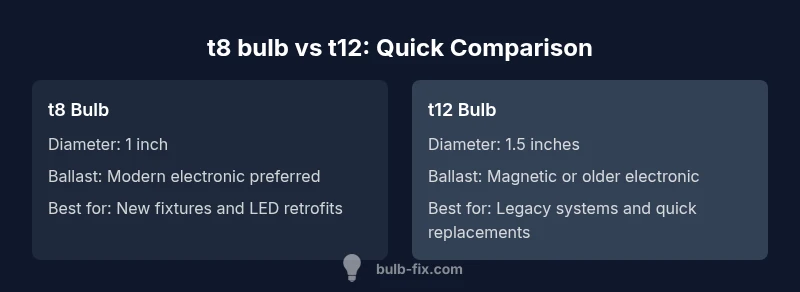
The most obvious physical difference is diameter: T8 tubes are about 1 inch in diameter, while T12 tubes are about 1.5 inches. That difference matters for fixture compatibility and how the tube sits within the housing. Ballast compatibility follows a parallel path: many modern fixtures use electronic ballasts designed for T8 tubes, while older fixtures were built around magnetic ballasts that catered to T12 sizes. If a ballast mismatch exists, you may experience flicker, reduced light, or ballast failure. Before purchasing replacements, verify the ballast type listed on the fixture and consult the ballast compatibility chart from the manufacturer or a trusted guide like Bulb Fix. When upgrading, many homeowners find it easier to replace with the tube that fits the existing ballast rather than retrofitting the entire ballast system.
Efficiency and performance: energy use and lumen output
Energy efficiency is often the deciding factor in t8 bulb vs t12 discussions. In general, T8s paired with modern electronic ballasts outperform older T12 setups in terms of lumen output per watt and overall operating efficiency. A well-matched T8 system can produce brighter light using less energy, which translates to lower electricity bills over time and cooler operation. This efficiency advantage is particularly noticeable in spaces that run lights for long periods, such as basements, workshops, and garages. It is important to consider the ballast’s condition when evaluating efficiency; a failing ballast can negate the advantages of a more efficient tube. Bulb Fix Analysis, 2026 suggests that upgrading to an efficient T8 system with an up-to-date ballast typically yields the most consistent performance without increasing heat load.
Light quality and consistency: color temperature, CRI, and flicker
Light quality depends on color temperature, color rendering index (CRI), and flicker characteristics. T8 bulbs come in a range of color temperatures, commonly around 3500K to 4100K, with CRI values typically in the 80s. T12 tubes offer similar ranges but may show more aging-related color shifts in legacy systems. When upgrading, aim for a consistent color temperature across all tubes in the space to avoid mismatched lighting that can be visually jarring. For areas requiring precise color discrimination, such as crafting spaces or kitchens, select tubes with higher CRI and stable phosphor chemistry. If flicker has been noticeable in an older T12 setup, replacing with a well-matched T8 electronic-ballast combination can reduce perceptible flicker and create steadier illumination.
Ballasts, wiring, and compatibility considerations
Ballasts are the often-overlooked gatekeepers in the t8 bulb vs t12 decision. Magnetic ballasts (typical with older T12 installations) are heavier, generate more heat, and can be less efficient than modern electronic ballasts designed for T8 tubes. If you replace T12 tubes with T8s without addressing the ballast, you risk performance issues and shortened lamp life. In many cases, a ballast-compatible approach—either by selecting Type A (ballast-compatible LEDs or fluorescents) or by bypassing the ballast in a Type B LED retrofit—delivers a smoother upgrade path. Always confirm the ballast type and consider upgrading to a compatible electronic ballast or LED retrofit to maximize efficiency and reliability.
Practical upgrade paths: fluorescent to LED retrofit options
LED retrofits are a major consideration in the t8 bulb vs t12 decision. Type A LED tubes are designed to work with existing ballasts, while Type B LED tubes bypass the ballast altogether. If your goal is maximum energy savings and the ability to maintain a modern lighting feel, LED retrofits can offer significant improvements in longevity and maintenance costs. A careful assessment of fixture housing, lumen output, and heat dissipation is essential. Bulb Fix recommends evaluating total cost of ownership over 5–10 years, including replacement tubes, ballast failures, and energy use, to determine whether a fluorescent upgrade or a move to LED makes the most sense for your space.
Real-world scenarios: kitchen, garage, basement, and hallway lighting
In kitchens and work areas, brightness and color accuracy are crucial. T8 systems with newer ballasts often provide more consistent light and better efficiency for these spaces, whereas older garages with T12s may still function adequately if the ballast is reliable. Hallways and utility rooms benefit from long, uniform runs of light, where T8 LEDs or T12 tubes with good ballast performance can deliver stable illumination. When choosing between t8 bulb vs t12 for a multi-room home, consider mixing strategies where modernized zones (T8) coexist with legacy zones (T12) during a staged upgrade. This approach minimizes disruption while improving overall energy performance.
Cost considerations: upfront vs operating costs
Upfront costs for T8 tubes can be higher in some markets when retrofitting to LED or replacing entire fixtures, but operating costs tend to be lower due to improved efficiency. Legacy T12 systems, while sometimes cheaper to purchase initially, can incur higher maintenance and energy costs over time, particularly if ballast failures occur or replacements become scarce. When evaluating cost, consider the fixture count, the ease of ballast replacement, and the anticipated lifetime of the tubes. A simple rule of thumb is to compare total cost of ownership over the expected system lifetime, not just the sticker price of a tube. Bulb Fix recommends running a simple energy-use calculation for your typical daily usage to estimate potential savings.
Installation safety and best practices
Safety should be your first concern when changing fluorescent tubes. Always switch off the circuit, discharge any capacitors, and wear eye protection. Handle tubes carefully to avoid breakage, which can expose you to hazardous materials. Check for any signs of ballast overheating or buzzing, which can indicate a failing ballast. If you aren’t comfortable working with electrical systems, hire a licensed electrician. When upgrading, document the ballast type, fixture model, and tube specifications to avoid compatibility issues later on. A staged approach—test one or two fixtures, observe performance, and then expand—reduces risk and ensures a smoother upgrade path.
Common mistakes and how to avoid them
Common errors include assuming all T8s fit all fixtures, mismatching ballast types, and ignoring dimming or control compatibility. Another frequent mistake is selecting LEDs without verifying heat dissipation and driver compatibility, which can shorten LED lifespan or cause flicker. Always confirm the ballast type and fixture compatibility before purchasing replacements, and plan for future maintenance in spaces with long light runs. By avoiding these pitfalls, you’ll achieve better energy savings, more consistent light, and fewer maintenance surprises.
Comparison
| Feature | t8 bulb | t12 bulb |
|---|---|---|
| Diameter | 1 inch | 1.5 inches |
| Typical ballast compatibility | Electronic ballasts common (newer setups) | Magnetic or older electronic ballasts (legacy) |
| Energy efficiency (qualitative) | Generally higher with modern T8 + electronic ballast | Varies with ballast age; older T12 often less efficient |
| Best for | New installations and retrofits with modern ballast | Legacy fixtures and certain quick replacements |
| Upgrade paths | LED retrofit or ballast replacement for best results | Potential ballast upgrades or tube replacements for compatibility |
Upsides
- Typically better energy efficiency with modern ballasts
- More consistent light with electronic ballast options
- Easier to source modern replacements in newer installations
- Clear upgrade path to LED retrofits when upgrading fixtures
Drawbacks
- Ballast compatibility can complicate replacements
- Older T12 systems may require ballast changes for optimal performance
- LED retrofits can have higher upfront costs or driver considerations
- Availability can vary by region and fixture model
In most homes, T8 with modern ballasts is the better choice for efficiency and modernization; T12 remains viable for legacy fixtures, but upgrade paths favor T8-based systems.
Choose T8 for new builds or when upgrading to modern ballasts; opt for T12 only if you must preserve a legacy fixture. The best long-term value generally comes from upgrading to a compatible T8 system or moving to LED retrofits when feasible.
Got Questions?
What is the primary practical difference between T8 and T12 bulbs?
The main practical difference is diameter and ballast compatibility. T8 tubes are 1 inch in diameter and pair best with modern electronic ballasts, while T12 tubes are 1.5 inches and were designed for older magnetic ballasts. This affects efficiency, light quality, and maintenance, guiding you toward an upgrade path that fits your fixture.
The main difference is size and ballast fit, which changes efficiency and maintenance.
Can I mix T8 and T12 tubes in the same fixture?
Generally, you should not mix T8 and T12 tubes in the same fixture because ballast and reflector designs are tube-specific. Mismatched tubes can cause poor performance or ballast stress. If you’re upgrading, replace all tubes together and ensure the ballast is compatible with the chosen tube type.
Don’t mix different tube types in one fixture; replace all tubes at once for best results.
Are T8 bulbs compatible with old magnetic ballasts?
Some T8 tubes can work with older magnetic ballasts, but performance is often suboptimal and reliability may be lower than with a ballast designed for T8. In many cases, upgrading to an electronic ballast or LED retrofit yields better efficiency and reliability.
Old magnetic ballasts may not give you good performance with T8; upgrading ballast or switching to LED is often better.
Which is cheaper to install upfront, T8 or T12?
Upfront costs vary by region and whether you stay fluorescent or switch to LED. T12 replacements might be cheaper in places with abundant legacy stock, but long-term energy and maintenance costs often favor T8 with modern ballast or LED retrofits.
Upfront costs vary, but long-term energy savings often favor T8 or LEDs.
What about LED replacements for T8 vs T12?
LED replacements are a popular long-term option. Type A LEDs work with some existing ballasts (ballast-compatible), while Type B bypasses the ballast completely (ballast-bypass). For many homes, a well-chosen LED retrofit provides the best balance of energy savings and maintenance.
LED upgrades can save energy; choose ballast-compatible options when possible.
What’s the best way to decide between T8 and T12 for my space?
Start by identifying your current fixture and ballast, then price out upgrades for each option (T8 with electronic ballast, T12 with ballast or LED). Consider light quality, fixture clearance, and long-term costs. A staged upgrade can minimize disruption during the decision process.
Check ballast, consider light quality, and compare long-term costs to decide.
Key Points
- Prioritize ballast compatibility when choosing between t8 bulb vs t12
- T8 systems often offer better efficiency with modern electronics
- LED retrofits are a strong option for long-term savings
- Avoid mixing ballast types in the same space without testing
- Plan upgrade path before purchasing tubes