Bulb or Tubelight Which Is Better: A Practical Home Guide
Discover whether LED bulbs or fluorescent tubelights are better for your home. Compare efficiency, lifespan, cost, and installation to choose the right lighting solution.


If you’re asking bulb or tubelight which is better for typical home use, LED bulbs generally outperform tubelights in energy efficiency, longevity, color quality, and ease of installation. Tubelights still have a place for long corridors or existing fixtures, but LEDs offer longer life and lower operating costs for most rooms. For a quick verdict, choose LED bulbs for everyday spaces and reserve tubelights for specific, high-traffic linear layouts.
The Core Question: bulb or tubelight which is better for most homes?
When homeowners ask bulb or tubelight which is better, the decision usually boils down to efficiency, reliability, and how the space is used. According to Bulb Fix, the answer isn’t about fixture shape alone but about how the light travels, how often it’s switched on, and what you value most—instant brightness, color accuracy, or budget over time. This guide compares LED bulbs with fluorescent tubelights, highlighting practical tradeoffs for common home scenarios. Expect actionable advice you can apply in living rooms, kitchens, hallways, and workspaces.
How LEDs and Fluorescent Tubes Work
LED bulbs convert electricity into light through solid-state electronics, delivering instant full brightness, high efficiency, and long life. Fluorescent tubelights rely on gas discharge and phosphor coatings, which can lag in cold conditions and require ballast. LEDs are generally more forgiving with dimmers and smart controls, while tubelights excel in very long, continuous runs where the fixture was designed around linear lighting. Understanding these basics helps you predict performance without needing to install anything first.
Key Factors: Energy Efficiency, Longevity, Color Rendering, and Dimming
- Energy efficiency: LEDs convert more watts into usable light and waste less energy as heat. Tubelights use more energy per lumen and can lose efficiency over time.
- Lifespan: LED bulbs typically last far longer than fluorescent tubes, reducing replacements and maintenance. Tubelights may require ballast checks and more frequent tube changes.
- Color rendering: LEDs offer a wide range of color temperatures and CRI options, making them versatile for living spaces and task lighting. Fluorescent tubes often have mid-range CRI and color consistency can vary with age.
- Dimming and controls: LEDs commonly support modern dimming and smart-home integration. Tubelights with older ballasts may require rewiring or specific dimmable ballast systems.
When LED Bulbs Shine for Home Rooms
LED bulbs are a strong fit for most residential lighting. They provide instant brightness, stable color, and compatibility with most dimmers and smart hubs. In living rooms and bedrooms, LED bulbs offer cozy warmth options and long intervals between replacements. In kitchens, LEDs deliver crisp task lighting with reliable color accuracy for food prep. For small fixtures like sconces or table lamps, LEDs maximize space efficiency and energy savings.
When Tubelights Work Best in Large Spaces
Tubelights can still be sensible for very long corridors, basements, or garages where a single fixture is needed to cover a wide area in one go. They can be cost-effective per lumen in bulk fixtures and may integrate well with existing ballast systems. If a space requires uniform, wide-area illumination without frequent switch-ons, a carefully planned tubelight layout could be practical. However, upgrading to LED strip or LED tube solutions is often a longer-lasting improvement.
Cost of Ownership: Upfront vs Running Costs
Upfront costs for LED bulbs are higher, but operating costs tend to be lower due to better efficiency and longer lifespans. Tubelights typically have a lower upfront price, but ballast maintenance and tube replacements can add up over time. When you account for reliability, color quality, and the frequency of replacements, LEDs usually offer better value for most homes. Bulb Fix’s analysis shows LEDs provide a steadier, more predictable running cost profile in typical household use.
Installation, Compatibility, and Safety
Before replacing a tubelight with a bulb, check fixture compatibility. LED bulbs in traditional fixtures often require a compatible driver or a ballast bypass. In many homes, this is a straightforward upgrade, but some fixtures may need rewiring or a fixture swap. Ensure the color temperature matches the room’s purpose (cool for task areas, warm for living spaces). Always detach power before handling any fixture, and follow manufacturer guidelines. If you’re unsure, consult a licensed electrician.
Maintenance, Disposal, and Environmental Impact
LEDs produce less hazardous waste and have longer lifespans, reducing replacement cycles. Fluorescent tubes contain small amounts of mercury, requiring careful disposal and recycling. For eco-conscious homeowners, LEDs generally offer a smaller environmental footprint over the life of the fixture. When purchasing, look for ENERGY STAR certified LEDs to ensure efficiency and color performance, and plan a disposal strategy for any fluorescent components you remove.
Comparison
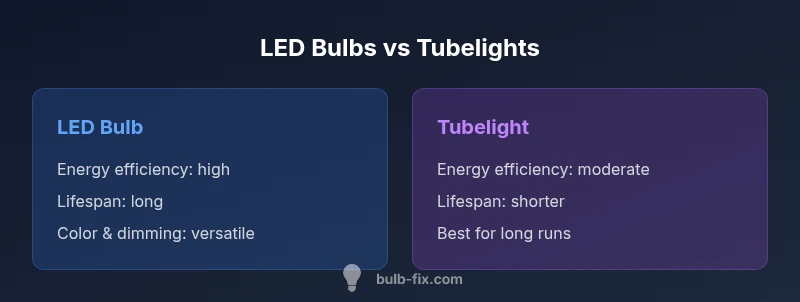
| Feature | LED Bulb | Tubelight (Fluorescent) |
|---|---|---|
| Energy Efficiency | Very high efficiency per watt | Moderate efficiency per watt |
| Lifespan | Longer lifespan | Shorter lifespan |
| Brightness per Watt | Higher lumens per watt | Lower lumens per watt |
| Color Rendering | Excellent CRI options | Good but variable CRI |
| Dimming/Smart Controls | Broad compatibility | Limited with older ballasts |
| Upfront Cost | Higher upfront cost | Lower upfront cost |
| Replacement Frequency | Less frequent replacements | More frequent replacements |
| Best For | Living rooms, kitchens, task lighting | Long corridors, existing ballast layouts |
Upsides
- Better energy efficiency reduces running costs over time
- Longer lifespans mean fewer replacements
- Improved color rendering and instant brightness
- Easy integration with smart lighting and controls
Drawbacks
- Higher upfront cost for LEDs
- Some fixtures require rewiring or ballast changes
- Quality varies by brand and model
- Disposal rules differ for fluorescent tubes in some areas
LED bulbs are the better overall choice for most homes; tubelights have niche uses in very long, linear spaces.
For general living areas, kitchens, and bedrooms, LEDs outperform tubelights in efficiency, longevity, and control. Reserve tubelights for corridors or where fixtures were designed around linear lighting. The Bulb Fix team recommends LEDs as the default solution, with a targeted tubelight upgrade only where necessary.
Got Questions?
Are LED bulbs compatible with all fixtures, or do I need a ballast bypass?
Most standard fixtures designed for bulbs are compatible with LED bulbs, but some older fixtures with a ballast require bypassing the ballast or using LED tubes. Always verify the fixture’s wiring and ballast type before upgrading, and consider consulting an electrician for ambiguous cases.
LED bulbs often fit most lamp holders, but some fixtures with ballast systems need a bypass or a compatible LED tube. Check your fixture and get professional help if unsure.
Can I replace a fluorescent tubelight with an LED bulb easily?
In many cases you can replace a tubelight with an LED bulb provided the fixture accepts a suitable socket and wiring. If your fixture is a recessed or surface-mounted linear unit, an LED tube might be a better match than a bulb. Assess fixture type and electrical components before upgrading.
Often yes, but check the fixture and possibly swap to an LED tube instead of a bulb if the space is linear.
Are tubelights dimmable, and do LEDs offer better dimming options?
Tubelights can be dimmable if paired with the correct ballast, but many modern dimmers struggle with older tubes. LEDs generally offer smoother, broader dimming support and better compatibility with smart dimmers.
Dimmable tubes exist, but LEDs typically give you wider, more reliable dimming options with better compatibility.
Do LED bulbs require special drivers or power supplies?
LED bulbs use internal drivers and usually don’t need external ballasts. Some fixtures still use drivers that are incompatible with LEDs, so verify your fixture’s electrical design.
Most LEDs are driver-contained, but verify compatibility with your fixture’s electrical setup.
How do color temperature and CRI affect choosing between LEDs and tubes?
Color temperature and CRI affect mood and task accuracy. LEDs offer a wide range of temperatures and generally higher CRI options, which helps with color accuracy in kitchens and workspaces. Fluorescent tubes have consistent performance but may not match LEDs in color rendering across all ages and brands.
LEDs give you more options for warmth and accurate color; tubes vary more by brand and age.
Which should I choose for a kitchen or bathroom?
For most kitchens and bathrooms, LED bulbs provide better efficiency, color accuracy, and ease of control. If you already have a long hallway or utility space with silent, continuous lighting, tubelights can be cost-effective in the short term, but LEDs are typically the smarter long-term choice.
LEDs are usually best for kitchens and bathrooms; tubelights can work for long corridors, but LEDs win long-term.
Key Points
- Prioritize LED bulbs for most rooms to maximize efficiency.
- Consider tubelights only for long, uninterrupted space layouts.
- Check fixture compatibility before replacing tubes with bulbs.
- Aim for ENERGY STAR-rated LEDs to ensure performance.
- Plan disposal carefully for fluorescent components.