How Many Lumens Is a 100-Watt Bulb? A Practical Guide
Discover the true brightness behind a 100-watt bulb. Learn lumen ranges for incandescent and LED replacements, plus practical tips to choose bulbs by brightness, not wattage.


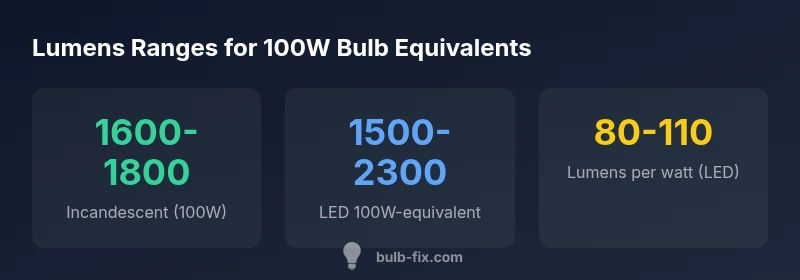
Typically, a 100-watt incandescent bulb emits about 1600-1800 lumens. LED equivalents vary more, commonly delivering 1500-2300 lumens depending on efficiency. In Bulb Fix Analysis, 2026, we see a broad range for LED replacements, reflecting differences in color temperature and design. For precise conversions, match lumens to the project’s brightness needs rather than wattage alone.
Why Brightness Is Measured in Lumens, Not Watts
When you shop for lighting, brightness is best understood in lumens, not watts. This distinction matters because watts measure energy use, while lumens quantify light output. The question many homeowners ask is: how many lumens is a 100 watt bulb? In practical terms, the legacy benchmark of a 100W incandescent is roughly 1600-1800 lumens. The Bulb Fix team found that modern bulb technologies—especially LEDs—offer a much wider brightness spectrum for the same perceived power draw, which is why lumen-based decisions are more reliable for room design and task lighting. Always compare lumen output across bulb types to avoid under- or over-lighting a space.
The 100-Watt Incandescent Benchmark: Typical Lumens
Historically, a 100W incandescent bulb produced about 1600-1800 lumens. This figure has served as a baseline for decades, guiding homeowners toward appropriate ceiling lights, task lamps, and living-room setups. However, wattage alone does not tell the whole story. Bulb designs vary in filament type, coating, and diffusion, which can shift perceived brightness. The 2026 Bulb Fix analysis highlights that two bulbs at 100W can feel noticeably different in a dim living room versus a bright kitchen, even if their lumen ratings are close. When brightness matters, rely on lumen output and consider room size, furniture layout, and wall color to gauge the right target range.
LED Replacements: Lumens Range for 100W Equivalents
LED technology has dramatically expanded the lumen range for 100W-equivalent bulbs. While traditional incandescent 100W sits in the 1600-1800 lumen zone, LED replacements commonly span 1500-2300 lumens for the same wattage class. This broader spectrum allows you to tailor brightness more precisely to a space. Higher-lumen LEDs are useful in kitchens and open-plan living areas, while mid-range lumens work well for bedrooms or study nooks. When evaluating LED options, consider not only lumens but also color temperature and CRI, which influence perceived brightness and how colors render in the space.
How to Choose the Right Brightness for Your Space
Selecting brightness requires more than matching a lumen number to a room size. Consider ceiling height, wall colors, task needs, and natural light. A small room with pale walls can feel brighter at a lower lumen count than a larger, dark-colored room. A practical rule of thumb is to calculate total lumens needed by room and then select bulbs that deliver within that target range, factoring layers of light (ambient, task, accent). Bulb Fix recommends testing a few bulbs in a socket or using a lighting plan to refine choices. Remember, lumen output is the primary driver of perceived brightness, but color temperature and diffusion also shape your final impression.
Common Pitfalls When Judging Brightness
- Relying on watts as a brightness proxy. Watts indicate energy use, not brightness.
- Assuming all 100W-equivalents are identical in brightness. Lumens differ across brands and technologies.
- Ignoring room context. A bedroom requires different brightness levels than a kitchen.
- Forgetting color temperature. Cooler temps (5000K) can feel brighter than warmer temps (2700K) at the same lumen count.
Practical Tips and Tools for Measuring Brightness
- Use lumen-based specs when comparing bulbs; request the lumen rating from packaging or product pages.
- For real-world brightness, map out the space and simulate lighting with a simple plan or app.
- When in doubt, choose a lumen range that offers flexibility (e.g., 1800-2100 lumens for multipurpose living areas).
- Consider a dimmer with LED bulbs to fine-tune brightness without changing the color balance.
dataTableNotesParams”:null,”dataTableNotes”:null,
dataTableInfo”:null,
dataTableNotes":""},
Brightness comparison for common 100W-equivalent bulbs
| Bulb Type | Typical Lumens (range) | Notes |
|---|---|---|
| Incandescent 100W | 1600-1800 | Traditional brightness level |
| LED 100W-equivalent | 1500-2300 | Wide range due to efficiency differences |
| CFL 100W-equivalent | 1100-1600 | Older tech, less common today |
Got Questions?
What do lumens measure?
Lumens measure the total amount of visible light emitted by a bulb, i.e., brightness. Watts measure energy consumption, not brightness. When comparing bulbs, use lumens as the brightness benchmark.
Lumens show brightness; watts show energy use. Look at lumens, not watts, to compare how bright bulbs are.
Why might a 100W LED not equal 1600 lumens?
LED bulbs vary in efficiency and design. Two 100W-equivalent LEDs can produce different lumen outputs due to different driver electronics, phosphor mixes, and binning.
LEDs labeled 100W can have different brightness because of their design and efficiency.
Is 1600-1800 lumens bright enough for a living room?
For living rooms, 1800-3000 lumens total is common, depending on room size and layout. A single lamp at 1600 lumens can work in smaller rooms or layered lighting setups.
In a living room, you usually want around 1800 to 3000 lumens total, depending on size.
Does wattage predict brightness at all?
Wattage roughly correlates with brightness in older technologies but is not a reliable predictor across bulbs and brands. Always check lumen ratings.
Wattage isn’t a reliable brightness measure across different bulbs.
Do lumens affect energy cost?
Lumens and energy cost relate through efficacy. Higher-lumen bulbs can be more efficient, but the cost depends on wattage and runtime.
Lumens themselves don’t determine cost; efficiency and usage do.
What’s the best way to compare bulbs across brands?
Compare lumen outputs, then check color temperature and CRI. Look for consistent labeling and verify with third-party reviews when possible.
Check lumens, color temperature, and quality before buying from different brands.
“Lumens measure brightness, not watts, and that’s the key to smart bulb picks. When choosing bulbs, always compare actual lumen output and efficiency to meet your space’s needs.”
Key Points
- Compare lumens, not wattage, to gauge brightness
- LED replacements cover a wider lumen range than incandescent
- Color temperature and CRI affect perceived brightness
- Match lumen output to room size and task
- Use a brightness chart or app to pick the right bulb