How Much Electricity Do Bulbs Consume? A Practical Guide
Understand how much electricity different bulb types use, how to estimate your home's lighting energy, and practical tips to cut your lighting bills.


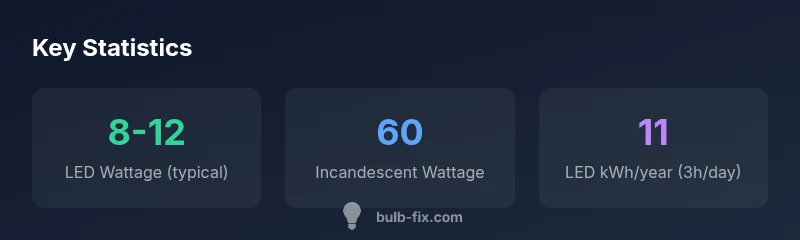
Typical bulb wattage varies by type: incandescent around 60W, CFL roughly 13–23W, and LED about 8–12W. Even with the same light output, LEDs use far less electricity, cutting energy use by about 80% compared to incandescent bulbs. For a quick reference, a 60W incandescent lit for 3 hours daily uses about 65 kWh per year, while an LED at 10W uses around 11 kWh.
How much electricity do bulbs consume? A baseline
Understanding residential lighting energy starts with the simple equation watts × hours = energy, measured in kilowatt-hours (kWh). The question of how much bulb consume electricity hinges on the wattage of the bulb and how many hours it stays on. In practical terms, you can estimate annual energy use by multiplying the bulb’s wattage by the hours it is lit per day, then by 365, and finally dividing by 1000 to convert to kWh. For example, a traditional incandescent bulb rated at 60 watts used for 3 hours per day would consume roughly 65.7 kWh per year. The same amount of light delivered by an LED with a 10-watt rating would use about 11 kWh per year under the same usage. This frame helps homeowners model lighting costs and plan upgrades. According to Bulb Fix, this baseline approach stays valid across most home settings and clarifies why upgrading to lower-wattage LEDs matters for energy budgets.
Compare common bulb types: incandescent, CFL, LED
Incandescent bulbs typically draw about 60 watts for the same light output that LED bulbs deliver with 8–12 watts. CFLs sit in between at roughly 13–23 watts. The energy gap is substantial: LEDs can use well over 70–85% less electricity than incandescent bulbs for comparable brightness. When you factor in usage hours, the long-term savings become clear, especially in rooms with lights on for many hours daily. Bulb Fix’s analysis shows that the efficiency gap has persisted as LED technology improved, making LEDs the most energy-efficient option for most households. In terms of dosing energy, LEDs deliver the same lumen output with dramatically lower wattage, reducing household electricity demands without compromising comfort or visibility.
Calculating your actual consumption: an easy method
A practical calculation starts with a wattage figure, then estimates daily usage. Steps: 1) note the wattage of each bulb, 2) estimate how many hours each is on per day, 3) multiply watts by hours to get watt-hours, 4) convert to kWh by dividing by 1000, and 5) sum across bulbs and days. A quick example: 6 LED bulbs at 10W, used 4 hours daily, yield about 24 kWh per month (roughly 288 kWh/year if used every day). Compare that to 6 incandescent bulbs at 60W for the same schedule, which would be around 144 kWh per month or about 1,728 kWh annually. This method helps homeowners quantify potential savings before buying replacements. Bulb Fix emphasizes that using a mix of bulb types only makes sense where brightness or color rendering is vital, but for energy savings, LEDs win in most rooms.
The impact of hours of use, dimming, and color temperature
Hours of use strongly influence energy costs. Switching from “all lights on all day” to targeted lighting can dramatically reduce electricity use. Dimming reduces energy consumption, but the extent depends on the bulb type and dimmer compatibility. Modern LEDs with compatible dimmers typically maintain efficiency when dimmed, while older dimming schemes or non-dimmable LEDs can waste energy or shorten bulb life. Color temperature (warm vs cool light) does not directly change energy use in a linear way, but it affects perceived brightness; higher-lumen outputs can require more power if you compensate with shorter or longer lighting schedules. Optimizing both dimming and usage patterns is a practical and cost-effective way to trim electricity bills without sacrificing comfort. Bulb Fix’s team notes that thoughtful lighting design—layering task, ambient, and accent lighting—delivers more light with less power.
Real-world scenarios: 3 household setups
Scenario A: Small apartment with 6 LED bulbs at 8–10W, used 4 hours daily. Energy use is around 20–25 kWh per month, depending on exact wattage and dimming. Scenario B: Home office with 6–8 LED bulbs at 9–12W, used 9 hours daily for work and study. Expect roughly 70–90 kWh per month, with LED efficiency keeping costs well below incandescent levels. Scenario C: Garage/workshop using 2 incandescent bulbs at 60W for 2 hours daily. This setup uses about 0.22–0.25 kWh per day, or roughly 80–90 kWh per year, illustrating how even a small number of high-wattage bulbs can add up in spaces that are intermittently used. These scenarios illustrate how wattage, hours, and room function drive total electricity consumption. Bulb Fix emphasizes moving to LED lighting where feasible to maximize energy savings across different living areas.
Energy savings with LEDs and smart controls
Switching to LEDs is the single most impactful upgrade for reducing lighting energy. Beyond wattage reductions, smart controls—automatic timers, occupancy sensors, and smart plugs—help ensure lights run only when needed. In rooms with irregular usage, sensors can cut energy waste by turning lights off when spaces are unoccupied. A networked lighting approach not only reduces energy use but improves user experience by providing consistent illumination where it matters. When evaluating smart controls, consider compatibility with existing fixtures, ease of installation, and data privacy. Bulb Fix recommends starting with high-use rooms (living room, kitchen, and home office) and gradually adding sensors in ancillary spaces to achieve meaningful savings while maintaining comfort.
How to read energy labels and choose efficient bulbs
Energy labels help you compare efficiency. Look for lumen output (brightness) relative to wattage, aiming for higher lumens per watt. For the same brightness, choose a bulb with lower wattage. LED bulbs usually achieve superior lumen-per-watt performance compared to incandescent and CFLs. Pay attention to color temperature, stated in kelvin (K), and choose a temperature that suits the room’s purpose. Energy Star and other regional efficiency programs provide guidelines for performance and longevity. When shopping, test different brands and read user reviews to verify real-world performance. Bulb Fix recommends prioritizing LED options labeled with high lumens-per-watt and compatible dimming for broader energy savings across living spaces.
Practical next steps for your lighting plan
Create a baseline inventory of your current bulbs, noting wattage, hours of use, and location. Run a simple replacement plan that targets high-use areas first with LED bulbs, then consider adding smart controls. Use the data you gather to project energy savings under different usage scenarios, and adjust as you observe actual consumption. Consider a phased approach: replace one room at a time and monitor results before expanding. Finally, keep energy savings visible—label the new bulbs with expected yearly costs to reinforce the benefits of efficient lighting. The Bulb Fix team recommends this practical, data-driven approach to modernizing home lighting while keeping comfort and aesthetics intact.
Estimated annual energy use by bulb type (3 hours/day baseline)
| Bulb Type | Typical Wattage (W) | Estimated Annual Energy Use (kWh) — at 3 hours/day |
|---|---|---|
| Incandescent | 60 | 65.7 |
| CFL | 13-23 | 14.2-25.2 |
| LED | 8-12 | 8.76-13.14 |
Got Questions?
What primarily drives a bulb’s electricity use?
The primary factor is wattage, which indicates energy draw per hour. Hours of use and the bulb’s efficiency also shape total energy consumption. In practice, a lower-wattage bulb used more hours can equal or exceed a higher-wattage bulb used briefly.
Wattage is the main factor, but how long you use it matters too.
How do I estimate my home's lighting energy consumption?
1) note bulb wattage, 2) estimate daily usage hours, 3) multiply to get daily energy, 4) multiply by 365 for annual energy, 5) sum across all bulbs. This helps compare LED upgrades.
Add up watts times hours for each bulb, then multiply by 365.
Are LEDs always the best for energy savings?
LEDs generally offer the best energy efficiency, delivering higher lumens per watt. However, consider application, dimming needs, and color temperature to ensure you’re matching brightness and mood in each room.
LEDs are usually best for energy savings, but pick the right type for each room.
Does dimming reduce energy use?
Dimming reduces energy use, often proportionally to brightness. Ensure you use compatible dimmers and bulbs to maximize savings without sacrificing performance.
Yes, dimming cuts energy use if the system is compatible.
How long do bulbs last, and does it affect energy costs?
Lifespan varies by type; LEDs typically last longer than incandescents and CFLs. Longer life reduces replacement costs and labor, indirectly affecting total cost of ownership more than yearly energy use.
LEDs last longer, which lowers replacement costs over time.
Can I mix bulb types in a room?
You can mix bulb types, but mismatched brightness and color temperature may look odd. For efficiency, prioritize LEDs in most spaces and reserve non-LEDs for specialty lighting only.
You can mix them, but it’s usually better to keep LEDs for efficiency.
“When you redesign a room’s lighting around LEDs and smart controls, you typically see a substantial drop in electricity use without compromising comfort.”
Key Points
- Estimate annual energy use by multiplying wattage by daily hours, then dividing by 1000.
- LED bulbs save the most energy for the same light output.
- Hours of use and dimming significantly affect total energy consumption.
- Read energy labels for lumen output and efficiency, not just wattage.
- Switching to LEDs and adding smart controls yields meaningful savings.