LED Bulb Watt: A Practical Guide to Brightness and Efficiency
Learn how led bulb watt relates to brightness and energy use. Practical tips for choosing LED bulbs, reading labels, and saving energy in every room.


LED bulb watt is the power rating that indicates energy use, but brightness is determined by lumens, not watts alone. In modern LEDs, a small wattage can produce bright light, while older high-watt bulbs used more energy for the same output. For homeowners upgrading lighting, understanding led bulb watt helps size bulbs correctly, compare efficiency, and predict energy savings across rooms.
Understanding LED bulb wattage and what it means for your home
The term led bulb watt describes how much electrical power a bulb draws. It is a useful starting point for estimating energy use, but it does not directly determine brightness. For real performance, homeowners should read lumens (brightness) and efficacy (lumens per watt) in addition to wattage. The Bulb Fix team notes that modern LEDs deliver more light per watt than older tech, enabling smaller wattages to replace much higher-wattage incandescents. In practice, comparing products means translating a label into expected room results: energy use, brightness, color tone, and lifespan.
How watts relate to brightness: lumens, efficacy, and color temperature
Wattage measures power consumption, but light output is defined by lumens. Efficacy, or lumens per watt, shows how efficiently a bulb converts power into visible light. A higher efficacy LED delivers more lumens for the same wattage. Color temperature, measured in kelvin (K), also shapes perception—2700–3000K for warm, 3500K–4100K for neutral, and 5000K+ for cool daylight. When you choose a bulb, compare lumen output (brightness) and efficacy alongside wattage to predict true performance.
Room-by-room wattage guidance: living rooms, kitchens, bedrooms
Different spaces benefit from different brightness levels. Living rooms and family spaces typically aim for a comfortable 1,500–3,000 lumens total, depending on size and task lighting. Kitchens benefit from higher brightness in task zones, while bedrooms favor softer illumination for relaxation. A practical approach is to target a lumen range per room and then pick LED bulbs that meet or exceed that output with lower wattage. Remember: two 9W LEDs can easily replace a single 60W incandescent in common setups if lumen targets are matched.
Reading packaging and labels: lumens, watts, Kelvin, CRI
LED packaging often lists watts, but the brighter indicator is lumens. Look for a lumen range that matches your needs, then check efficacy (lm/W) to gauge efficiency. Kelvin values reveal color: 2700–3000K is warm, 3500–4100K is neutral, and 5000K–6500K is cool. A higher CRI (color rendering index) near 80–90 means colors appear more natural under the light. By reading all four terms—watts, lumens, kelvin, CRI—you can select bulbs that balance energy use with task performance.
Common myths about wattage and LED brightness
Myth: Higher wattage always means brighter. Fact: Brightness is measured in lumens. Myth: LEDs are too cool to use in living spaces. Fact: LED options come in warm colors that suit homes well. Myth: Wattage alone guarantees energy savings. Fact: Efficiency (lm/W) and lumen output determine real energy savings, not wattage alone. Debunking these myths helps homeowners choose lighting that truly fits their rooms.
Dimming, compatibility, and wattage considerations
Dimming performance varies by technology. Not all LEDs dim smoothly with older dimmers, and some bulbs require compatible dimmers to avoid flicker. When replacing dimmable incandescent bulbs, select LED bulbs explicitly labeled as dimmable and ensure your dimmer supports LED loads. Wattage matters for circuit design, but lumens and dimming compatibility ultimately determine user experience.
How to estimate energy savings with LED wattage
To estimate savings, compare the old wattage to the new LED wattage, multiply by daily usage, and convert to yearly kWh. For example, replacing a 60W incandescent with a 9W LED used 3 hours per day yields a rough energy reduction of about 50–60 kWh per year per bulb, depending on actual usage. This simple calculation helps you plan across rooms and fixtures.
Practical buying checklist and quick-reference table
- Determine the required lumen target for each room
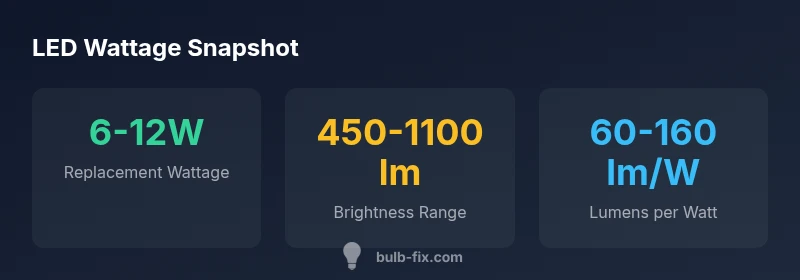
- Choose LED bulbs with wattage within the 6–12W range for typical replacements
- Verify lumens, efficacy, color temperature, and CRI on the label
- Check dimming compatibility if using dimmers
- Consider the bulb’s lifespan and warranty for long-term value
| Room | Target Lumens | Suggested Wattage (W) | Color Temp | CRI | |Living room| 1500–3000 | 9–12 | 2700–3000K | 80+ | |Kitchen| 2000–4000 | 9–12 | 3500–4100K | 80+ | |Bedroom| 1200–2500 | 6–9 | 2700–3000K | 80+ |
Regulatory and safety considerations
Ensure bulbs carry recognized safety certifications (UL, CE as applicable in your region) and are compatible with your fixtures. Avoid counterfeit bulbs that may fail early or present a safety risk. Proper disposal and recycling of old bulbs is also important for environmental protection.
Representative LED wattage classes and brightness
| Wattage Class | Typical Brightness (lm) | Typical Power (W) | Lifespan (years) |
|---|---|---|---|
| 6-8W (soft) | 450-800 | 6-8 | 15-25 |
| 9-12W (bright) | 800-1100 | 9-12 | 15-25 |
| 14-18W (high) | 1100-1600 | 14-18 | 15-25 |
Got Questions?
What does LED wattage measure?
LED wattage measures power consumption. Brightness is determined by lumens, which can vary even at the same wattage. Practically, compare lumen output and efficacy to predict real-world results.
Wattage tells you energy use, while brightness is lumens. Look at lumens and efficacy to estimate real performance.
Is wattage alone enough to judge brightness?
No. Wattage is only part of the story. Brightness depends on lumens, and efficiency (lm/W) determines how efficiently the bulb converts power into light.
Wattage isn’t enough—check lumens and efficiency for brightness and value.
Can I replace a 60W incandescent with a 6W LED?
Yes, if the LED delivers similar lumen output. Always compare lumens, not wattage, to ensure comparable brightness.
Yes, but make sure the LED’s lumens match the old bulb’s brightness.
Do higher wattage LEDs always mean more brightness?
Not necessarily. LED brightness depends on lumens and efficacy. Higher wattage can compensate for lower efficiency, but the best choice is higher lumens per watt.
More watts don’t always mean more brightness—look at lumens per watt.
Where can I find wattage on LED packaging?
Wattage is usually printed prominently on the front of the package, but always verify lumens and lumen/watt efficiency as well.
Check the front label for watts, then compare lumens and lm/W.
Are LED wattage labels standardized?
Labeling follows general industry standards, but formats vary by region. Always cross-check lumens, kelvin, and CRI for consistent comparisons.
Label formats can vary; focus on lumens, kelvin, and CRI for reliable comparisons.
“Wattage alone does not guarantee lighting quality; brightness and color accuracy matter more for real-world rooms. When in doubt, prioritize lumen output and efficacy over raw wattage.”
Key Points
- Start with lumens, not watts, to measure brightness
- LED wattage is about energy use; lumen output defines light output
- Choose wattage ranges that match room brightness targets
- Check color temperature for mood and task lighting
- Ensure dimmer compatibility for smooth control