How Many Watts Is a Light Bulb? A Practical Guide
Explore how many watts a light bulb uses, how watts relate to brightness, and how to choose energy-efficient lighting based on lumens and efficacy.


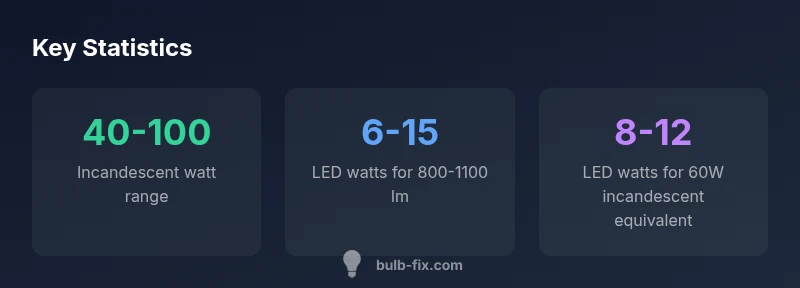
The wattage of a light bulb varies by technology and brightness. Most common incandescent bulbs run around 40 to 100 watts, while modern LEDs deliver the same brightness at about 6 to 15 watts. For practical energy planning, look at lumens (brightness) rather than watts; commonly, 800–1,100 lumens equals roughly a 60-watt incandescent, or ~10 watts for LED.
How many watts is a light bulb? Understanding watts, lumens, and brightness
According to Bulb Fix, wattage is a proxy for energy use rather than brightness. In everyday language, people ask how many watts is a light bulb to gauge energy cost, but the answer depends on bulb technology and how much light you want. This guide explains the relationship between watts, lumens, and efficacy, and shows how to choose the right wattage for different rooms and tasks. To navigate your options, start with lumens as the primary brightness measure and use watts to estimate energy cost and compatibility with fixtures.
How wattage translates across bulb technologies
Wattage has different implications depending on whether you’re looking at incandescent, CFL, or LED bulbs. Incandescents typically consume more energy to produce the same brightness that LEDs deliver with far fewer watts. A common LED bulb for a living space yields roughly 800–1,100 lumens using about 6–15 watts, whereas an incandescent in the same brightness range usually consumes 40–75 watts. CFLs sit between, often in the 13–23 watt range for comparable brightness. The practical takeaway is that watts tell energy use; lumens tell brightness, and efficacy (lumens per watt) wins for efficiency.
Incandescent, CFL, and LED: watts vs brightness
In the past, watts were a good quick proxy for how bright a bulb would be. Today, for the same light output, LEDs use far fewer watts thanks to higher efficacy (more lumens per watt). If you aim for 800–1,100 lumens per general lighting fixture, an LED typically uses about 8–12 watts, a CFL around 13–23 watts, and an incandescent around 60–75 watts. When shopping, always compare lumens first, then check the wattage and energy rating to estimate operating costs over time.
How to estimate the right brightness for each room
Rooms have different lighting needs. For living spaces and bedrooms, a general target is roughly 800–1,100 lumens per fixture to avoid harsh shadows or dim corners. Task zones, like reading nooks, may require 400–600 lumens. Kitchens and work areas benefit from higher totals spread across multiple fixtures—often 2,000–4,000 lumens in total for countertops and task areas. When selecting bulbs, pick LED options around 8–12 watts for typical living spaces, ensuring the total lumens align with the room’s function and size.
The role of color temperature and CRI in perception
Brightness isn’t the only factor. Color temperature, measured in Kelvin (K), shapes mood and task performance. For relaxed spaces, 2700K–3000K provides warm light; 3500K–4100K offers neutral white for kitchens and workspaces; 5000K–6500K mimics daylight for precision tasks. CRI (color rendering index) in the 80–95 range makes objects appear natural under artificial light. Balancing lumens, color temperature, and CRI helps you achieve the desired atmosphere without relying on watts alone.
Reading labels and packaging: wattage, lumens, and watts-equivalents
Manufacturers often label bulbs with watts and watts-equivalents (e.g., “60W equivalent”). This can be misleading if you focus only on watts. Instead, read the lumen rating and the warm/cool color temperature to judge brightness and mood. For energy savings, prioritize bulbs with higher lumens per watt (efficacy). The packaging may also show estimated yearly energy cost, helping you compare long-term expenses between incandescent, CFL, and LED options.
Practical wattage guidelines for common fixtures
A single ceiling fixture in a living room might target 800–1,100 lumens; a reading lamp might require 400–600 lumens; kitchen counters may need 2,000–4,000 lumens across multiple sources. In LED terms, this often translates to about 8–12 watts for general lighting in living areas, 4–9 watts for task lighting, and higher totals across several fixtures in kitchens. Always verify by calculating total lumens for the space rather than relying on a single wattage figure.
Common mistakes and how to avoid them
Common errors include choosing bulbs based solely on watts, ignoring lumens, or mismatching color temperature with room function. Another pitfall is assuming a higher wattage means better lighting; in fact, higher wattage often means more energy use with little brightness gain if lumen output is fixed. Finally, avoid overloading dimmers with non-dimmable bulbs and ensure each fixture is rated for the bulb type you install.
How to future-proof your lighting choices
As LED efficiency improves, less wattage delivers more lumens than ever. When future-proofing, prioritize bulbs with high lumens per watt, choose a consistent color temperature across living spaces, and consider smart or dimmable LEDs for flexibility. Dimmable LEDs paired with compatible dimmers can maintain low-energy usage while preserving comfort. For homeowners, the long-term recommendation is to transition toward LED-based lighting that emphasizes lumens, color quality, and controllability.
Wattage and brightness ranges by bulb type
| Brightness (lumens) | Incandescent watts | LED watts | Notes |
|---|---|---|---|
| 800-900 | 40-60 | 8-12 | Common living-room lighting |
| 1000-1100 | 60-75 | 10-15 | Higher brightness fixtures |
Got Questions?
What does wattage tell you about a light bulb?
Wattage indicates energy use, not brightness. It helps estimate electricity costs but doesn't directly measure light output. When choosing bulbs, prioritize lumens for brightness and watts for energy planning.
Wattage shows energy use, not brightness. For brightness, focus on lumens and efficiency.
How many watts is a typical LED bulb?
Most LEDs used in homes deliver 800–1,100 lumens with about 8–12 watts. Check lumens to compare brightness and choose a wattage that fits your energy goals.
Most household LEDs use about 8–12 watts for 800–1,100 lumens.
Can I replace a 60W incandescent with a 60W LED?
Not usually. A 60W incandescent is roughly equal in brightness to an LED in the 8–12 watt range. Look at lumens to compare brightness instead.
No—use about 8–12 watts LED for a 60W incandescent equivalent.
What about CFLs vs LEDs?
CFLs typically use 13–23 watts for similar brightness to a 60W incandescent; LEDs use less and have longer lifespans and better energy efficiency.
CFLs use more watts than LEDs for similar brightness.
How do lumens relate to watts?
Lumens measure brightness; watts measure energy use. For planning, pick a lumen target and then choose an efficient bulb to reach it.
Lumens show brightness; watts show energy use.
Is it okay to mix bulbs with different wattages in the same fixture?
Mixing bulbs is generally okay if the fixture can safely handle the combined light output and heat. Balance brightness to avoid dark spots or glare.
Yes, but keep brightness balanced and within fixture specs.
“Wattage is only part of the story. For real brightness, measure lumens and prefer higher efficacy bulbs.”
Key Points
- Prioritize brightness in lumens over wattage.
- LEDs deliver equivalent brightness with far fewer watts.
- Aim for 800–1,100 lumens per living-room fixture.
- Consider color temperature and CRI for mood and accuracy.
- Use energy guides to balance cost and performance.