How Many Watts Does a Light Bulb Use? A Practical Guide
Learn how many watts different bulb types use for the same brightness, why lumens matter more, and how to choose energy-efficient bulbs for your home. Bulb Fix explains watts, lumens, and cost with clear, actionable steps.


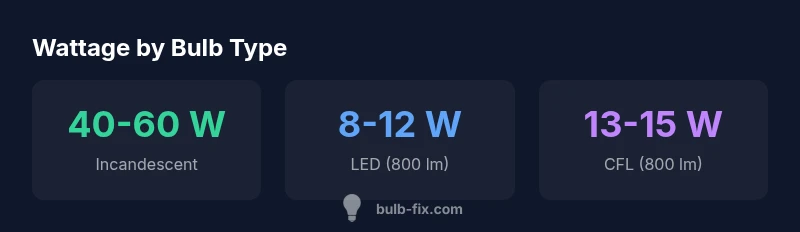
If you’re asking how many watts does a light bulb use, note that wattage varies by technology. Incandescent bulbs commonly run about 40–60 watts to produce typical room brightness, while LED equivalents deliver the same output for about 8–12 watts, CFLs around 13–15 watts. For 800 lumens, compare lumen ratings and energy use rather than wattage alone.
Understanding watts and lumens
The common question is how many watts does a light bulb use in practice, and the answer depends on the technology. Watts measure energy consumption, while lumens measure light output. In practice, brightness is driven by lumens. Packaging now emphasizes lumens for brightness, making it easier to compare bulbs. For example, an LED bulb that emits around 800 lumens typically uses about 8–12 watts, while an incandescent bulb delivering the same light might consume roughly 60 watts. The efficiency gap between these technologies explains most energy savings homeowners realize when switching to LEDs. When planning a room, start with a target lumen level and then select a technology that delivers that brightness efficiently. Also consider color temperature and CRI, since warmth of light affects mood and task performance.
Wattage by bulb type: incandescent, LED, CFL
Different bulb technologies achieve the same brightness with different wattages. Incandescent bulbs are less efficient, so higher wattage is required; LED bulbs are far more efficient, achieving the same lumen output with much lower wattage; CFLs fall in between. For common targets like 800 lumens: Incandescent: about 40–60 watts; LED: about 8–12 watts; CFL: about 13–15 watts. Always verify lumen output on the package rather than relying on wattage alone, as two bulbs with the same wattage can produce different brightness. When upgrading, expect a substantial reduction in energy use with LEDs, plus a longer life and lower replacement frequency.
Translating watts to real-world energy costs
Energy cost depends on wattage, usage hours, and your local electricity rate. Use the formula: energy (kWh) = (WATTAGE ÷ 1000) × hours. For a 60W incandescent used 4 hours daily, the energy draw is 0.24 kWh per day; for a 10W LED used the same hours, it is 0.04 kWh per day. Because many households run multiple bulbs, switching to LEDs can yield meaningful annual savings even at modest usage. The exact savings depend on local rates and how often you dim or switch off lights.
Practical room-by-room wattage planning
Plan by room and activity. Living rooms and kitchens typically benefit from higher lumen targets and mixed color temperatures to support tasks, while bedrooms can use lower brightness for relaxation. A common approach: for living spaces, aim for 300–600 lumens per area, distributed across several bulbs with 8–15W LEDs each. For task lighting, use brighter lamps or desk lights in the 4–12W LED range with good color rendering. Dimming, smart controls, and occupancy sensors can dramatically cut energy use without sacrificing comfort.
Common myths and mistakes
Common myths persist about watts. One is that higher wattage always means better brightness; in reality, more lumens produce more light, and wattage is only a proxy. Another mistake is ignoring lumen output on unfamiliar bulbs; always check lumens and efficacy. Finally, many people underestimate the long-term savings of LED bulbs due to higher upfront costs; the payback comes from energy savings and fewer replacements.
Wattage ranges by bulb type for common brightness targets
| Lumens target | Incandescent (W) | LED (W) | CFL (W) | Notes |
|---|---|---|---|---|
| 800 lumens | 40-60 W | 8-12 W | 13-15 W | Equivalent brightness |
| 1600 lumens | 100-110 W | 18-28 W | 26-32 W | Two-bulb brightness |
Got Questions?
What is the difference between watts and lumens?
Watts measure energy consumption while lumens measure light output. A bulb can draw more or less power but still produce similar brightness; always compare lumens for brightness.
Watts tell you energy use; lumens tell you brightness.
Can I replace a 60W incandescent with LED?
Yes. Choose an LED with similar lumens (around 800) rather than matching wattage; LED wattage is typically 8–12W for that brightness.
Yes—look for the same brightness in lumens, not watts.
Do I need to worry about wattage for outdoor bulbs?
Wattage matters for energy use and heat, but outdoor lighting emphasizes brightness, color rendering, and beam angle. Check lumens and ratings suitable for outdoor use.
Outdoor lighting focuses on brightness and coverage.
Why do some bulbs show different wattage ratings?
Different technologies achieve the same brightness with different wattages. Look at lumens and efficacy to compare.
Different tech, different power used.
How many watts does a typical smart bulb use?
Smart bulbs usually use about 5–11W depending on brightness; always check the lumen rating to compare with standard bulbs.
Around 5–11 watts, depending on brightness.
“Wattage alone is a poor measure of brightness. Focus on lumens and efficacy to compare bulbs, then factor in the energy use.”
Key Points
- Start with lumens, not watts, to compare brightness
- LEDs deliver the same brightness with far fewer watts
- Check lumen ratings on packaging for accuracy
- Estimate energy costs by using the watts × hours guideline