Incandescent Light Bulb vs LED Health: A Practical Guide
Explore health considerations of incandescent vs LED lighting. Learn how heat, blue light, and color rendering affect sleep, comfort, and wellbeing, with practical guidance from Bulb Fix.


Quick answer: When comparing incandescent light bulb vs led health, LEDs generally reduce heat, exposure, and energy-related risks, while blue-light considerations and circadian timing deserve care. Incandescent bulbs emit more heat and use more energy, which can impact comfort and long-term maintenance. For most homes, LED lighting is the health-forward choice, especially when paired with warm, dimmable options.
The health lens on incandescent light bulb vs led health
When evaluating lighting options from a health standpoint, the question often boils down to heat, light quality, and circadian impact. The incandescent light bulb vs led health debate surfaces because LEDs are cooler, energy-efficient, and offer precise control over color temperature, while incandescent bulbs reward with a familiar warm glow but deliver more heat and require more frequent replacements. According to Bulb Fix, prioritizing health-friendly lighting means favoring LEDs for most living spaces, while selecting warmer LED variants for evening use. This section lays out the core health-related factors, including how blue light, flicker, and glare can influence sleep quality, eye comfort, and overall wellbeing. The aim is to empower homeowners to choose lighting that supports daytime alertness and nighttime rest without sacrificing comfort.
The health lens on incandescent light bulb vs led health
When evaluating lighting options from a health standpoint, the question often boils down to heat, light quality, and circadian impact. The incandescent light bulb vs led health debate surfaces because LEDs are cooler, energy-efficient, and offer precise control over color temperature, while incandescent bulbs reward with a familiar warm glow but deliver more heat and require more frequent replacements. According to Bulb Fix, prioritizing health-friendly lighting means favoring LEDs for most living spaces, while selecting warmer LED variants for evening use. This section lays out the core health-related factors, including how blue light, flicker, and glare can influence sleep quality, eye comfort, and overall wellbeing. The aim is to empower homeowners to choose lighting that supports daytime alertness and nighttime rest without sacrificing comfort.
Comparison
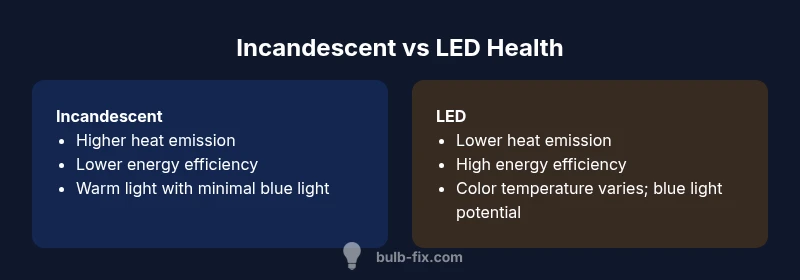
| Feature | Incandescent light bulb | LED light bulb |
|---|---|---|
| Heat output | high | low |
| Blue light exposure | minimal blue-light exposure (warm glow) | noticeable blue-light exposure (depends on color temperature) |
| Lifespan | short-lived relative to LEDs | long-lasting; fewer replacements |
| Energy efficiency | low energy efficiency | high energy efficiency |
| Color rendering (CRI) and variability | warm spectrum with consistent glow | broad range of color temperatures with high CRI available in many models |
| Best for health-related goals | familiar warmth but higher heat risk | low heat, controllable temperature, better glare control |
Upsides
- LEDs reduce heat and burn risk in most rooms
- LEDs offer energy savings and lower running costs
- Longer LED lifespans mean fewer replacements and less waste
- Wide range of color temperatures helps tailor mood and acuity
- Dimmable LED options enable better circadian-friendly timing
Drawbacks
- Higher upfront cost for quality LED bulbs
- Blue-light exposure in some LED configurations can affect night routines
- Quality varies; some LEDs have flicker or uneven color rendering
- Incandescent nostalgia can be hard to replace in decorative fixtures
LED lighting is generally the health-forward choice, with caveats for blue light timing and flicker.
Choose LED bulbs with warm color temperatures for evening use and ensure flicker-free designs. For daytime tasks, LEDs offer safer heat profiles and energy efficiency, while incandescent may still suit specific decorative needs or color preferences.
Got Questions?
How does incandescent light bulb vs led health compare in terms of blue light exposure?
LEDs can emit blue light, which can influence circadian rhythms if used late at night. Incandescent bulbs typically emit little blue light due to their warm spectrum. When health is a priority, choose warm LED options and limit use after sundown.
LEDs can emit blue light, so use warm temperatures at night and limit late-night exposure to support sleep health.
Do LED lights worsen sleep if used at night?
Yes, high blue-light emissions or bright nighttime lighting can disrupt sleep. Use warmer LEDs, dimming, and timers after dark to minimize circadian disruption.
Blue light at night can disrupt sleep; use warm, dimmed LEDs after sunset.
Are LED bulbs safer for heat and burns compared to incandescent?
LED bulbs run cooler and pose less burn risk. They also reduce heat buildup in enclosed fixtures and rooms, contributing to overall comfort.
LEDs stay cooler and are safer to touch than incandescent bulbs.
Do LEDs affect indoor air quality or ozone?
LEDs do not produce ozone like some older lamp technologies. The main health considerations include heat, light quality, and electrical flicker rather than air pollutants.
LEDs don’t emit ozone, and the main concerns are light quality and heat.
What features should I look for to minimize health concerns?
Look for warm color temperatures, high CRI, low flicker, and dimmability. Ensure the bulb matches your fixture and environment to reduce glare and eye strain.
Seek warm temps, high color rendering, low flicker, and dimmable options.
Is it necessary to replace all bulbs at once when upgrading?
No. A staged upgrade is common and practical. Start with high-use rooms and consider consistency in color temperature to avoid visual mismatches.
You can upgrade gradually; focus on busy spaces first and keep a consistent feel.
Key Points
- Prioritize LED bulbs for health and energy efficiency
- Opt for warm color temperatures in evenings to support sleep
- Check for flicker-free LED options and high CRI in living spaces
- Use dimmable LEDs with timers to align light with daily rhythms
- Replace bulbs gradually to manage budget and ensure consistent lighting quality