What bulb wattage for living room: A practical guide
Discover how to pick the right wattage for living room bulbs by focusing on lumens, room size, and mood. Practical LED guidance from Bulb Fix helps you balance brightness, energy use, and comfort.


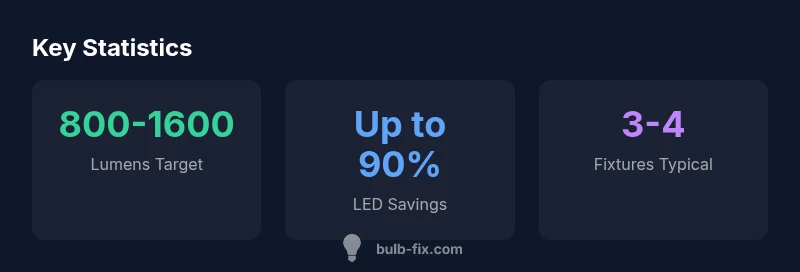
For most living rooms, aim for about 800–1600 lumens total to achieve comfortable ambient light. That typically translates to roughly a 60–100W incandescent equivalent, but with LED lighting you’ll use far less wattage overall. If you prefer multiple sources, distribute the lumens across layered lighting (ambient, task, and accent) to avoid glare and shadows.
Why wattage matters in living room lighting
According to Bulb Fix, selecting the right wattage for living room lighting is a proxy for lumens; the real goal is achieving the right total light output for the space and activities. When you ask what bulb wattage for living room, the answer depends on room size, ceiling height, finishes, and how you use the room. A common rule is to aim for a comfortable ambient level that lets you read, watch TV, and relax without glare. This means moving beyond a single bulb and toward a layered approach that combines ambient, task, and accent lighting. In practical terms, you’ll regulate brightness by varying lumen output rather than chasing a fixed wattage number. LED bulbs make this easier, because you can reach the same lumen level with far lower wattage and save energy over time.
A layered lighting plan accounts for different activities and times of day. A living room might need a soft glow for evenings, brighter light for reading, and a few accent lights to highlight art or architectural features. The goal is not a single, bright bulb but a balanced mix of sources that add up to the target lumens. Start with a rough lumen target—800 to 1600 lumens for most spaces—and adjust with dimmers, smart bulbs, and additional fixtures as needed. This approach also supports energy efficiency and reduces heat in warmer rooms.
Decoding lumens, watts, and room size
Lumens measure the total amount of visible light a bulb emits, while watts measure energy consumption. The two are related but not interchangeable: a higher wattage bulb isn’t inherently brighter if it’s inefficient, and a low-wattage LED can outperform a high-wattage incandescent. For living rooms, a practical starting point is a total lumens target that matches the room size and intended mood. Rough benchmarks suggest about 20-30 lumens per square foot for general ambient lighting, with additional lumens added for task areas like reading nooks or desks. Ceiling height, wall color, and natural light exposure all influence perceived brightness. If you’re unsure, aim for a flexible plan that uses dimmable LEDs and multiple light layers, so you can dial brightness up or down without swapping bulbs.
LED lumens benchmarks for living rooms
LED technology lets you hit the same lumen targets with far less wattage. For a typical living room, most people find 800-1100 lumens to be a comfortable ambient level when used as the primary ceiling light, while 1200-1600 lumens can be preferable in rooms with cooler color schemes or deeper furniture. If you have dedicated reading nooks or workspaces, add 400-800 extra lumens in those zones. As a rough guide, LED bulbs in the 8-15W range often provide 800-1600 lumens, depending on the model and efficiency. Don’t rely solely on wattage; focus on the lumen output you need and verify lumens per bulb on the packaging. Layering sources helps avoid glare and shadows that can occur with a single bright fixture.
How to calculate target wattage by space
A simple method starts with measuring your room in square feet and selecting a lumen-per-square-foot target. For many living rooms, 20-30 lumens per square foot gives a comfortable ambient level, while 30-40 lumens per square foot is useful near seating areas or reading corners. Total lumens = room area (sq ft) × lumens per sq ft. To translate lumens to watts, use an LED efficiency benchmark around 90 lm/W (roughly 10–11W per 900–1000 lumens). If you use incandescent or halogen bulbs, expect higher wattage per the same lumen value (roughly 60–100W incandescent equivalents for 800–1600 lumens).
A practical tip is to plan for a total bulb count of 3-4, distributing light across ceiling fixtures, floor lamps, and table lamps. Using dimmers allows you to stay within the lumen target across different activities and times of day.
Lighting layering: ambient, task, accent
A robust living room lighting plan includes three layers. Ambient lighting provides overall illumination and should comprise about 60-70% of total lumens. Task lighting focuses on specific activities like reading, hobbies, or work and can contribute 15-25% of lumens. Accent lighting highlights artwork or architectural features and should account for the remaining 5-15% of lumens. For example, ceiling fixtures (ambient) plus a couple of floor lamps (task) and a small set of wall sconces (accent) deliver a balanced, flexible glow. In practice, aim for a total ambiance in the 800-1600 lumen range and adjust per zone with dimmers.
Tip: Place task lighting to the side of the reading chair rather than directly behind it to reduce glare on screens and improve contrast.
Practical layouts for different living rooms
Living rooms vary in shape and light exposure. For a small 150 sq ft space, a single overhead fixture plus a floor lamp can reach 800-1200 lumens when dimmed. For medium rooms (200-250 sq ft), combine a ceiling fixture (700-900 lumens) with two table lamps (each 400-600 lumens). Large rooms (300+ sq ft) benefit from two ceiling fixtures or a ceiling light plus multiple lamps to distribute 1500-2000 lumens. If natural light is strong, you may adjust down the distal lumens. Finally, layer lighting for zones—television viewing, seating areas, and reading corners—so every seat receives comfortable light without glare. A well-planned layout makes a room feel larger and more inviting.
Safety, energy efficiency, and buying tips
Choose LED bulbs with a high color rendering index (CRI) for accurate color perception—ideally 80+ for living spaces. Use dimmable LEDs when possible, and pair them with compatible dimmers to fine-tune brightness. Address energy use by selecting bulbs labeled as energy-efficient or ENERGY STAR. Check for flicker-free designs, warm to neutral color temperatures (2700K–4000K) depending on the mood, and ensure lamp shades and fixtures are rated for the bulb type. Finally, bear in mind that total lumens matter more than wattage alone; wattage is a proxy that varies by bulb efficiency. By focusing on lumens and layering, you can achieve the desired ambiance with fewer watts and less heat.
Table: Common bulb types and lumen guidance
| Bulb Type | Typical Wattage (Incandescent Equivalent) | Approx. Lumens | Color Temp (K) | Notes |
|---|---|---|---|---|
| Incandescent | 60-100 | 800-1600 | 2700-3000 | Lower efficiency, higher heat |
| LED | 8-15 | 800-1600 | 2700-4000 | Energy efficient, long life |
| CFL | 13-23 | 700-1400 | 2700-6500 | Moderate efficiency, variety of temps |
Got Questions?
What is the recommended total lumens for a standard living room?
Total lumens depend on room size and intended use, but a common range is 800–1600 lumens for general ambient lighting in living rooms. Larger spaces may benefit from up to 2000 lumens when layered with task and accent lighting. Always start with the lumens target and adjust with dimmers.
For most living rooms, aim for about 800 to 1600 lumens as a baseline, then adjust with dimmers for mood and tasks.
Should I use one bright bulb or several dimmable lamps?
A layered approach with multiple dimmable light sources is preferable. It reduces glare and improves flexibility for different activities. Use a strong ambient source plus two to three supplementary lamps for tasks or accents.
Layer your lighting with one main dimmable light and a couple of lamps to tune brightness as needed.
What color temperature is best for living rooms?
A range of 2700K to 4000K covers most living room moods. Warmer temperatures (2700K–3000K) feel cozy, while neutral to cool temperatures (3500K–4000K) offer clarity for activities like reading or crafts.
Choose 2700K to 4000K depending on whether you want warm coziness or brighter task lighting.
How many bulbs should a typical living room have?
Most living rooms work well with 3-4 bulbs total when layered (one main ceiling light plus a couple of lamps). Rooms with high ceilings or long layouts may need more fixtures to reach the lumen target evenly.
Three to four fixtures usually do the job; add more if the space is large or has unique zones.
Do LED bulbs need special dimmers?
Yes. Use dimmable LEDs with compatible dimmers to avoid flicker and ensure smooth brightness changes. Check fixture compatibility and bulb packaging for dimming specifications.
Yes—use dimmable LEDs with compatible dimmers for smooth dimming.
How should I adjust wattage for a small living room?
In small spaces, start with fewer fixtures and lower lumens targets, around 800-1200 total lumens. Consider warm 2700K tones and a couple of compact, dimmable LEDs to avoid overcrowding and heat.
Keep it simple: fewer fixtures, lower lumens, and warm tones with dimmable LEDs.
“Layered lighting that targets total lumens, not just wattage, consistently delivers better living room ambiance.”
Key Points
- Start with a lumen target, not a fixed wattage
- LEDs deliver the needed lumens using far less wattage
- Balance ambient, task, and accent lighting
- Adjust with dimmers to match activities and mood
- Choose bulbs with 2700K–4000K for living spaces