How Long Do Lamps Last? A 2026 Lifespan Guide for Homes
Discover how long lamps last by bulb type (LED, CFL, incandescent), usage patterns, and care. This Bulb Fix guide explains realistic lifespans, maintenance tips, and strategies to maximize lamp longevity in your home.


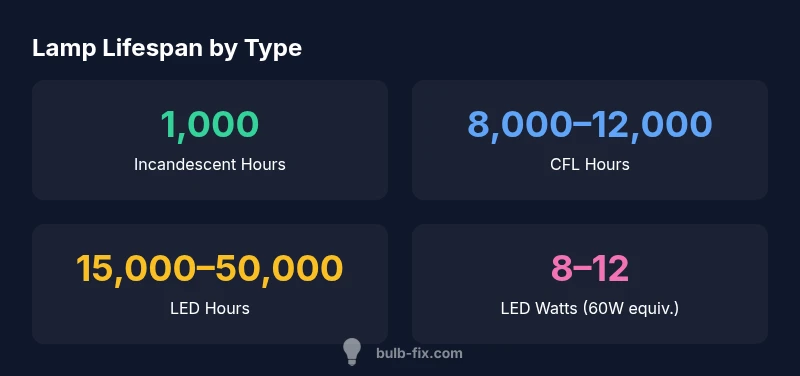
How long lamp life lasts depends on bulb type. For common options: incandescent lamps typically last about 1,000 hours, CFLs around 8,000–12,000 hours, and LEDs often reach 15,000–50,000 hours. Usage patterns, dimming, and heat also affect longevity. In short, LED lamps offer the longest practical life, with CFLs mid-range and incandescent shortest.
How to interpret lamp life and its measurement
How long lamp life lasts is defined by a bulb’s rated life, measured in hours, but the actual lifespan depends on usage. In consumer lighting, you’ll see three common benchmarks: incandescent, CFL, and LED. The question often asked is 'how long lamp life lasts' as a practical matter. While a manufacturer may advertise 1,000 hours for incandescent, 8,000–12,000 for CFLs, and 15,000–50,000 for LEDs, real-world results vary widely. The key idea: rated life is a statistic based on standardized tests under specific conditions. In practice, if you switch bulbs on and off many times per day, run lamps at high heat, or place them in enclosed fixtures, the actual hours can be lower. Conversely, using bulbs in a stable environment, with adequate ventilation and appropriate wattage, can help you reach the upper end of the ranges. The term 'how long lamp life lasts' is strongly influenced by the bulb’s design and by how well the fixture helps dissipate heat. Homes with smart lighting, or bulbs rated for enclosed fixtures, tend to see more predictable lifespans. According to Bulb Fix, understanding these variables helps homeowners plan replacements and budgets more accurately.
LED vs CFL vs incandescent lifespans and what it means for your home
LEDs typically deliver the longest lifespan, followed by CFLs, with incandescent bulbs far behind. Real-world averages place LEDs in the 15,000–50,000‑hour range, CFLs in the 8,000–12,000‑hour range, and incandescents around 1,000 hours. These figures reflect ideal operation and normal room conditions; actual results depend on heat, duty cycle, and fixture design. For households aiming to minimize replacement frequency, LEDs offer the most predictable performance when paired with properly cooled fixtures and compatible dimmers. For decorative or emergency lighting where color and warmth matter, CFLs and incandescents still fill important niches—but you should expect more frequent changes. In terms of budgeting, plan for longer replacement intervals with LEDs, but also account for higher upfront costs. Bulb Fix’s analysis shows that the long-term savings from LEDs are often worth the higher initial price, particularly in high-usage areas.
How usage patterns affect longevity in real homes
How long lamp life lasts in a real home hinges on how you use bulbs. Frequent on/off cycling, especially for incandescent and some CFLs, accelerates wear. In rooms where lights are on for many hours each day, LED longevity truly shines, stretching to tens of thousands of hours. Occupancy patterns, daylight harvesting, and smart timers can reduce burn time while keeping rooms comfortable. Additionally, running bulbs at full brightness or under excessive heat discourages longevity. In contrast, using bulbs at moderate brightness and ensuring good ventilation around enclosed fixtures can help reach higher life estimates. The practical takeaway: if you want minimal replacements, prioritize LED bulbs in high-usage zones and design your lighting plan to avoid unnecessary switching.
Heat, fixture design, and their impact on lamp longevity
Lamp life is sensitive to heat. Excess heat inside enclosures and poor heat sinking shorten lifespans, especially for LEDs. Even a few degrees of excess temperature can shave thousands of hours off a bulb’s rated life. Fixture design matters: open fixtures promote cooling, while enclosed or recessed fixtures trap heat. Dimming can also influence longevity; if a dimmer is incompatible with a bulb, it can cause flicker and accelerated wear. Choosing bulbs with adequate heat management, and using fixtures that provide good airflow, helps protect the internal electronics. Bulb Fix notes that match between bulb type and fixture is essential, and heat considerations are often overlooked in consumer decisions.
Practical tips to extend lamp life in everyday scenarios
To maximize lamp longevity, consider these action steps:
- Prefer LEDs for high-usage rooms and outdoor lighting.
- Use compatible dimmers and avoid dimming non-dimmable LEDs.
- Avoid turning lights on and off repeatedly in short intervals.
- Ensure fixtures have adequate ventilation and aren’t placed in enclosed spaces not rated for LED heat.
- Select bulbs with higher lumen output at lower wattage to achieve desired brightness without extra stress on the electronics.
- Schedule periodic replacements before failures occur to prevent unexpected outages.
- Keep sockets clean from dust and debris, and gently handle bulbs during replacement to avoid micro-damage. These small habits can meaningfully extend lamp life and reduce total ownership costs.
Room-by-room guidance for longevity-focused bulb selection
Living rooms and bedrooms: LED bulbs with warm color temperatures (2700–3000K) maintain comfort while delivering long life. Kitchen task lighting benefits from cooler LEDs (3500–4500K) that sustain brightness with minimal deterioration. Bathrooms require bulbs rated for moisture and heat; LEDs with enclosed fixture ratings perform best in humid environments. Hallways and stairwells should use dimmable LEDs where appropriate, but only with compatible dimmers. For outdoor lighting, select LEDs designed for exterior use and heat-dissipating housings. In each case, reading the product’s Lumens per Watt (lm/W) and L70 rating provides guidance. With careful selection based on fixture type and usage, you can maximize lamp longevity without sacrificing convenience or aesthetics.
Maintenance and care to extend lamp life
Regular care reduces early failure. Clean sockets and lamp bases with a dry cloth; avoid moisture and harsh cleaners. When replacing bulbs, handle with a clean cloth to minimize skin oils. If you notice flicker or reduced brightness, check for loose connections, incompatible dimmers, or overheating. Periodically test outdoor fixtures for consistency and ensure weatherproof seals remain intact. Storing spare bulbs in their original packaging helps prevent damage. Finally, avoid using bulbs outside their rated voltage; power surges and brownouts can shorten life. Following these practices keeps lamps performing longer and safer.
Economic perspective: budgeting for lamp longevity in a typical home
Investing in longer-lasting bulbs reduces maintenance costs over time. LED bulbs may have a higher upfront price, but their lifespan and lower energy use typically translate to lower total cost of ownership. In a home with average daily use, LED replacements may occur once every 10–20 years in many rooms, depending on fixture environment and usage. CFLs and incandescents require more frequent replacements, increasing both material costs and labor. When you calculate lifetime cost, include energy savings, maintenance time, and the environmental impact of bulbs. Bulb Fix emphasizes that homeowners should weigh upfront costs against long-term savings and choose a plan that aligns with their energy goals and living patterns.
Real-world myths and practical realities about lamp lifespans
Common myths include: brighter bulbs always burn longer, more watts mean more life, or leaving lights on wastes life. In reality, brightness and lifespan are not directly proportional; wattage and electronic design matter. Another myth: LED failure is sudden; often LEDs fail gradually with color shift or brightness drop. Understanding the labeled life hours helps you schedule replacements before failures occur. The real-world takeaway is to read product specs, verify temperature ratings, and ensure your fixtures are compatible with your bulbs. This helps you avoid overpromising performance and aligns expectations with what bulbs can deliver.
Common lifespans and usage notes by bulb type
| Bulb Type | Typical Lifespan | Common On/Off Behavior | Best Practices |
|---|---|---|---|
| Incandescent | 1,000 hours | Frequent on/off reduces life | Avoid frequent switching; use exterior-rated fixtures |
| CFL | 8,000–12,000 hours | Not ideal for frequent switching | Allow warm-up; avoid enclosed fixtures unless rated |
| LED | 15,000–50,000 hours | Long life even with many switches | Ensure proper heat sinking; use compatible dimmers |
Got Questions?
How long does an incandescent lamp last?
Incandescent bulbs typically last about 1,000 hours. Frequent switching, vibration, or excessive heat can shorten that lifespan further.
Incandescent bulbs last around a thousand hours, and life can drop with frequent switching or harsh conditions.
Do LED bulbs really last longer than CFLs?
Yes. LEDs generally last 15,000 to 50,000 hours, while CFLs tend to provide 8,000 to 12,000 hours under typical use.
Yes—LEDs usually last far longer than CFLs, often tens of thousands of hours.
Does leaving a lamp on all the time shorten its life?
Leaving a lamp on continuously can wear out some bulb types more quickly due to heat and filament stress, but LEDs are relatively tolerant. Turning lights on/off frequently can also reduce lifespan for incandescent and some CFLs.
Constant use can wear some bulbs faster; LEDs handle it better, but frequent switching hurts others.
Does dimming affect lamp life?
Dimming can extend bulb life when done with a compatible dimmer, but using the wrong dimmer or non-dimmable bulbs can shorten life due to heat or flicker.
Dimming helps life if you use compatible dimmers; otherwise, it can shorten it.
What maintenance helps lamp life?
Keep fixtures clean, ensure heat is managed, and replace aging bulbs in time. Use bulbs suited to the fixture and environment.
Keep things clean and ventilated, and replace old bulbs before failure.
Are there warranties that guarantee lamp life?
Many bulbs come with warranty periods based on expected life; read the terms and ensure you purchase from reputable brands.
Check the warranty terms; many bulbs offer limited guarantees against early failure.
“Lamp longevity hinges on matching the bulb to the fixture and using proper heat management. When paired thoughtfully, LEDs offer the best balance of length and efficiency.”
Key Points
- Choose LED for longest life in high-use areas
- Heat and improper dimming shorten lamp life
- Rated life is an estimate; real-life hours vary
- Plan replacements to minimize outages