Powering a Light Bulb with a Battery: Step-by-Step Guide
Learn safe, practical methods to power a light bulb from a battery. This guide covers bulb types, voltage compatibility, simple circuits, safety tips, and troubleshooting for DIY lighting projects.


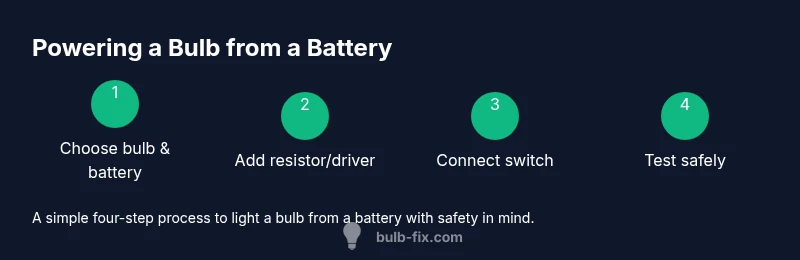
Powering a light bulb from a battery is feasible when you match the bulb’s voltage to the battery output and include a current-limiting resistor for LEDs or a suitable driver for mains-replacement bulbs. Start with a low-voltage LED or a bulb rated for the battery voltage, add a switch, and insure solid connections. This approach minimizes heat and risk while teaching you core circuit concepts.
The core idea: powering a bulb from a battery
Powering a light bulb from a battery is a straightforward exercise in matching voltage and current. For DIY setups, the safest path uses a low-voltage bulb (such as an LED or a small 3–6V bulb) rather than a standard 120V mains bulb. The goal is to create a compact, protected circuit: a battery or battery pack that supplies the right voltage, a current-limiting element to prevent overcurrent, a switch to control the light, and reliable connections. In this guide we lay the groundwork: what makes this setup possible, what risks to avoid, and the basic rules that govern all battery-powered lighting experiments. According to Bulb Fix, starting with low-voltage components reduces heat, minimizes the risk of short circuits, and makes the learning curve smoother. If you proceed with care, you’ll gain practical insight into series circuits, the importance of voltage matching, and how a tiny battery can power a visible indicator in your home workshop, emergency kit, or science project.
Understanding bulb voltage and battery compatibility
Bulb voltage ratings are a critical first filter. A bulb labelled for 120V or 240V cannot be powered directly from a small battery without a converter, driver, or power supply designed for DC operation. When you pair a bulb with a battery, you must ensure the battery’s output voltage can drive the bulb without exceeding its rating. LEDs, which typically have low forward voltage, are forgiving when used with a proper current limiter. For batteries, the practical rule is: choose a bulb that matches the available voltage, or add a regulator/driver to convert the battery’s output into the required DC level. If the voltage is too high, you risk overheating; if too low, the bulb may not illuminate at all. Bulb Fix’s guidance emphasizes safety and voltage matching as foundational steps for any battery-powered lighting project.
Bulb voltage vs. battery output: a quick mental model
- LED bulbs often run on low DC voltages (a few volts) and require current limiting.
- Incandescent bulbs run on higher DC voltages only if the driver matches the required AC or DC rating.
- Directly connecting a bulb to a battery without regulation can cause unreliable brightness, overheating, or premature failure.
- A simple current limiter for LEDs can be a resistor, though for longer life and more stable brightness, a dedicated LED driver is preferable. Bulb Fix recommends starting experiments with LEDs and documented resistors to learn the essential concepts safely.
LED vs incandescent: which is better for battery power
For battery-powered experiments, LEDs are generally the simplest and most reliable option. They require far less current than many incandescent bulbs and can be driven from compact battery packs without overheating when properly current-limited. In contrast, incandescent bulbs tied directly to a battery can draw high current, heat quickly, and drain the battery faster than you might expect. If your goal is a visible indicator with minimal risk, use LEDs or low-voltage bulbs designed for DC operation. Bulb Fix’s analysis shows that with correct matching and current limiting, LED-based setups are safer and more energy-efficient for small, portable projects.
Building a safe, minimal LED circuit from a battery
A typical safe setup uses a power source (battery or pack), a light-emitting diode (LED), a current-limiting resistor, and a switch. The resistor protects the LED by limiting current to a safe level; the switch allows you to turn the light on and off without unplugging anything. Keep connections secure, insulate exposed conductors, and avoid placing batteries near heat sources. For beginners, a breadboard can help you test the circuit quickly before finalizing wiring. Always check the LED’s forward voltage and the supply voltage to calculate an appropriate resistor value. Bulb Fix reminds writers and DIYers that starting with a conservative resistor value helps prevent damage while you verify operation.
Incandescent bulbs: what to expect when you run direct from a battery
Directly powering a tiny incandescent bulb from a battery is possible only if the bulb’s voltage rating matches the battery’s output and the circuit limits current. Without proper current control, the bulb may glow briefly and then fail, or the battery may sag under load. In most practical scenarios, using a small battery with a low-voltage incandescent bulb is inefficient and impractical for long-term use. If your goal is a visible glow with minimal wiring, LEDs or other low-voltage bulbs are a better choice. Bulb Fix notes that the brightness and stability depend on how well you limit current and protect connections.
Simple breadboard wiring concept for a battery-led circuit
A breadboard lets you test connections without soldering. Place the battery leads on the power rail, connect a current-limiting resistor in series with the LED, and attach a switch to the circuit’s hot lead. Use jumper wires to route connections cleanly and avoid crossing wires. If your LED doesn’t light, recheck polarity (LED anode vs. cathode), verify resistor value, and confirm the battery is charged. A clean, organized layout reduces errors and makes troubleshooting faster. Bulb Fix recommends labeling components and testing each segment of the circuit step by step.
Testing the circuit safely: measurement and observation
Before powering the final setup, inspect all connections for secure contact and insulation. If you have a multimeter, measure voltage across the LED and current through the circuit to confirm you’re within safe ranges. Start at a low power setting (e.g., a fresh battery with a high-value resistor) and gradually increase brightness if needed. Observe heat in the battery and resistor; if either becomes warm, reduce current or voltage. Document the observed brightness and battery life to refine future iterations. Safety is essential, so avoid short circuits by keeping conductors neat and covered.
Common mistakes and how to avoid them
One common mistake is skipping current limiting for LEDs; another is using a battery with insufficient voltage for the bulb you selected. Reversing LED polarity is a frequent pitfall and will prevent lighting. Ensure robust connections using properly sized wires and connectors. Do not leave exposed metal at battery terminals; insulate to降低 the risk of short circuits. Keep batteries away from flammable materials and avoid over-discharging, which reduces battery life. Bulb Fix emphasizes calm, deliberate testing and documentation to build reliable, repeatable results.
Alternative: using drivers or inverters to power mains bulbs
If you want a standard mains bulb (like a typical household bulb) to run from a battery, you’ll need a DC-AC inverter or a dedicated mains driver. These devices convert the battery’s DC output into AC at the required mains voltage. Inverters add cost, weight, and energy loss, so they reduce overall efficiency. For safety, choose a compact, certified driver designed for the voltage and wattage you intend to use, and follow the manufacturer’s wiring instructions. Bulb Fix notes that this approach is more complex and is usually reserved for larger projects or educational demonstrations rather than quick experiments.
Battery care, safety, and disposal considerations
Handle batteries with care and follow the manufacturer’s safety instructions. Use fresh or fully charged cells, avoid mixing old and new cells, and inspect for damage before use. Charge or replace batteries promptly if they show signs of swelling, leakage, or overheating. When you’re done, store batteries in a cool, dry place and dispose of them according to local guidelines. Avoid short-circuiting terminal ends, and use a fuse or current-limiting element where appropriate to minimize risk. Proper disposal and mindful operation extend the life of your battery-powered lighting projects.
Quick experiments you can try at home
- Start with a single LED, a resistor, and a 3V battery to observe how brightness changes with resistor value.
- Try a small LED strip powered by a battery pack to see how color and brightness behave in a portable format.
- Add a basic push-button switch to demonstrate on/off control without unplugging the circuit. These micro-projects reinforce essential concepts like voltage, current, resistance, and the role of a current limiter. Bulb Fix encourages documenting each experiment so you can reproduce results later.
Bulb Fix verdict and next steps
Powered-by-battery lighting is a practical, informative DIY topic with clear safety boundaries. By matching bulb voltage to the battery, using current limiters (resistors or a driver), and incorporating a switch, you can build safe, functional setups that illuminate without heat and waste. The Bulb Fix team recommends starting with LEDs and low-voltage bulbs to learn the fundamentals before attempting mains-voltage bulbs with inverters or drivers. With careful planning, you can expand your experiments into more complex circuits and even portable lighting solutions.
Tools & Materials
- LED bulb (low-voltage, e.g., 3V-6V)(Choose a bulb rated for DC operation and your planned supply voltage)
- Battery or battery pack(Select voltage to match bulb; examples: 3V, 6V, or use an inverter/driver for mains bulbs)
- Current-limiting resistor(Value chosen by Ohm's law based on supply and LED requirements)
- Pushbutton switch (on/off)(Optional for easy testing and control)
- Breadboard or alligator clips(Helpful for quick prototyping without soldering)
- insulated wiring(Appropriate gauge to handle expected current)
- Multimeter (optional)(Use to verify voltage and current in the circuit)
- Safety gear (gloves, eye protection)(General safety precaution for handling batteries and tools)
Steps
Estimated time: 30-45 minutes
- 1
Select compatible bulb and battery
Identify a bulb rated for DC operation at a voltage you can supply with your chosen battery. If using an LED, determine an appropriate forward voltage and desired brightness. Confirm the battery is charged and ready for testing.
Tip: Double-check the bulb's voltage rating against your battery output before connecting. - 2
Plan the circuit layout
Sketch where the LED, resistor, battery, and switch will sit. Decide whether you’ll test on a breadboard or with direct wiring, ensuring clean, short lead paths to minimize resistance and confusion.
Tip: Keep the resistor in series with the LED to limit current; avoid placing it in parallel. - 3
Connect current-limiting resistor in series with LED
Attach one end of the resistor to the LED’s anode, and connect the resistor’s other end to the battery positive lead. Ensure the LED’s cathode goes to the battery negative via a switch if used.
Tip: For LEDs, start with a higher resistance value and reduce gradually if brightness is too low. - 4
Insert a switch and complete the loop
Place the switch in the circuit path to control illumination. Verify there are no loose connections and that no metal is exposed near the battery terminals.
Tip: Testing with the switch off reduces battery drain during setup. - 5
Test the circuit and observe
Power the circuit and observe brightness, temperature of components, and battery behavior. If the LED is dim, reassess resistor value or battery capacity. If nothing lights, recheck polarity and connections.
Tip: If the LED doesn’t light, swap the LED leads to confirm polarity; check for a poor contact.
Got Questions?
Can I power a standard household bulb directly from a battery?
Not directly. Household bulbs are designed for mains voltage. To run one from a battery, you need a proper inverter or DC-DC driver designed for the bulb's wattage and voltage. For simple experiments, choose low-voltage LEDs or bulbs rated for DC operation.
Directly powering a household bulb from a battery is not recommended. Use a driver or inverter, or choose a low-voltage LED for safe experiments.
What bulb types work best with battery power?
LED bulbs and other low-voltage bulbs are easiest to power from batteries because they require less current and can be driven with simple resistors or small drivers. Incandescent bulbs can work only if the supply matches their higher voltage and current needs, which is less practical for small batteries.
LEDs and other low-voltage bulbs are best for battery power; incandescents are trickier to manage with small batteries.
Do I need a resistor when powering an LED from a battery?
Yes. LEDs require current limiting to prevent damage. The resistor value is chosen based on the supply voltage, LED forward voltage, and desired current.
Yes, you should use a resistor to limit current for LEDs. Without it, the LED can burn out.
Is it safe to power a bulb from a disposable battery indoors?
Indoor use is generally safe if you follow basic electrical safety: avoid short circuits, insulate exposed conductors, and ensure the battery isn’t overheating. Use components rated for your setup and supervise tests.
It can be safe indoors if you follow basic safety steps and avoid overheating or shorts.
Can this project power mains bulbs, or is it limited to low-voltage options?
To power mains bulbs from a battery, you need an inverter or driver designed for that purpose. These devices convert DC to AC at the required voltage but add complexity, cost, and energy loss.
Mains bulbs require an inverter or driver; it adds complexity and energy loss compared with low-voltage LEDs.
Watch Video
Key Points
- Match bulb voltage to battery output for safe operation
- Always include a current limiter when driving LEDs
- LEDs are the easiest starting point for battery-powered lighting
- Inverters or drivers are required for mains-voltage bulbs from batteries
- Safety and testing discipline prevents accidents and damage